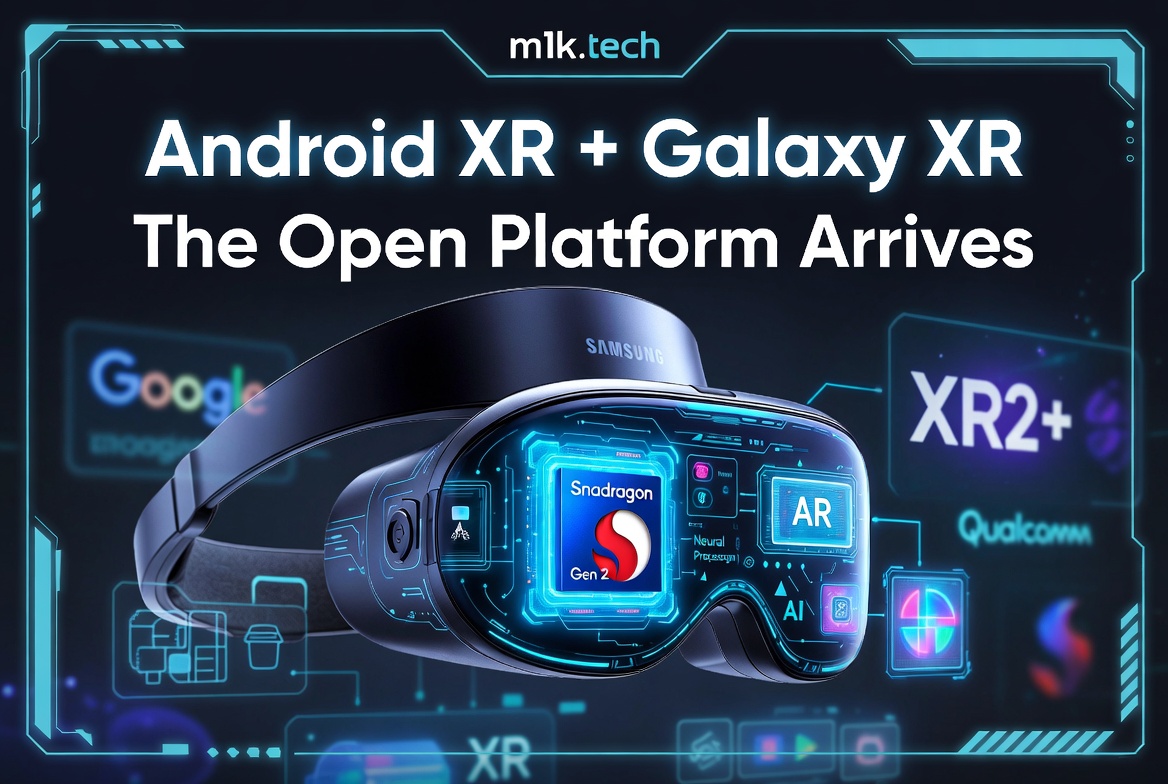
Google just did what it does best: turned XR into a platform. Android XR is live, and Samsung’s Galaxy XR headset, the one everyone has been calling Project Moohan, ships this week at $1,799 as the launch device. It runs on the Snapdragon XR2+ Gen 2. For the first time in the headset era, the underlying OS is Android: open, familiar, and backed by the ecosystem powering over a billion phones.
Three companies, one bet
This is a Samsung-Google-Qualcomm triple play. Samsung built the hardware: dual micro-OLED at 3552 by 3840 per eye, eye and hand tracking, Wi-Fi 7, and an external battery pack to keep the weight on your face manageable. Google wrote the OS and brought Gemini AI into the experience. Qualcomm supplied the XR2+ Gen 2, the most powerful XR chip it has shipped. The pitch is an open alternative to Apple’s closed visionOS and Meta’s closed Quest platform, and the open-platform argument is the one that attracts developers fastest.
The trend for the year ahead
XR just got a third major OS. Apple has visionOS, Meta has Quest, now Google has Android XR with a hardware partner and a chip partner already in place. Expect more headset and glasses makers to build on Android XR. Open platforms attract ecosystems faster than proprietary ones, and the developer momentum behind Android is not something you manufacture from scratch.
Snapdragon Insider bias on the table: the XR2+ Gen 2 powering this is the culmination of a chip arc that started with the XR1 back in 2018. Seven years from a dedicated platform concept to a flagship spatial computer. The price is steep. The open-platform story is the one that wins in the long term, and this is the hardware that makes that story credible.
Part of Two Decades of XR, my running diary of virtual, augmented, and mixed reality.