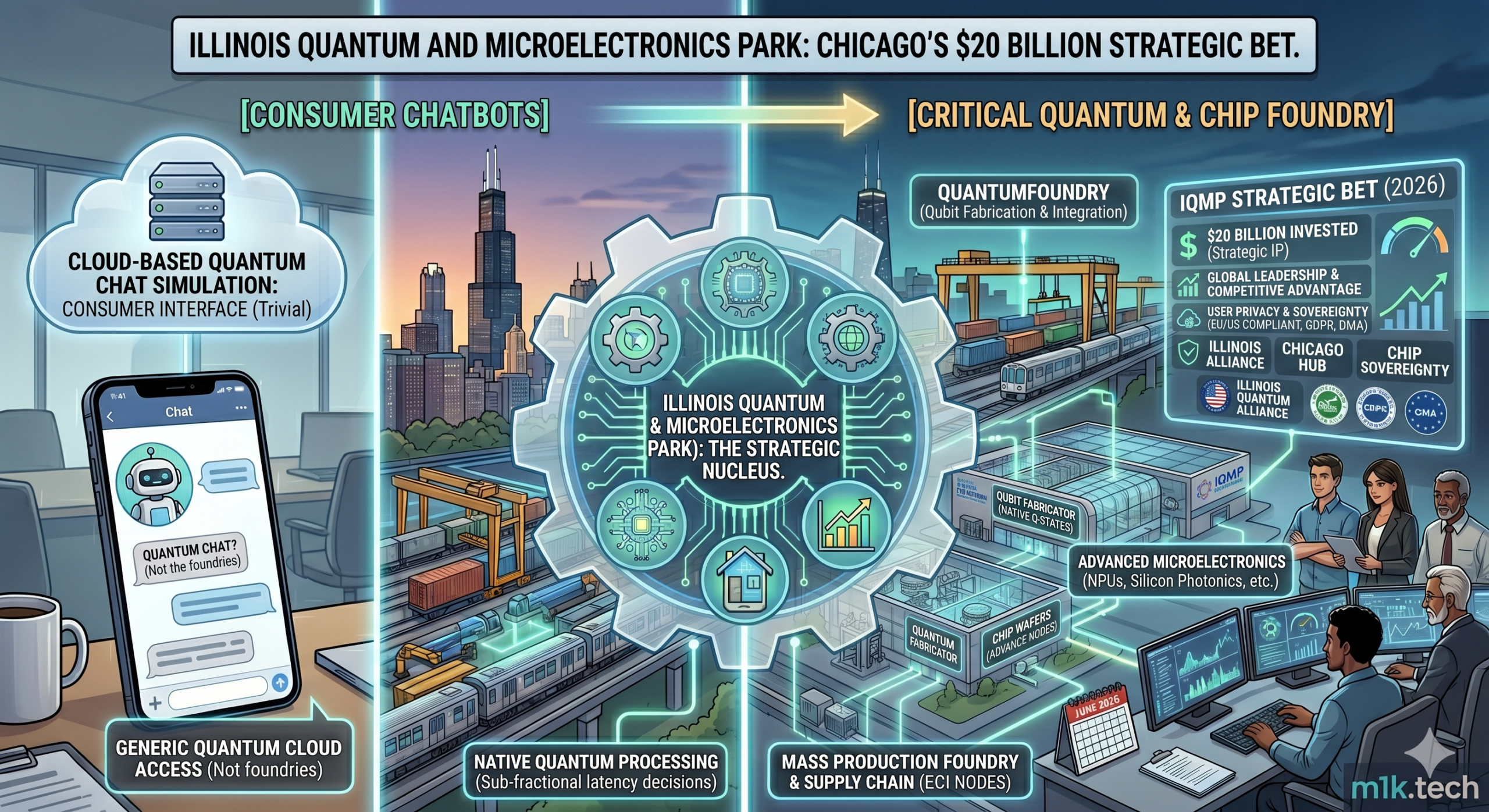
On a stretch of the South Side where U.S. Steel’s South Works once employed tens of thousands of people, Chicago is making the biggest technology bet in its history. It is called the Illinois Quantum and Microelectronics Park, IQMP for short, and it is trying to turn a dead steel site into the center of gravity for an entire industry that barely exists yet. I look at investment-attraction projects for a living, and this one is in a category of its own.
Let me walk through what is actually being built, who is paying for it, and why it might not work, because all three matter.
The anchor tenant: PsiQuantum
The whole park hangs on one company. PsiQuantum announced in September 2025, according to the company, that it had raised more than $1 billion in a Series E round, with Nvidia’s venture arm among the participants, one of the largest US investments ever made in quantum computing. It then broke ground at IQMP in the fall of 2025 as the park’s anchor tenant. According to the announcement, the first thing it builds there is its largest intermediate-scale quantum test system, which will be evaluated by the Defense Advanced Research Projects Agency under its Quantum Benchmarking Initiative. When DARPA is the one grading your homework, the federal government is paying close attention.
PsiQuantum’s bet is photonic. Instead of the supercooled approaches most rivals lean on, it builds quantum chips on standard semiconductor manufacturing lines, produced through its partnership with GlobalFoundries, and networks them with ordinary telecom fiber. The long-term goal it has stated is a utility-scale, error-corrected machine, the kind that could actually be useful for drug discovery, materials science, and logistics rather than just lab demos.
Who else is moving in
PsiQuantum is the anchor, not the whole story. According to the University of Chicago, the park’s tenant roster also includes IBM, the Australian firm Diraq, and Colorado-based Infleqtion, which spreads IQMP across several competing quantum approaches instead of a single bet on one. The university describes it as the largest concentration of quantum activity in North America. Two University of Illinois facilities are also planned on the site: a National Quantum Facility to house the cryogenic plant and shared research infrastructure, and Quantum Works, a research and workforce space tied to the Discovery Partners Institute.
The money stack, which is the real story
This is the part I find most interesting, because it is a textbook layered-financing play. The site depends on money from every level at once. According to reporting on the project, Illinois pledged $500 million to the park in its 2025 budget, the federal Quantum Proving Ground initiative is directing roughly $280 million to IQMP, and PsiQuantum brought its own billion-dollar-plus private round to the table. State, federal, and private capital stacked on a single site to anchor a frontier industry. That is exactly the structure you use when you are trying to win an industry that could otherwise land somewhere else.
The federal tailwind kept building into 2026. According to his office, Senator Dick Durbin met PsiQuantum’s interim CEO, Victor Peng, on March 26, 2026, to talk about Illinois’ position in quantum, and in February 2026 he introduced the DOE Quantum Leadership Act, which would authorize more than $2.5 billion in quantum research and development over five years.
Now the part the press releases skip
Here is where I put the skeptic hat on. Quantum computing is still experimental, and nobody can tell you yet which approach will actually win commercially, whether that is photonic, superconducting, trapped-ion, or something nobody has scaled yet. The funding picture outside the headline names is thin too. According to Global Quantum Intelligence, the entire global quantum industry pulled in about $2.4 billion in venture capital in 2024, rising to $3.5 billion in 2025, which is a rounding error next to AI, and the firm’s own chief executive has said it is hard for any quantum startup that is not PsiQuantum to raise money at all. There is also a tell from 2024: the project was passed over when the federal government picked its official CHIPS tech hubs, reportedly because it looked too future-facing.
So this is a real bet, not a victory lap. A lot of public money is riding on a technology that may not pay off on the promised timeline.
Why I still think it is the right move for Chicago
I have written before about how Chicago’s tech base is quietly formidable and how the city is getting serious about AI. Quantum is the natural next chapter of that same story, and it leans on real local assets: the University of Chicago, the University of Illinois, Argonne and Fermilab, and a research base that has been doing quantum for a decade. The fact that Nvidia put venture money into the anchor tenant is its own signal about where smart capital thinks this is going.
And the symbolism is hard to beat. A site that used to make the steel for American skyscrapers is being repurposed to chase the most advanced computing on earth. The projected economic impact, according to the University of Chicago, runs above $20 billion for the region with thousands of jobs. I would rather Chicago take this swing and miss than never step up to the plate, and if even half of that number shows up, the South Side gets an industry instead of just another ribbon-cutting.