Every conversation about American tech starts in the same two cities. The valley gets the origin stories. New York gets the finance angle. Chicago gets the footnote, somewhere after Boston and Austin, usually framed as “a surprising hub” by writers who have never spent time here. That framing is wrong, and the gap between perception and reality is worth closing properly.
I moved to Chicago from France through the Franco-American business development world, and the city I found was not a scrappy underdog trying to punch above its weight. It was a mature, deeply diversified innovation economy that has been building quietly for decades, producing companies and technologies that the rest of the country notices only when they go public or get acquired. This is the overview version of a series I have been running across multiple posts: what Chicago is, how it got here, and why the next few years might finally close the perception gap.
The foundation: three sectors that nobody disputes
Chicago’s tech economy has three undisputed anchors, and each is older and deeper than the startup narrative suggests.
Financial technology is the first. Chicago is the derivatives trading capital of the world, and that identity has produced a technology ecosystem around latency, risk management, and quantitative analysis that is essentially unmatched outside of New York. The Chicago Mercantile Exchange, the CBOE, and the trading firms that surround them, Citadel Securities, Jump Trading, DRW, Akuna Capital, run some of the most sophisticated technology operations on the planet. When Citadel Securities moved its headquarters from Chicago to Miami in 2022, it made headlines as a loss; what the coverage missed is that the company’s engineering and trading infrastructure remained deeply entangled with Chicago’s talent base and technical infrastructure. The exit was a business address change, not an ecosystem departure.
Healthcare and life sciences are the second anchor. Chicago is home to some of the most important medical institutions in the country, Northwestern Memorial, Rush, UChicago Medicine, and the convergence of those institutions with a serious technology sector has produced a health tech ecosystem that is generating consequential companies. Tempus Labs, which I covered in the context of how it kicked off Chicago’s unicorn era, is the standout example: a company that emerged from the intersection of Eric Lefkofsky’s technology instincts and the oncology infrastructure of UChicago Medicine, and that has become one of the most valuable health AI companies in the United States.
Enterprise software is the third. Chicago is B2B country. The city does not produce consumer apps for teenagers; it produces software that runs supply chains, manages risk, processes transactions, and runs back-office operations for mid-size companies across America. Morningstar, Motorola Solutions, the Salesforce Tower’s tenant roster: the pattern is the same. Serious software for serious businesses, sold on capability rather than consumer buzz. That is a less glamorous story than a consumer app going viral, and it is a more durable one.
The unicorn era and what it proved
The years from 2018 to 2022 were when the outside world started paying attention. In 2021, Chicago minted more unicorns than at any point in its history, part of a national surge in venture-backed valuations, but notable because so many of the companies reaching billion-dollar valuations were not in the canonical tech categories. VillageMD, which I covered through its 2020 Walgreens partnership, is the example I return to most often: a primary care technology company that was neither a pure software play nor a traditional healthcare provider, but something in between, and that reached a multi-billion-dollar valuation by exploiting exactly the kind of healthcare-technology convergence that Chicago’s dual infrastructure makes possible.
The honest caveat is that the same period produced some cautionary tales. The Outcome Health fraud, which I covered in detail, is the most visible: a company that reached a billion-dollar valuation on the back of healthcare advertising technology and turned out to have been deceiving its investors and customers about the most basic metrics of its business. Chicago’s ecosystem is not immune to the dynamics that produce fraudulent companies anywhere; what distinguishes it is how quickly the legal and regulatory machinery processed the case.
The infrastructure layer: what distinguishes Chicago from most markets
Beyond the companies, Chicago has an infrastructure story that most of the “surprising tech hub” coverage ignores entirely.
The University of Chicago is not Stanford. It does not produce consumer companies. What it produces, through the Booth School of Business, the Pritzker School of Molecular Engineering, and the Department of Statistics, is the kind of foundational research that underlies quantitative finance, machine learning, and molecular design. The Argonne National Laboratory and Fermilab sit in the Chicago metropolitan area, and between them they run some of the most powerful scientific computing infrastructure in the federal government. The Aurora supercomputer at Argonne, which I covered when it reached exascale status, is the most powerful scientific computer in the United States, and its presence in the Chicago suburbs is not a coincidence.
The Illinois manufacturing corridor adds another dimension. The Rivian Normal plant, which I covered in the context of Illinois becoming an EV hub, represents the intersection of automotive manufacturing and technology that the Midwest is positioned to own. Belvidere’s revival, which I tracked through its second act, extends that story into what happens when a legacy automotive economy reinvents itself around electric powertrains and battery supply chains.
The friction and the corporate exodus
The honest version of the Chicago tech story includes the friction. The 2022 corporate exodus, which I covered in detail, saw Boeing, Caterpillar, and Citadel all move their headquarters out of the city within a compressed window. The departures made national news and generated the predictable commentary about crime, taxes, and urban decline. The reality was more textured: Boeing moved to Arlington to be closer to government contracts; Caterpillar moved to Texas for tax reasons that were long in the making; Citadel’s Miami move was partly about lifestyle preferences and partly about the posturing of a CEO who had made public statements about Chicago’s challenges. None of the moves represented an engineering team picking up and leaving. The talent stayed. The brass plaques relocated.
Chicago’s real friction is not corporate headquarters flight; it is the perception gap that makes recruiting harder for companies based here. The city consistently underperforms its actual quality-of-life reality in national surveys aimed at tech workers. That gap costs real companies real talent every year, and closing it is a marketing problem as much as a policy one.
What comes next
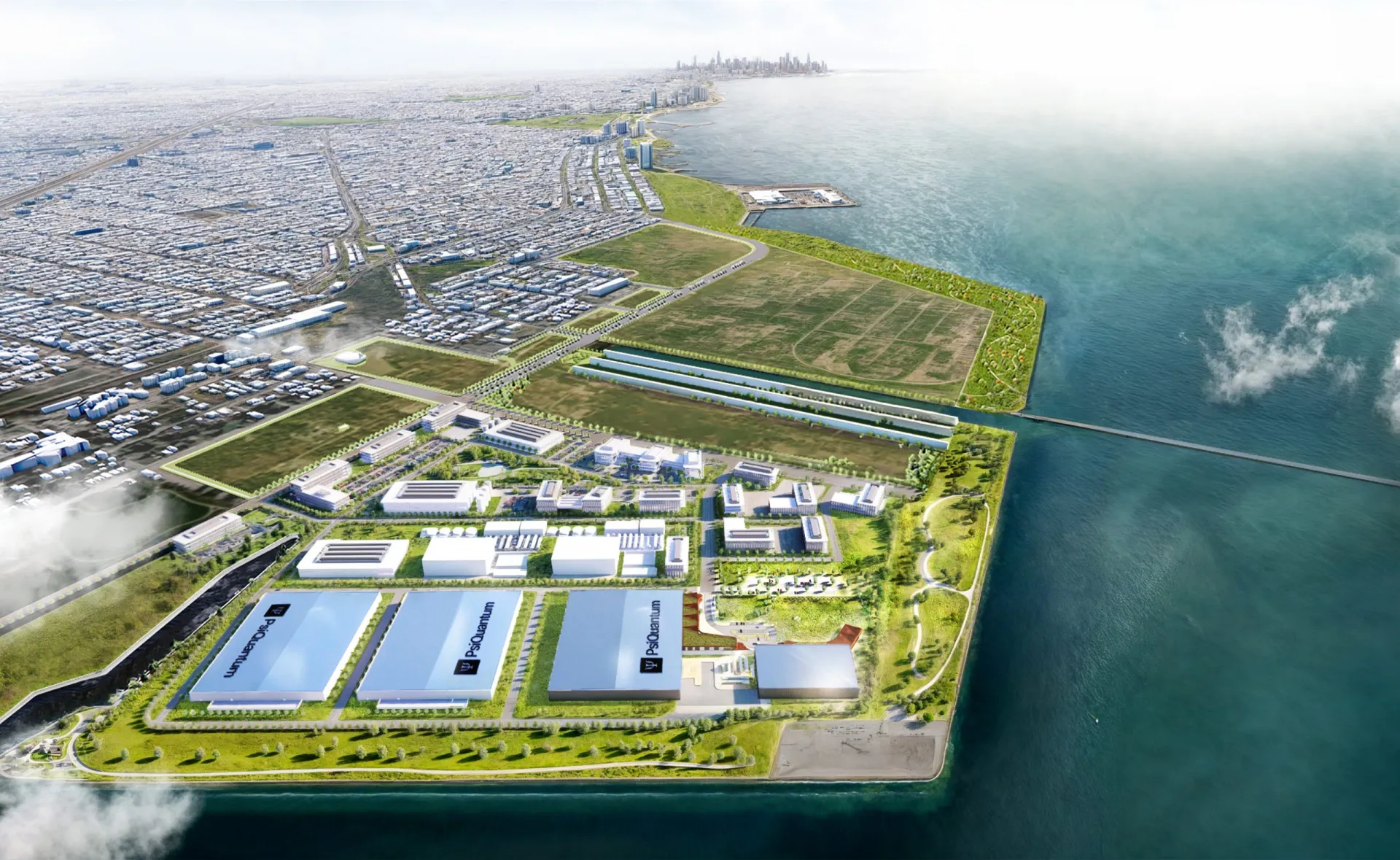
The categories building toward Chicago’s next phase are not subtle. The UChicago-Microsoft-Nvidia AI initiative is the clearest signal: serious institutional capital, serious computing infrastructure, and serious academic research converging on a geography that already has the financial, healthcare, and enterprise customer base to absorb AI applications at scale. The Illinois Quantum and Microelectronics Park, a $20 billion bet on semiconductor and quantum computing manufacturing in the Chicago metro, extends the infrastructure story into the hardware layer that the next decade of computing will require.
From my position watching how foreign companies evaluate American markets for investment, Chicago comes up more often than most of the coverage would suggest. The city’s combination of world-class research institutions, deep industry verticals, serious regulatory infrastructure, and relatively affordable real estate creates an investment proposition that competes seriously with coastal alternatives. The companies that have already figured this out tend to be the ones whose business models require depth over buzz, and that is exactly the profile that performs over a ten-year horizon.
The quiet giant has been building for a long time. The rest of the country is starting to notice.