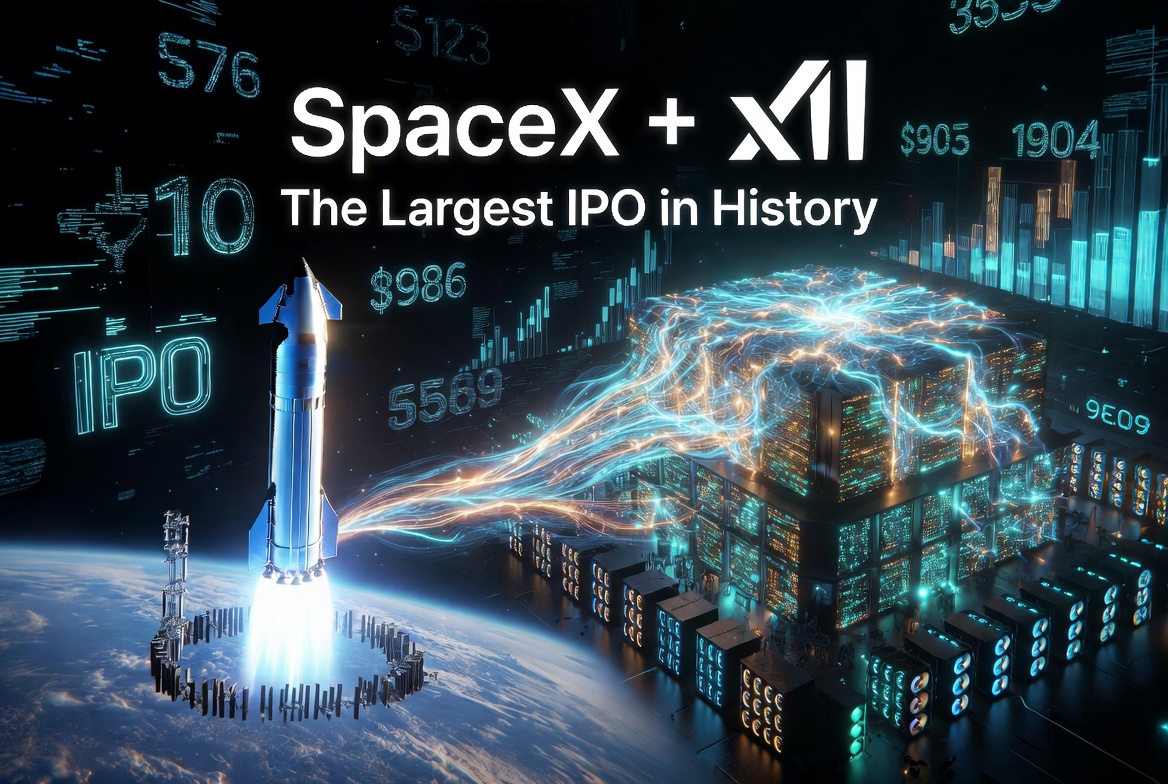
SpaceX is about to go public, and the numbers are staggering. The company is targeting a valuation of $1.5 to $1.75 trillion, a raise of $50 to $75 billion, and a listing that would be the largest IPO in history, surpassing Saudi Aramco’s $29 billion debut in 2019. The S-1 was filed confidentially with the SEC in April. The target date, according to multiple reports, is mid-June 2026. That is now.
This is the deep dive: the technology, the platforms, the infrastructure, the financials, the market position, and the question that matters most, whether a company that has redefined space launch and satellite internet deserves to trade alongside Apple, Microsoft, and Nvidia at a trillion-dollar-plus valuation.
The founding bet: 2002 to 2008
SpaceX exists because Elon Musk got frustrated with the price of rockets. In 2001, he tried to buy refurbished ICBMs from Russia to send a greenhouse to Mars as a publicity stunt. The Russians wanted $8 million per missile. Musk decided it was cheaper to build his own. He founded Space Exploration Technologies Corp in June 2002 with about $100 million of his PayPal proceeds and a thesis that rockets, designed with modern manufacturing techniques and vertical integration, could be built for a fraction of what Lockheed and Boeing charged.
The first three Falcon 1 launches failed. The company was nearly bankrupt by mid-2008. The fourth flight, on September 28, 2008, succeeded, making the Falcon 1 the first privately developed liquid-fueled rocket to reach orbit. Musk has said publicly that SpaceX had enough money for exactly one more attempt. If the fourth launch had failed, the company would have died.
The commercial breakthrough: 2010 to 2015
The Falcon 9, a much larger rocket with nine Merlin engines on the first stage, flew for the first time in June 2010. Two years later, the Dragon spacecraft became the first commercial vehicle to deliver cargo to the International Space Station under a NASA contract. That contract, and the ones that followed, gave SpaceX steady revenue and a proving ground for reliability.
But the real breakthrough was the landing. On December 21, 2015, a Falcon 9 first stage flew to orbit, separated, re-entered the atmosphere, and landed vertically on a concrete pad at Cape Canaveral. The video of that landing, a tall white cylinder descending on a column of flame and touching down upright, is the single most important moment in commercial spaceflight. It proved that orbital-class boosters could be reused, laying the foundation for every cost advantage SpaceX has today.
Reusability and the cost revolution: 2016 to 2020
Reusability changed the economics of launch. A Falcon 9 first stage costs roughly $30 million to build. If you throw it away after one flight, your launch price has a hard floor. If you fly the same booster 20 times, the marginal cost per flight drops to the fuel, refurbishment, and operations. SpaceX charges customers around $67 million for a Falcon 9 launch. ULA’s Atlas V, an expendable launch vehicle, costs over $100 million. Arianespace’s Ariane 6, still in development during this period, was designed for a similar price range. SpaceX undercut the entire industry by building a business model around reuse.
Falcon Heavy flew in February 2018, putting Musk’s Tesla Roadster into a heliocentric orbit in a spectacle that doubled as the most effective product placement in history. In May 2020, SpaceX launched NASA astronauts Doug Hurley and Bob Behnken to the ISS on Crew Dragon, making it the first private company to fly humans to orbit. And underneath all of this, a much larger bet was quietly taking shape: Starlink.
Starlink: the business that changed everything
Starlink is the reason SpaceX can justify a trillion-dollar valuation. Without it, SpaceX is a launch services company with a dominant market share but a limited total addressable market. With it, SpaceX is a global telecommunications platform.
The concept is straightforward: a constellation of thousands of small satellites in low Earth orbit providing broadband internet to anyone with a dish on their roof. The first 60 Starlink satellites launched in May 2019. By early 2026, the constellation will exceed 7,500 active satellites, making it the largest satellite network in history by a wide margin. Starlink currently serves over 10 million subscribers across more than 150 countries.
The financials tell the growth story. According to reporting and the S-1 filing, Starlink generated approximately $11.4 billion in revenue in 2025, up from negligible revenue in 2020. Average revenue per user has declined to about $81 per month as SpaceX pushes into lower-price markets, but subscriber growth has more than compensated: Starlink doubled its base in both 2024 and 2025. EBITDA margins on Starlink are estimated at around 54%, making it one of the highest-margin connectivity businesses in the world.
The product has also expanded well beyond consumer broadband. Starlink Maritime serves cruise lines and cargo ships. Starlink Aviation provides in-flight Wi-Fi. Enterprise and government contracts add higher-ARPU customers. And the Ukraine war demonstrated Starlink’s value as a resilient communications infrastructure in a conflict zone, which opened doors to defense contracts that SpaceX does not break out publicly but that analysts estimate contribute meaningfully to the revenue mix.
Starship: the next platform
Starship is SpaceX’s fully reusable super-heavy launch system, the vehicle that connects the launch business to everything else. Standing 121 meters tall with 33 Raptor engines on the Super Heavy booster, Starship is designed to carry 150 metric tons to low Earth orbit, roughly five times the capacity of Falcon 9. The intended use cases span NASA’s Artemis lunar lander, next-generation Starlink V2 satellite deployment, point-to-point Earth transport, and, eventually, Mars colonization.
Development has been iterative and public. The first integrated flight test in April 2023 ended in an explosion. Subsequent tests in 2023 and 2024 achieved orbit, booster catch with the “chopstick” arms at Starbase in Boca Chica, Texas, and successful payload deployment. The system is not yet operational for commercial payloads, but the trajectory is clear: once Starship is flying reliably and frequently, it will drop the cost per kilogram to orbit by another order of magnitude, unlocking business models that are currently impossible.
xAI and the Colossus bet: 2023 to 2026
In July 2023, Musk founded xAI as a standalone artificial intelligence company. Its flagship product was Grok, a large language model integrated into the X platform (formerly Twitter). The company raised $12 billion across multiple rounds, with investors including Andreessen Horowitz, Sequoia Capital, and sovereign wealth funds.
But the real xAI story is infrastructure. In mid-2024, xAI began building Colossus, an AI supercomputer in a former Electrolux factory in Memphis, Tennessee. The facility was constructed in approximately 120 days, a speed that stunned the data center industry. Colossus 1 houses around 220,000 Nvidia GPUs across 300 megawatts of power capacity, making it the world’s largest single-site AI training installation at the time of completion.
xAI then purchased a second site nearby for Colossus 2, which came online in January 2026. A third building in Southaven, Mississippi, was acquired in December 2025 to push total capacity toward 2 gigawatts and 555,000 GPUs. The infrastructure investment totals roughly $18 billion in GPU purchases alone, before accounting for power, cooling, and construction.
Despite the scale, xAI’s AI products struggled commercially. According to The Information, Grok’s model flops utilization was approximately 11%, well below the 40% achieved by competitors. Subscriber growth lagged behind Claude and ChatGPT. Several cofounders and dozens of staff departed. The infrastructure was world-class. The product-market fit was not.
The merger: SpaceXAI
On February 2, 2026, SpaceX formally acquired xAI. Musk announced the dissolution of xAI as an independent entity and its absorption into SpaceX under a new division called SpaceXAI. The rationale, per Musk’s internal memo, was that maintaining a separate corporate structure with its own board, fundraising, and overhead was inefficient when SpaceX could absorb the operation with less friction.
The deal valued the combined entity at approximately $1.25 trillion. xAI shareholders received SpaceX equity in exchange for their stakes at board-determined exchange ratios. For institutional investors like a16z and Sequoia, the conversion from a struggling AI company’s equity into pre-IPO SpaceX shares was arguably an upgrade.
The practical fallout is revealing. Colossus 1, the 300-megawatt Memphis facility, was not being fully utilized for xAI’s own model training. In May 2026, SpaceX leased the entire Colossus 1 capacity to Anthropic in a deal reportedly worth $1.25 billion per month through May 2029, approximately $40 billion over the contract life. SpaceX retains ownership of the infrastructure and generates revenue on capacity that would otherwise sit partially idle. Colossus 2 and the Southaven expansion remain under SpaceXAI for internal use. Grok continues as a SpaceX product, integrated into the X platform.
Musk has also articulated a longer-term vision: AI data centers in space, powered by solar energy, connected to the ground via Starlink. The thesis is that global electricity demand for AI training cannot be met by terrestrial solutions without imposing hardship on communities, a pointed statement given xAI’s own controversies in Memphis, where the NAACP and environmental groups protested air pollution from gas-burning turbines powering the data center. Whether space-based compute is viable within any reasonable time horizon is an open question, but the strategic narrative connects Starlink’s orbital infrastructure, Starship’s launch capacity, and xAI’s compute workloads into a single vertical.
The financials: what the S-1 reveals
SpaceX’s S-1, filed confidentially in April 2026, provides the first comprehensive look at a company that has operated in financial darkness for two decades.
Total revenue for 2025 was $18.7 billion, up 33% from $14.1 billion in 2024. Starlink contributed approximately $11.4 billion, or about 61% of the total. Launch services, including commercial, NASA, and national security missions, account for the remainder. Adjusted EBITDA was $6.6 billion, reflecting strong operating margins on both Starlink subscriptions and launch contracts.
However, SpaceX posted a GAAP net loss of $4.94 billion for 2025. Q1 2026 accelerated that trend with a $4.28 billion net loss in a single quarter. The accumulated deficit now sits at $41.3 billion. The gap between EBITDA profitability and GAAP losses is driven by stock-based compensation, depreciation on the Starlink constellation (satellites have finite orbital lifetimes and must be replaced), and capital expenditures on Starship development and xAI integration. The $19.6 billion purchase of EchoStar’s spectrum for direct-to-cell services is an additional one-time capital commitment that alone exceeds SpaceX’s full-year 2025 revenue.
At a $1.75 trillion target valuation, SpaceX would trade at approximately 94 times 2025 revenue. For context, Nvidia trades at roughly 25 times revenue. Amazon, at the peak of its growth narrative, reached about 5 times revenue. The SpaceX multiple is in a category of its own, justified by the argument that the company is not a rocket company but a platform business with three compounding revenue streams (launch, connectivity, compute) and a monopoly-like position in two of them.
Market share and competitive position
SpaceX’s dominance in launch services is difficult to overstate. In 2025, SpaceX conducted more orbital launches than every other launch provider on the planet combined. Its share of the global commercial launch market exceeds 60% by mission count and is higher by payload mass. The only credible state-backed competitor is China’s CASC and its growing constellation of commercial spinoffs (Galactic Energy, LandSpace, iSpace), which benefit from state subsidies and do not need to turn a profit.
In satellite internet, Starlink’s lead is equally stark. Amazon’s Project Kuiper, backed by Jeff Bezos, has begun launching test satellites but remains years behind Starlink’s operational constellation of 7,500 satellites. Eutelsat OneWeb, the merged European operator, has a smaller constellation in a different orbit and targets enterprise and government rather than consumer broadband. Bank of America estimates Kuiper could capture 30% of the global satellite internet market by 2032, but Starlink’s first-mover advantage in subscriber acquisition, ground infrastructure, and regulatory approvals across 150+ countries creates a significant moat.
The direct-to-cell initiative, where Starlink satellites connect directly to standard smartphones without a dish, represents the next expansion vector. SpaceX’s acquisition of EchoStar’s spectrum assets for $19.6 billion signals the scale of the bet. If direct-to-cell works at scale, the total addressable market expands from the ~100 million households without broadband to billions of smartphones worldwide.
The risks
A $1.75 trillion valuation requires everything to go right, and there are real reasons it might not.
Key-man risk is the most obvious. Elon Musk is CEO of SpaceX, Tesla, and the social media platform X, and he holds leadership positions at Neuralink and The Boring Company. His involvement in US government through the Department of Government Efficiency has generated political controversy that could affect SpaceX’s government contracts. A single individual running multiple trillion-dollar enterprises is an organizational structure without precedent, and the concentration of decision-making authority is a governance risk that public market investors will scrutinize.
Starship execution risk is material. The vehicle is not yet commercially operational. NASA’s Artemis program depends on a Starship lunar lander variant. If Starship development stalls or the reliability does not meet commercial standards on the timeline SpaceX has projected, the growth narrative underpinning the valuation weakens significantly.
Starlink’s ARPU decline is a trend to watch. Average revenue per user fell 18% to $81 per month in 2025 as SpaceX expanded into lower-income markets. If subscriber growth slows before ARPU stabilizes, the revenue trajectory flattens. Constellation maintenance costs are also high: LEO satellites have five-to-seven-year operational lives and must be continuously replaced, creating a capex cycle that never ends.
Chinese competition is the long-term structural risk. China is building its own LEO broadband constellation (Guowang), subsidized by the state, and its commercial launch sector is developing rapidly. A state-backed competitor that does not need to generate returns for shareholders can undercut pricing indefinitely.
And the xAI integration adds complexity. Grok’s commercial traction has been weak. The Colossus infrastructure is generating revenue through the Anthropic lease, but the core AI product has not yet justified the $12 billion invested. Most of xAI’s cofounders have left since the acquisition. Whether SpaceXAI can build a competitive AI business or whether Colossus becomes an infrastructure-as-a-service play primarily remains unclear.
Potential outcomes
The bull case writes itself: Starlink reaches 30 million subscribers by 2028, Starship begins commercial operations and collapses launch costs by another 10x, direct-to-cell captures a slice of the smartphone connectivity market, and SpaceX becomes the infrastructure layer of both space and AI compute. At that scale, $1.75 trillion looks reasonable, even conservative.
The bear case is a company trading at 94 times revenue with a $41 billion accumulated deficit, a key-man governance structure, an AI division that has not proven product-market fit, and a Starship program that is still in development. If Starship is delayed, if Kuiper erodes Starlink’s pricing power, if the AI business does not scale, the valuation compresses hard, and the public market discovers that a $1.75 trillion price tag required a very specific version of the future.
The most likely outcome is somewhere between. SpaceX’s launch business is a genuine monopoly in the West and will remain one for years. Starlink’s subscriber trajectory is real and accelerating. The xAI compute infrastructure has value as a leasable asset, even if Grok never catches up to Claude or ChatGPT. But the valuation premium is pricing in perfection across every line of business simultaneously, and perfection is not how the real world works.
SpaceX is the most important private company of the last two decades. The reusable rocket changed launch economics. Starlink is building a global connectivity layer that did not exist five years ago. The execution speed, from Falcon 1 to 100+ launches per year, is without parallel in aerospace history.
But $1.75 trillion is not a valuation for what SpaceX is. It is a valuation for what SpaceX might become if Starship works, if direct-to-cell scales, if the AI compute business finds its footing, and if Elon Musk, who is simultaneously running five companies and advising a government, can sustain the operational intensity that got the company here. That is a lot of ifs for a single stock at 94 times revenue.
I would not bet against SpaceX. I have watched this company turn every skeptic’s argument into a highlight reel. But I would not confuse admiration for the engineering with confidence in the multiple. The IPO will be historic. Whether the stock holds the valuation will depend on whether SpaceX can do something no company has ever done: execute perfectly across three businesses, in two industries, on two planets, all at once.