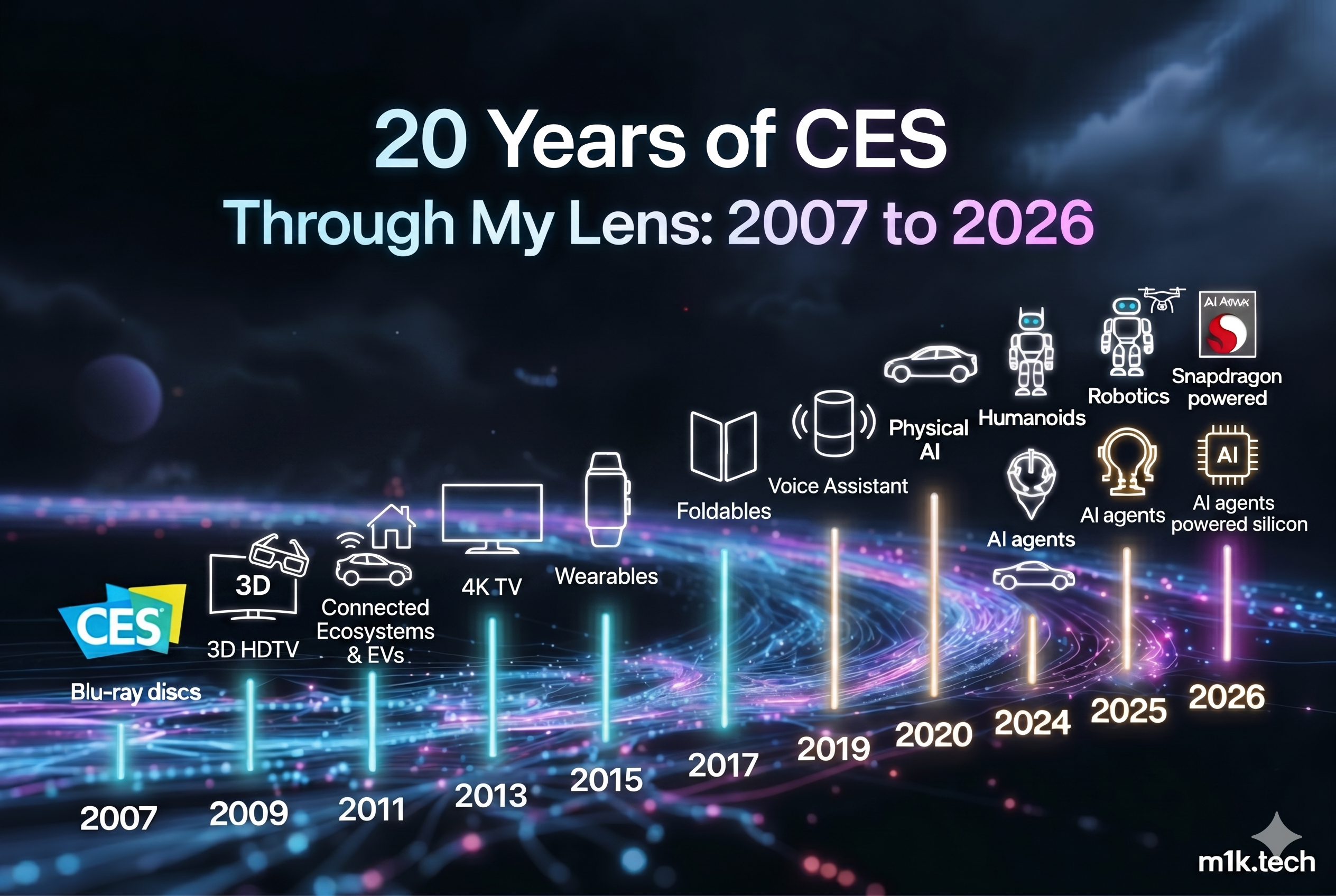
I have been following CES for twenty years, first through livestreams and liveblogs, lately from the floor itself with a Snapdragon Insider badge. Two decades is long enough to see which “future of everything” actually became the future and which ones quietly vanished by spring. This is the retrospective: the throughline of the show from 2007 to 2026, what panned out, what flopped, and how a handful of slow-burning trends mutated into the AI-everything era we are in now. Each year links to the full diary entry I wrote at the time.
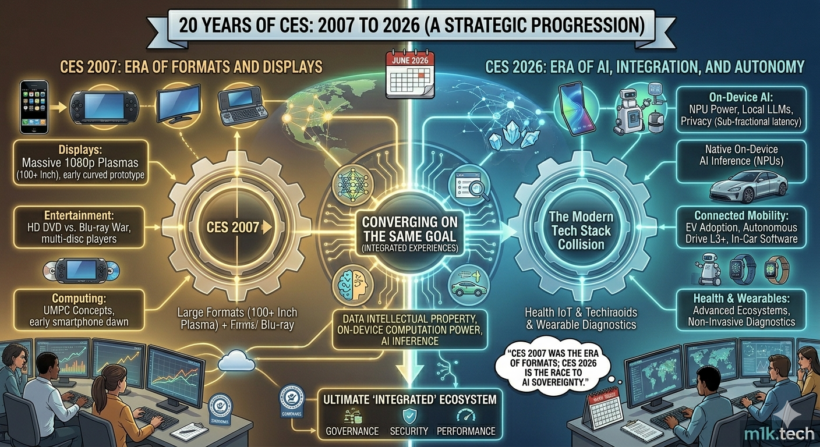
The disc war that did not matter (2007 to 2009)
The CES of the late 2000s was obsessed with a format war, Blu-ray versus HD DVD, that felt enormous and turned out to be a footnote within a year. The bigger story of 2007 happened across town, where Apple unveiled the iPhone the same week and quietly redrew the map. By 2008, Bill Gates gave his last keynote; Blu-ray won; and in 2009, Palm showed webOS, a remarkably well-designed mobile platform that flared brightly and died fast. Lesson one: the thing everyone is fighting over at CES is rarely the thing that matters.
Full entries: CES 2007, CES 2008, CES 2009.
Mobile eats the show (2010 to 2013)
This is the stretch where the smartphone took over CES from the inside. 3D TV arrived in 2010 as the big mandated trend and flopped completely, while the real momentum was the Android wave and the first Snapdragon-powered devices. 2011 brought the dual-core phone, 2012 chased thin-and-light and OLED, and 2013 is when Qualcomm stole Microsoft’s keynote slot with the gloriously weird Born Mobile show and turned Snapdragon into a brand people ask for by name. Lesson two: watch the silicon, not the spectacle.
Full entries: CES 2010, CES 2011, CES 2012, CES 2013.
Wearables, 4K, and the assistant wars (2014 to 2018)
The mid-2010s threw a lot at the wall. The wrist became a battleground in 2014, 4K went from luxury to default by 2015, and VR took its big swing in 2016 with Oculus preorders, a swing that never quite connected with the mainstream. Then the voice assistants arrived: Alexa was in everything by 2017, Google counterattacked with a citywide “Hey Google” blitz in 2018, and the show literally lost power midweek. The assistant war looked like the future of computing. It cooled into a feature. Lesson three: a category can own CES and still end up a footnote.
Full entries: CES 2014, CES 2015, CES 2016, CES 2017, CES 2018.
5G, folds, and the car becomes a computer (2019 to 2023)
This run is where two genuine shifts landed. Foldables looked like a gimmick in 2019 and matured into real products. And the car quietly became the most important thing on the floor. Sony shocked everyone with the Vision-S in 2020, formed a mobility division in 2022, and by 2023, the Sony-Honda Afeela proved the software-defined car was here. The flashy EV startups from the 2010s, Faraday and LeEco among them, mostly cratered, but the idea they were selling, the vehicle as a computer, won completely. Lesson four: the startup dies, the idea survives.
Full entries: CES 2019, CES 2020, CES 2021, CES 2022, CES 2023.
AI eats everything, then grows a body (2024 to 2026)
The last three years collapsed every previous trend into one word: AI. 2024 was stamped with generative AI on everything, including a pocket gadget or two that overpromised. In 2025, chatbots moved from being used by agents, with Nvidia and Qualcomm racing to put AI silicon into laptops, and the AI PC finally became normal. And 2026, the one I attended in person, was the physical AI year, with Qualcomm’s Dragonwing robotics push and humanoids on the floor. The assistant that started as a voice on a speaker in 2017 is now reaching for a body. Lesson five: the slow trends are the real ones.
Full entries: CES 2024, CES 2025, CES 2026.
What panned out, and what did not
Quick scorecard from twenty years of bold reveals. Dead or niche: 3D TV, curved TVs, webOS, the rollable phone, most of the EV startups, the metaverse. Underdelivered but alive: VR, the smart home, lifelike artificial humans. Won outright: 4K, the smartphone, Snapdragon as a brand, the software-defined car, and on-device AI. The single best long bet was always the chip. The Snapdragon arc, phone to PC to robotics, is the throughline that actually paid off, and you can see the same silicon-eats-hardware logic now in gaming handhelds: Intel building Arc chips for the category, the ROG Xbox Ally bundles, and AMD pushing its handheld silicon hard. The hardware keeps changing. The bet on better, more efficient chips never stops winning.
The full diary, year by year
- CES 2007: The Calm Before the Storm
- CES 2008: The End of an Era
- CES 2009: Palm webOS Steals the Show
- CES 2010: 3D Mania and the Android Wave
- CES 2011: The Dual-Core Phone Arrives
- CES 2012: Thin Is the New Fast
- CES 2013: Qualcomm Steals the Keynote
- CES 2014: The Year of the Wrist
- CES 2015: 4K Floor, Autonomous Ceiling
- CES 2016: VR’s Big Swing
- CES 2017: Alexa Is Everywhere
- CES 2018: Google Strikes Back (and the Lights Go Out)
- CES 2019: 5G and the First Folds
- CES 2020: Sony Builds a Car
- CES 2021: The CES Nobody Attended
- CES 2022: Metaverse and Color-Changing Cars
- CES 2023: The Software-Defined Car Arrives
- CES 2024: AI Eats Everything
- CES 2025: From Chatbots to Agents
- CES 2026: The Physical AI Year
If these capsule recaps leave you wanting the long version, I keep a fuller, more detailed diary of the modern shows running in parallel; the CES 2025 deep-dive is the most recent, and each entry links back through the one before it.
Twenty years in, the lesson that keeps repeating is that CES is terrible at predicting next year and very good at showing you the next decade if you squint. The disc war was noisy. The quiet Snapdragon smartbook in a corner booth was the signal. I will keep showing up, badge and bias and all, because somewhere on that overcrowded floor is the thing nobody is talking about that turns out to matter most.