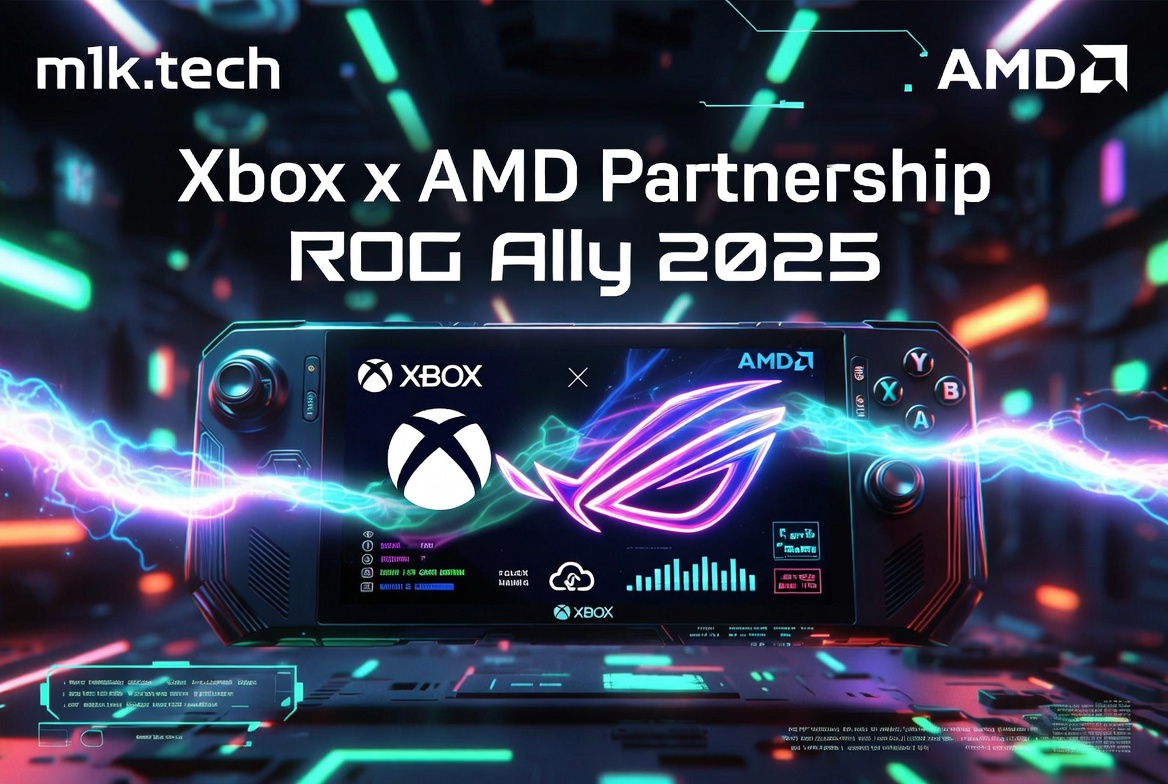
The ROG Xbox Ally and the AMD partnership behind it, both surfaced around the June 2025 Xbox Games Showcase, are where Xbox hardware stopped being a single console and became a strategy. Instead of one box, Microsoft started describing a family of devices, and tipped its hand on what the next Xbox actually is.
The AMD deal
According to Microsoft, Xbox President Sarah Bond announced a multi-year partnership with AMD to co-engineer silicon for a whole lineup of next-generation devices, spanning console, handheld, cloud, and accessories. The framing was the important part: not “the next Xbox console,” but a roadmap of hardware that all runs the Xbox experience, with the goal of letting players take their library wherever they are.
The handheld arrives
The first concrete product was the ROG Xbox Ally, built with Asus, a Windows gaming handheld carrying Xbox branding and a tailored full-screen interface. It put Xbox into the handheld category that AMD silicon had already come to dominate, the same space contested by devices I have covered like the ROG Xbox Ally X20 bundle and challenged by new Intel Arc handheld chips.
Why it matters
This is the hardware half of the everywhere strategy. Having made the games multiplatform, Microsoft made the hardware plural too, and pointed toward a next-gen console that is essentially a premium Windows PC in a console shell. It is a direct evolution of the ecosystem pitch from the Series X and S launch, and the foundation for what gets revealed around the 25th anniversary.
My take
As a hardware nerd, I like this direction, a family of devices that all run your library is a genuinely modern idea. The risk is the same one that haunts the whole strategy: the more Xbox becomes “Windows that plays games,” the harder it is to explain why it is still Xbox. The AMD deal is a bet that the brand, not the box, is what matters now.