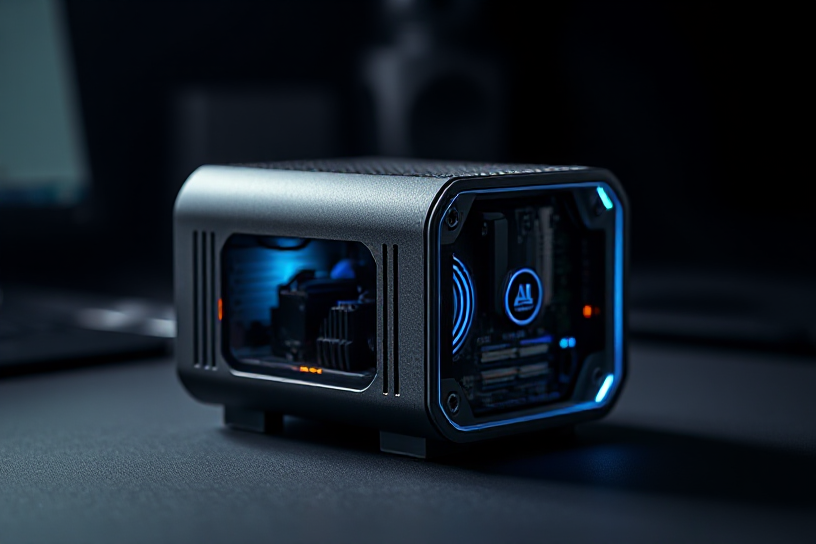
AMD just made the most compelling argument for local AI I have seen in hardware form. The GMKtec EVO-X2 is a mini PC built around the Ryzen AI Max+ 395 (Strix Halo), and it runs large language models locally, on your desk, with no cloud connection required. 16 CPU cores, a 40-core RDNA 3.5 GPU, and up to 128 GB of unified memory in a box smaller than a shoebox. At $1,700 to $2,200, it is not cheap. But after the Fable 5 shutdown proved that cloud AI can be revoked by a government letter, the value proposition of local inference just changed completely.
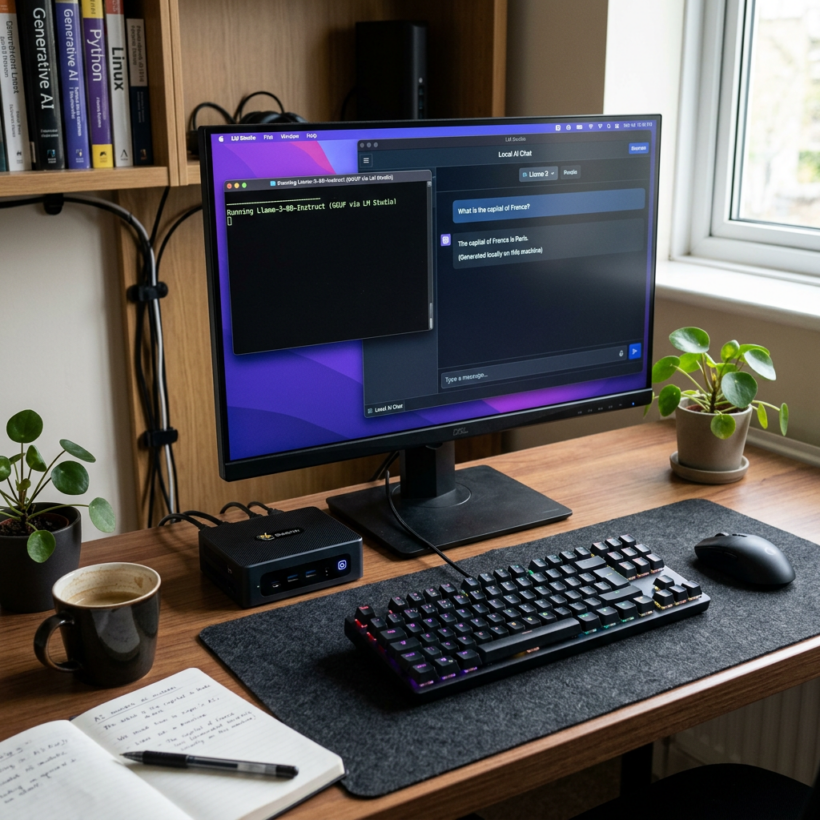
The unified memory advantage
The Ryzen AI Max+ 395 uses the same architectural principle that makes Nvidia’s RTX Spark interesting: unified memory shared between CPU and GPU. The EVO-X2 can be configured with 128 GB of LPDDR5X that both the CPU cores and the RDNA GPU cores address directly, which means a 70-billion-parameter model like Qwen3-235B can load entirely into memory without the bottleneck of shuttling data between system RAM and discrete VRAM. Early benchmarks show the EVO-X2 outperforming the RTX 5080 on specific large-model inference tasks, precisely because the 5080’s 16 GB of VRAM cannot hold what the EVO-X2’s 128 GB unified pool can.
Why local AI matters more now than it did last week
The timing of this product is almost too perfect. The Fable 5 and Mythos 5 suspension demonstrated that API-dependent AI is structurally vulnerable to political intervention. A model running on a cloud server can be disabled for every user on the planet with a single export control directive. A model running on your EVO-X2 cannot. Nobody can revoke your local weights.
This is the same argument I have been making around on-device AI: it is not just a performance feature, it is an independence feature. The EVO-X2 takes that thesis from the phone to the desk, with enough memory to run models that phone NPUs cannot touch.
The trade-offs are real
The EVO-X2 is not perfect. Performance degrades under sustained load because the thermal envelope of a mini PC chassis is limited. The fan gets loud during intensive inference runs. And the RDNA 3.5 GPU, while excellent for its size, does not have CUDA support, which means the vast CUDA ecosystem of AI tools (llama.cpp’s CUDA backend, TensorRT, vLLM) requires either ROCm ports or CPU-only fallbacks. Linux support is strong, and the open-source community has been enthusiastic, but the software stack is not as mature as Nvidia’s.
At $1,700 to $2,200, the price is also a consideration. That is less than a year of most cloud AI subscriptions for a team, but it is a meaningful upfront investment for an individual. The long-term math favors local hardware if you are running inference regularly, but only if the model you need fits in 128 GB and the software supports your workflow.
The competitive landscape for local AI hardware
The EVO-X2 sits in a rapidly filling category. Apple’s Mac Studio with M5 Ultra offers unified memory up to 256 GB with native CoreML support, but it costs significantly more and locks you into macOS. Nvidia’s DGX Spark (the desktop version of RTX Spark) offers 128 GB unified memory with full CUDA support, but it has not shipped yet and the price is expected to be higher. And Intel’s upcoming Bartlett Lake workstations will offer a different approach with discrete GPUs.
AMD’s advantage is price-to-memory ratio and the fact that the EVO-X2 exists today, not on a roadmap. If you want 128 GB of unified memory for local AI inference right now, on a box that fits on your desk, the options are a Mac Studio or this. The EVO-X2 is roughly half the price of the equivalent Mac.
The edge AI thesis is no longer theoretical. Between the sovereignty crisis in cloud AI, the maturation of open-weight models that run locally, and hardware like the EVO-X2 that can actually handle the compute, the pieces are in place for a real shift away from API dependency. Whether most users make that shift depends on how painful the software experience is compared to typing a prompt into a browser. Right now, local AI is for developers and power users. The EVO-X2 does not change that, but it does make the hardware barrier lower than it has ever been.