NVIDIA just entered the PC market. Not the GPU market, where it has dominated for three decades. The actual PC market: the processor, the platform, the whole machine. RTX Spark, announced at Computex 2026 on May 31, is a Windows on Arm superchip that combines a 20-core Grace CPU with a Blackwell RTX GPU on a single package, connected by NVLink-C2C, and it ships this fall in laptops and desktops from ASUS, Dell, HP, Lenovo, Microsoft Surface, and MSI. Jensen Huang stood on stage and called it a reinvention of the PC. I have spent the last two weeks digging into the Geekbench leaks, the architecture, the competitive benchmarks, and the app compatibility question, and here is the full breakdown.
The architecture: what RTX Spark actually is
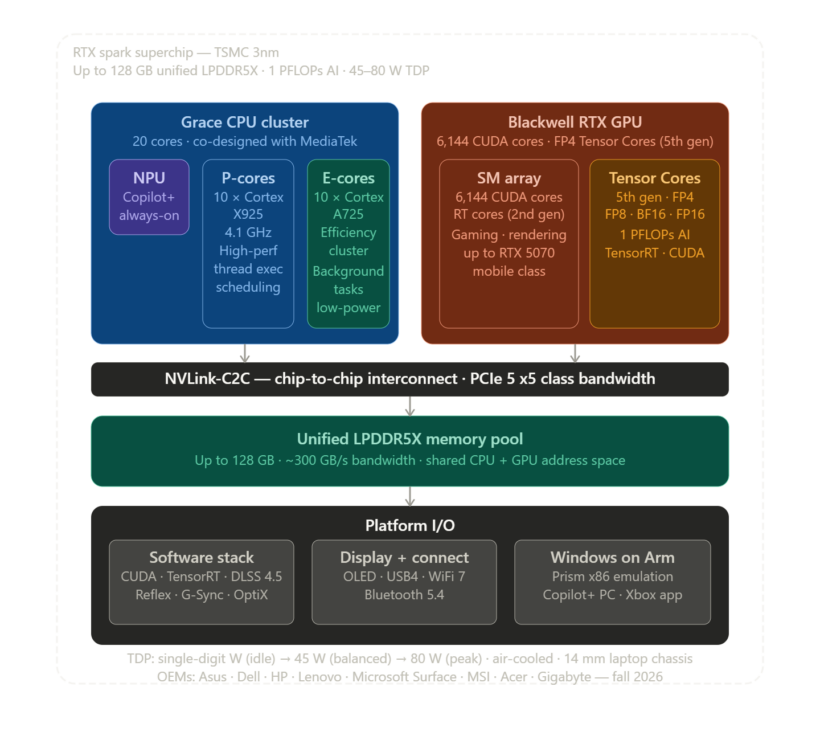
RTX Spark is not a CPU with a GPU bolted on. It is a unified system-on-chip built around Nvidia’s own NVLink-C2C chip-to-chip interconnect, the same interconnect technology that connects GPUs in data center racks. The CPU side is a 20-core Arm processor co-developed with MediaTek: 10 Cortex-X925 performance cores and 10 Cortex-A725 efficiency cores. The GPU side is a Blackwell-architecture RTX GPU with 6,144 CUDA cores and fifth-generation Tensor Cores supporting FP4 precision. Both sides share up to 128 GB of unified LPDDR5X memory.
The unified memory architecture is the design decision that matters most. In a traditional laptop, the CPU has its own RAM, and the discrete GPU has its own VRAM, but moving data between them goes through PCIe, which can be a bottleneck. RTX Spark eliminates that bottleneck. CPU and GPU share the same memory pool via NVLink-C2C, so an AI model running inference on the GPU can access the same data the CPU is using without a copy step. NVIDIA claims 1 petaflop of AI compute from this package. This number sounds absurd for a laptop chip until you remember that FP4 precision on Tensor Cores is optimized specifically for inference workloads.
The lineage is clear: RTX Spark is a productized version of the GB10 superchip that powers the DGX Spark mini AI PC, which Nvidia announced at CES 2025 as “Project DIGITS.” The DGX Spark runs the same 20-core Grace CPU and Blackwell GPU, but in a fixed desktop form factor at a fixed power envelope. RTX Spark takes the same architecture and packages it for laptop and compact desktop OEMs with thermal and battery constraints.
The N1 family: what leaked before the announcement
Before Nvidia branded it RTX Spark, the chip leaked extensively under the codenames N1 (laptop) and N1X (desktop). The leaked spec sheet, published by VideoCardz hours before Computex, revealed a four-chip family, not a single SKU:
The top-end N1X runs 20 cores (10+10) with 6,144 CUDA cores and a TDP window of 45W to 80W. A second N1X variant drops to 18 cores (9+9) with 5,120 CUDA cores in the same TDP range. Both desktop SKUs support 12 PCIe 5.0 lanes, 5 PCIe 4.0 lanes, and up to three M.2 SSDs. The laptop N1 variants are expected to carry the same core configurations at lower sustained power. NVIDIA has only formally announced the top-end 20-core configuration so far, but OEM design-in activity suggests the 18-core variant will appear in thinner machines where thermal headroom is tighter.
Geekbench breakdown: where the N1X actually lands
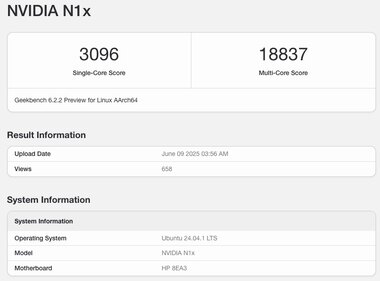
Multiple pre-release Geekbench 6 results for the N1X have surfaced over the past year, and the numbers tell a story of competitiveness but not dominance on the CPU side.
The most cited result, from an HP prototype board running Ubuntu 24.04.1, shows the 20-core N1X scoring 3,096 single-core and 18,837 multi-core in Geekbench 6. A second result from a different HP board (8EA3) running the same Ubuntu build posted 2,821 single-core and 17,152 multi-core with a base clock of 2.81 GHz. The variance is significant but expected for pre-production silicon tested on unoptimized firmware.
Here is how that compares to the competition:
Apple M5 (10-core, MacBook Pro 14-inch): 4,288 single-core, 17,926 multi-core. Apple M5 Max (18-core): approximately 4,300 single-core, 25,760 multi-core. Snapdragon X2 Elite Extreme (18-core, ASUS Zenbook 16): 4,033 single-core, 23,198 multi-core. AMD Ryzen AI Max+ 395 (Strix Halo, 16-core): 2,978 single-core, 21,269 multi-core.
The picture is clear. On a single core, the N1X lags behind both the M5 and the X2 Elite Extreme by a significant margin: roughly 28% behind Apple and 23% behind Qualcomm. On multi-core, the N1X’s 20 cores put it between the M5 base (which it beats) and the X2 Elite Extreme and M5 Max (which beat it). Against AMD’s Strix Halo, the N1X trades blows on single-core performance but loses on multi-core performance, despite having more cores.
The critical caveat: all N1X scores come from pre-release silicon running on Linux prototypes. Production firmware, Windows optimization, and the final clock profile will almost certainly improve these numbers. How much improvement is the question. A 10-15% gain from firmware tuning is reasonable. Closing a 28% single-core gap to Apple is a much harder ask.
The GPU side: where Nvidia actually wins
The CPU benchmarks tell one story. The GPU side tells a completely different story, and this is where Nvidia has an advantage that no one else in the Arm PC market can match.
6,144 CUDA cores on a Blackwell architecture is the same core count as the desktop RTX 5070. That is not a typo. NVIDIA is putting desktop-GPU-class graphics inside a laptop SoC. The leaked OpenCL Geekbench result of 46,361 is unimpressive. Still, the benchmark was run on early prototype silicon at 63% utilization and 59 degrees Celsius, suggesting the hardware was throttled or firmware-limited. The real-world performance will come from CUDA, not OpenCL, and Nvidia’s 30-year software ecosystem, CUDA, DLSS, TensorRT, OptiX, Reflex, and G-SYNC, will all run natively on RTX Spark.
This is the structural advantage. Apple has excellent integrated GPUs, but they run Metal, not CUDA. Qualcomm’s Adreno GPU in the X2 Elite Extreme is decent for mobile graphics but cannot compete with 6,144 CUDA cores on content creation, AI inference, or professional workloads. AMD’s Strix Halo has strong RDNA-integrated graphics, but it is an x86 chip with x86-level power consumption. NVIDIA is offering a combination that does not exist elsewhere: Arm efficiency on the CPU side and data-center-class GPU compute on the GPU side, in a laptop form factor.
The unified memory question
128 GB of unified LPDDR5X shared between CPU and GPU is the spec that developers will care about most. Today, running a large language model locally on a laptop means fitting the model and its context window into either system RAM (with slow GPU access) or VRAM (which is limited to 8-16 GB on most laptops). RTX Spark’s unified pool means a 70-billion-parameter model can reside in the same memory space that both the CPU and GPU address natively via NVLink-C2C. Apple’s M5 Max also offers unified memory (up to 128 GB), but Apple uses a memory bandwidth architecture optimized for its own frameworks, not CUDA. The developer ecosystem around CUDA for inference, llama.cpp, vLLM, and TensorRT run natively on RTX Spark. That ecosystem portability is the selling point.
App compatibility: the x64 question
This is the section that matters most for the average buyer, and Jensen Huang made the boldest possible claim on stage: “Every single application that Windows has ever run, meticulously optimized so that this computer literally runs everything the world has ever created.”
That is a big promise. Windows on ARM has struggled with app compatibility for years. The translation layer, Microsoft’s Prism emulator that converts x86 and x64 instructions to Arm at runtime, has improved dramatically since the Snapdragon X Elite launch in 2024. Still, edge cases remain: some anti-cheat software in games, certain legacy enterprise applications, and some professional tools that rely on x86-specific instruction sets.
NVIDIA’s approach appears to be three-pronged. First, the same Prism translation layer that Qualcomm’s chips use, since RTX Spark runs Windows on Arm. Second, Nvidia’s own optimization work: the company says it has “meticulously optimized” thousands of applications for RTX Spark, which likely means extensive testing and targeted patches in collaboration with Microsoft and ISVs. Third, the CUDA ecosystem: any application that uses CUDA, and there are thousands in creative, scientific, and AI workflows, will run natively on the Blackwell GPU without translation because the CUDA runtime is architecture-native.
The gaming-specific compatibility concern is anti-cheat. Kernel-level anti-cheat systems like BattlEye, Easy Anti-Cheat, and Vanguard have been the biggest obstacles for Windows on Arm gaming. EA has posted job listings specifically for porting its Javelin anti-cheat to ARM-based devices, which suggests the industry is moving in the right direction. NVIDIA’s DLSS, Reflex, and G-SYNC support will also run natively, which means RTX Spark laptops should deliver a gaming experience closer to a traditional discrete GPU laptop than anything the Arm PC market has offered before.
The honest assessment: compatibility will be very good at launch. It will improve over time, but “every application Windows has ever run” is a marketing claim that will face real-world exceptions on day one. The question is how quickly those exceptions shrink.
The competitive landscape: a three-way fight
The Arm PC market has just gone from a two-player contest (Apple Silicon vs. Snapdragon) to a three-way fight, and AMD’s x86 offerings are still in the ring as a fourth option.
Apple M5 series remains the single-core performance king and the integrated GPU efficiency leader. The M5 Max, with 18 cores and up to 40 GPU cores, is the benchmark everyone chases. Apple’s advantage is vertical integration: it controls the chip, the OS, the frameworks, and the apps, and the optimization depth that vertical control provides is visible in every benchmark. The disadvantage is the closed ecosystem: macOS only, no CUDA, no Windows, no choice of hardware vendor.
Snapdragon X2 Elite Extreme is the current Windows on Arm champion. Its Oryon Gen 3 cores deliver 4,033 single-core and 23,198 multi-core performance, beating the N1X on both axes. Qualcomm has been in this space for two years and has established OEM relationships, carrier partnerships, and a Copilot+ PC ecosystem. The Adreno X2-90 GPU is competent but not competitive with CUDA on professional workloads. Snapdragon Insider bias on the table: Qualcomm has a head start, and the X2 Elite Extreme is an excellent chip. RTX Spark threatens that position primarily on GPU performance and the CUDA ecosystem, not on CPU performance.
AMD Ryzen AI Max+ 395 (Strix Halo) offers the x86 compatibility advantage: no translation layer needed, every Windows application runs natively. The integrated RDNA 3.5 GPU, with up to 40 compute units, is well-suited for gaming. The penalty is power consumption: x86 cannot match ARM’s efficiency at the same performance level, which means shorter battery life and thicker laptops.
NVIDIA RTX Spark enters with the weakest CPU story (pre-release, so this may change) and the strongest GPU story by a wide margin. The bet is that GPU compute, AI inference, and the CUDA ecosystem matter more than raw CPU single-core speed for the workloads Nvidia is targeting: AI development, content creation, and gaming. That is a defensible thesis for professional users and creators. Whether it holds for mainstream laptop buyers who care about browser speed and Office performance is less clear.
The Snapdragon Insider perspective
I have to be transparent about where I sit. I am a Snapdragon Insider and have extensively covered Qualcomm’s Arm PC push, from the Snapdragon X chips at CES 2025 to the X2 Plus and Dragonwing at CES 2026. Qualcomm broke the Windows on Arm market open after years of Microsoft exclusivity, and the Snapdragon X Elite proved that Arm laptops could compete with x86.
RTX Spark is the first real threat to that position, and I think it is healthy. Competition sharpens everyone. The X2 Elite Extreme’s CPU advantage is real and may hold even after RTX Spark’s firmware matures. But Nvidia’s GPU advantage is equally real, and for a growing class of users, GPU compute, the CUDA ecosystem, and AI inference performance matter more than CPU single-core speed. The market is big enough for both, and the Arm PC category benefits from having two serious silicon companies pushing each other forward rather than Qualcomm alone.
RTX Spark is the most interesting new chip architecture to enter the PC market since Apple Silicon. The CPU benchmarks are underwhelming against Apple and Qualcomm, but benchmarks on pre-release Linux prototypes are an unreliable measure of a platform that will ship on Windows with production firmware. The GPU story is the real differentiator: 6,144 CUDA cores on a Blackwell architecture, inside a laptop SoC, sharing 128 GB of unified memory, is a spec sheet that did not exist before and that no competitor can match.
The x64 compatibility claim is the biggest risk. Jensen’s promise that every Windows application ever made will run on RTX Spark is the kind of statement that sounds incredible on stage and gets tested ruthlessly on launch day. If compatibility is 98%, it is a success. If compatibility is 95%, the headlines will be about the 5% that does not work, and the narrative will be “Arm still is not ready.”
What sets RTX Spark apart from every other Arm PC chip is that Nvidia is not trying to beat Apple at Apple’s game. It is building a platform where the GPU is the primary compute engine and the CPU is the coordinator, which inverts the traditional laptop architecture entirely. Whether that inversion matches how people actually use PCs in 2026 is the billion-dollar question. For developers, creators, and AI users, the answer is probably yes. For everyone else, the Snapdragon X2 and Apple M5 remain the safer, more proven bets. Fall 2026 will tell us which bet the market prefers.