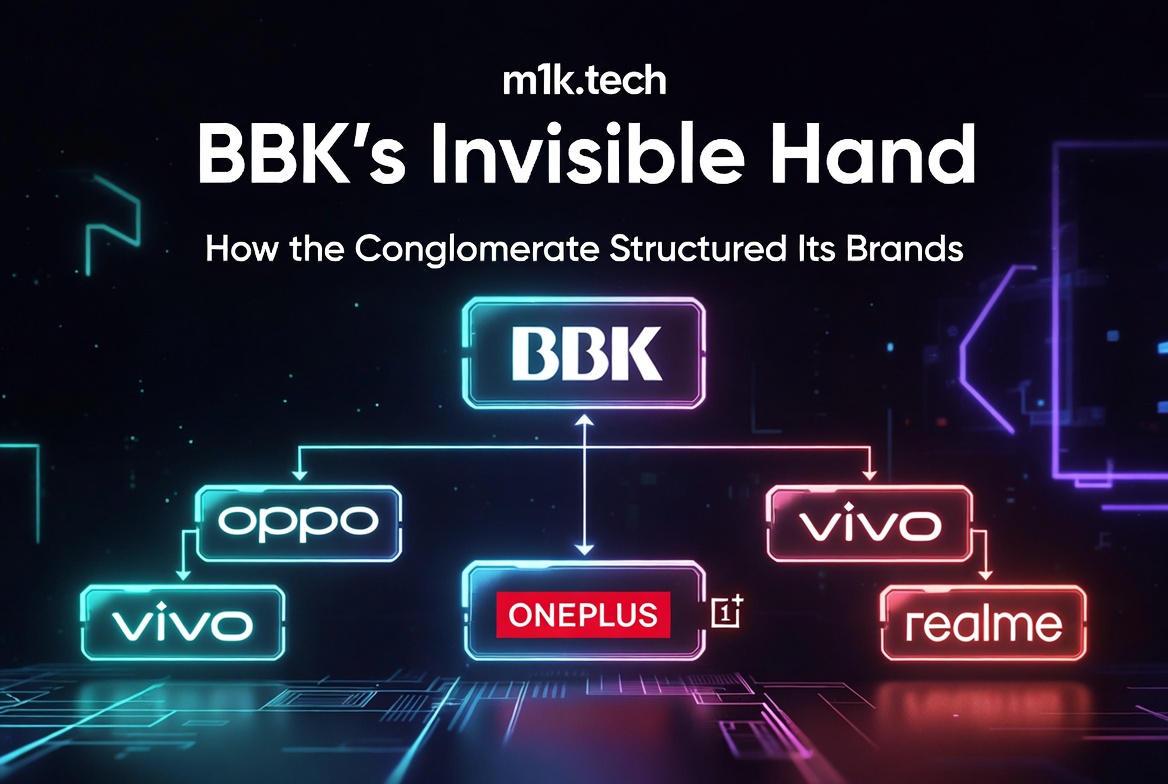
BBK Electronics, the Chinese conglomerate behind OPPO, Vivo, and OnePlus, was deregistered in April 2023 following a major restructuring. The April 2026 merger of OnePlus and Realme into a unified OPPO product center represents the latest step in a consolidation process that began when Pete Lau took the OPPO CPO role in 2021.
OnePlus built its brand identity on being distinctly different from competitors in software, pricing, and community engagement. As it increasingly shares a codebase and product organization with OPPO and Realme, sustaining that differentiation becomes structurally difficult, raising questions about whether OnePlus can maintain a distinct market identity within the consolidated group.
To understand what is happening to OnePlus right now, in June 2026, you have to understand the BBK conglomerate structure with more precision than most consumer tech coverage provides. BBK Electronics was a private company founded by Duan Yongping in Dongguan, China. Its history is more complicated than the simple “BBK owns OPPO, Vivo, and OnePlus” description that appears in most articles, and the complications are directly relevant to explaining why a brand with OnePlus’s community equity and product track record has arrived at its current position.
As a corporate entity, BBK Electronics no longer exists under that name, as the parent company was officially deregistered in April 2023 following a major restructuring.
The practical structure today: BBK was a holding entity whose equity stakes were not publicly disclosed but encompassed OPPO, Vivo, and, through OPPO, OnePlus and Realme. Vivo has been operating with increasing autonomy, driven in part by antitrust concerns in India, where having multiple smartphone brands under a single owner raises competition concerns that could be threatened by regulatory scrutiny. The April 30 merger of OnePlus and Realme into a unified OPPO product center is the most recent expression of a consolidation process that has been running since Pete Lau took the OPPO CPO role in June 2021.
Realme’s creation and what it was designed to do
Realme was founded on May 4, 2018, by Sky Li, a former OPPO executive, as an OPPO sub-brand targeting younger budget buyers in India and Southeast Asia. The timing was strategic: Xiaomi’s dominance of the Indian budget segment through its online-first model was leaving OPPO and Vivo’s offline-first strategies unable to compete. Realme was designed to fight Xiaomi in the online-direct segment without requiring OPPO to compromise its own premium positioning.
What happened with Realme’s growth was not the plan. It grew faster than OnePlus. By 2021, Realme was one of the world’s fastest-growing smartphone brands, with particularly strong performance in India and Southeast Asia. The sub-brand created to solve OPPO’s Xiaomi problem has become a significant market force in its own right, with a distinct product identity and an operating team led by Sky Li, with significant ambitions for the brand. That growth trajectory is what has placed Li at the center of the April 2026 reorganization, overseeing both OnePlus and Realme as OPPO’s sub-brand portfolio enters its next phase.
Why is the structure that enabled OnePlus also limiting it
BBK’s brand architecture worked well for volume brands. OPPO and Vivo had both built significant global market share through it. It was a structural problem specifically for OnePlus, and the reason was the product promise. OnePlus’s entire value proposition was that it was unlike other brands. The community loyalty that OnePlus built from 2013 to 2020 rests on the belief that OnePlus is making different decisions from OPPO, Xiaomi, and Samsung: different software decisions, different pricing decisions, and different community engagement decisions. Once OnePlus begins sharing a software codebase with OPPO and a product center with Realme, the “different decisions” story becomes difficult to sustain because the decision-making structure is shared.
The risk in the current consolidated structure was the same risk that had been present since June 2021: shared manufacturing and engineering allow brands to maintain market distinctiveness only when the independence is real. As independence becomes nominal and the shared codebase becomes the foundation rather than the exception, the market differentiation that made each brand valuable disappears while the conglomerate advantages remain. What that means for OnePlus’s product identity in the next two years is the question the new unified product center is just beginning to answer.OP will become just a segment of OPPO; the software team will merge, as OP already sells its products under ColorOS in Asia and the local market. With ColorOS now available globally, there is no reason to keep this masquerade. Looking at the code, you can see it’s the same across brands, with features enabled based on the device’s product ID.
Part of my ongoing OnePlus coverage at m1k.tech, tracking the brand from founding to the Realme merger.
Related reading: where Xiaomi sits in the 2026 competitive map these BBK brands are fighting over.