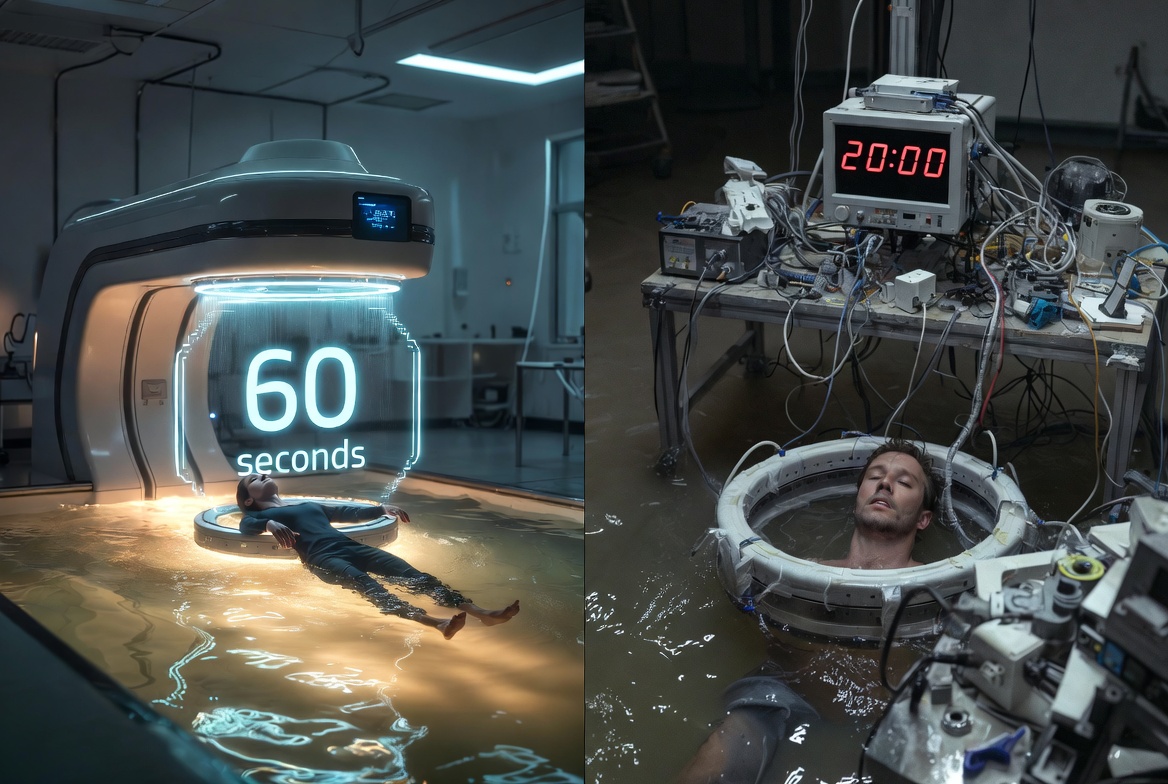
Midjourney has announced a full-body ultrasonic computed tomography scanner under a new division called Midjourney Medical, promising sub-millimeter 3D body scans in 60 seconds with no ionizing radiation. The current prototype takes around 20 minutes, has scanned only twelve people, and relies on conventional acoustic inversion rather than AI.
The underlying physics are established, and the company’s partnership with Butterfly Network provides credible transducer hardware. However, the device lacks FDA diagnostic clearance and is framed as a wellness tool to avoid regulatory requirements. Experts also warn that large-scale whole-body screening in asymptomatic populations routinely produces incidental findings that drive unnecessary follow-up care, a risk the company has not publicly addressed.
Twelve people have stepped onto the platform. Each scan took twenty minutes. Midjourney’s pitch says sixty seconds. That gap is the whole story.
On June 17 and 18, 2026, Midjourney, the company you know for spinning photorealistic images out of text prompts, announced a division called Midjourney Medical and a piece of hardware to go with it: the Midjourney Scanner, a full-body ultrasonic computed tomography system. CEO David Holz called it potentially “superior to even MRI machines in many ways.” The promise is sub-millimeter 3D maps of the torso and legs in roughly 60 seconds, no ionizing radiation, no strong magnetic fields. Ten of these are supposed to land inside a “Midjourney Spa” at Union Square in San Francisco by the end of 2027, sharing floor space with hot tubs, saunas, and cold plunges. The far horizon is wilder: 50,000 scanners worldwide running a billion scans a month by 2031.
The physics hold up, and that’s worth saying first. Ultrasound computed tomography is neither new nor magic. The FDA has already cleared USCT for breast imaging, with Delphinus Medical Technologies’ SoftVue the most prominent example, and the math behind reconstructing tissue density and sound-speed maps from acoustic data hit from many angles is settled science. Midjourney wants to stretch that principle from a breast-sized volume to a whole human body, and that stretch is where the engineering gets brutal.
The mechanical idea reads simply enough. You step onto a motorized platform that lowers you into the water at about 5 cm per second, drawing your body through a ring of transducers that fire ultrasonic pulses from every angle at once. The water isn’t a gimmick. Its acoustic impedance is close to that of soft tissue, so you lose far less signal to reflections at the skin than you would in air. Holz describes the ring as “half a million tiny squares each the size of a fine grain of sand,” roughly 500,000 transducer elements, every one of them both speaker and microphone. Target time for torso and legs: 60 seconds.
Those transducers come from Butterfly Network, the publicly traded outfit that pioneered Ultrasound-on-Chip. Butterfly’s trick was ditching piezoelectric crystals for CMUTs, capacitive micromachined ultrasonic transducers, etched onto ordinary CMOS silicon. Put thousands of elements on a single chip next to the analog front-end electronics, and the per-element cost collapses, which is exactly the kind of density Midjourney needs. One Butterfly chip holds up to 9,000 CMUT elements. The current scanner uses 40 of these modules, around 8,960 active CMUT channels in today’s build, a long way from half a million. The two companies signed a co-development and exclusive licensing deal in November 2025, as disclosed in an SEC Form 8-K: $15 million upfront, $10 million per year over five years, plus milestones and revenue sharing, for up to $74 million all in.
The data throughput is where the numbers stop sounding reasonable and start sounding like a stress test. A scan generates roughly 17 GB per second of raw acoustic data, and each reconstructed slice runs to about 40 GB. Holz’s framing is “500 hours of HD video per second of scan time.” Turning that torrent into a coherent 3D image takes around 2 petaflops. This is the one place the image-generation lineage actually pays off: Midjourney already owns large GPU clusters, and acoustic wavefield reconstruction is an inversion problem that maps cleanly onto the parallel tensor math those clusters were built to chew through.
Then TechTimes checked the bench. The prototype takes about 20 minutes, not 60 seconds. The bottleneck is data transfer between the transducer ring and the reconstruction cluster, and the throughput required for a one-minute scan simply isn’t available in the hardware yet. Twelve people have been scanned. There is no AI anywhere in the imaging pipeline, just conventional acoustic inversion. The Midjourney Medical team is nine people.
That doesn’t make any of it a scam. Prototypes miss their targets all the time, and 60 seconds is plainly a goal rather than a measurement. But a 20-minute rig that has scanned a dozen volunteers is a different universe from ten units running continuously in a public spa, and nobody on this team has ever shipped an FDA-regulated device. TechTimes reached for the Theranos comparison directly, not because the physics are faked (they aren’t), but because the distance between the announcement and the bench is wide and the claims are medical.
Holz’s roadmap fills that distance with revisions. The next twelve months go to algorithm and hardware refinement, plus the start of research trials. A Gen 2 hardware revision comes after. Gen 3, slated for 2028, drops the licensed Butterfly modules in favor of fully custom silicon that Holz calls a “night-and-day” improvement, and only then does the city-by-city rollout begin.
The regulatory move is the cleverest thing in the whole announcement. The scanner has no FDA clearance for diagnostic use, so Midjourney isn’t calling its output a diagnosis. It’s calling it a “body composition map,” numbers on muscle volume, fat distribution, bone geometry, and organ size. The FDA’s January 2026 general wellness guidance lets devices that track health metrics without specific disease claims reach consumers without the 510(k) or PMA pathway that a diagnostic device demands. Prenuvo and Ezra already run commercial whole-body MRI services on essentially this framing. The spa setting tightens the same logic: scan you between a sauna and a cold plunge, and the whole thing reads as wellness, not medicine. Holz says FDA conversations have begun and that the company will submit test results incrementally, which suggests eventual diagnostic clearance once enough scan volume and longitudinal data accumulate. That path exists. It’s measured in years and regulatory cycles, not months.
The catch is blunt: the device, as it will first operate, cannot tell you whether anything is wrong. It can tell you your liver volume is X and your muscle-to-fat ratio is Y. Whether those numbers indicate pathology is a clinical interpretation, and the wellness framing exists precisely to dodge that interpretation.
Scale the whole thing up, and a deeper problem surfaces, one that has nothing to do with the hardware. Systematic reviews of whole-body imaging in people with no symptoms keep landing in the same range: 20 to 40 percent of scans turn up incidental findings, anomalies that had nothing to do with why you got scanned. Only about 5 to 15 percent of those need any intervention. The rest spin off anxiety, repeat imaging, biopsies, and specialist visits that burn money and harm patients without changing outcomes. H. Gilbert Welch, whose research on overdiagnosis is the canonical reference here, calls it a Pandora’s box. Once a finding is in the chart, the system is obligated to follow up on it.
Run that against a billion scans a month, and even the floor of the incidentaloma range means 200 million people a month walking out with ambiguous results that demand follow-up. The announcement says nothing about this. It does, however, claim mass scanning could “avoid 30% of all deaths and 50% of all healthcare costs,” a figure attached to no cited peer-reviewed evidence and pointed in the opposite direction from the overdiagnosis literature, which finds that screening low-risk people tends to raise costs and can raise net harm through overtreatment. That’s not a fringe objection. It’s the mainstream view in health economics and preventive medicine.
Holz’s counter is that longitudinal scanning rewrites the math because tracking the same body over the years lets you judge an anomaly against your own baseline rather than population averages. It’s a reasonable hypothesis, and there’s some support for longitudinal biomarker tracking generally. But a hypothesis is not an outcome, and proving it out would require exactly the large-scale clinical trial data this modality lacks.
So how does any of this connect to making pictures? Technically, barely. Midjourney’s core product is a diffusion-model image synthesizer. Acoustic wavefield inversion is a different computational animal, and the company’s existing models aren’t touching the scanner’s reconstruction pipeline, not in the prototype anyway. Holz’s stated reason is philosophical: Midjourney makes images, and a 3D anatomical map is a kind of image. The concrete link is the infrastructure, spare GPU capacity that can be pointed at reconstruction compute, plus a house competence in large-scale parallel processing. The Verge noticed the same incongruity and floated the read that Midjourney Medical is partly a way to soak up compute that would otherwise sit idle between image jobs. Uncharitable, maybe, but not implausible. The technical overlap between the two businesses is thin, the medical device regulatory world is nothing like the consumer AI world, and those nine people are starting with zero cleared products and zero regulatory history.
None of which dooms the project. The USCT physics are real, Butterfly hands them credible transducer hardware, and the compute problem is the one Midjourney is genuinely built to solve. A 2027 spa that runs a wellness-framed, non-diagnostic service is aggressive yet reachable. It’s the 2031 number, I don’t believe. Fifty thousand scanners and a billion scans a month would demand diagnostic clearance, clinical validation, manufacturing at scale, and an honest answer to the incidentaloma flood the company has so far refused to even acknowledge. Ignore it, and the whole billion-scan vision is a machine for manufacturing 200 million scared patients a month.