Everybody clocked the $300 laptops, but personally, the Qualcomm Dragonwing IQ10 is the Computex announcement I cannot stop thinking about. I already wrote up the budget for Snapdragon C laptops, which are a big deal in their own right. This one is bigger, even if it got a fraction of the attention. Qualcomm showed up in Taiwan and pitched itself as the brain supplier for the entire humanoid-robot wave.
Let me break down what it actually is, because the spec sheet buries the lede.
So what is the Dragonwing IQ10?
CEO Cristiano Amon unveiled the Dragonwing IQ10 Robotics Reference Design, or RRD, on the Computex 2026 keynote stage. The keywords there are reference design. It is not just a chip; it is a full hardware-and-software blueprint, a fully enclosed package you can build a real robot around instead of stitching one together from a dozen different vendors. Qualcomm is putting it in front of early-access customers now, with global availability targeted for September.
The numbers
The headline figure is up to 700 TOPS of on-device AI, scalable to around 2,000 TOPS with external expansion modules. That comes from 18 Qualcomm Oryon CPU cores, a multicore NPU, and a GPU, all tuned so a robot can handle perception, planning, and reasoning on the device itself instead of leaning on separate accelerator cards. For an autonomous machine, doing the thinking locally is not a nice-to-have. It is the difference between reacting in milliseconds and reacting too late.
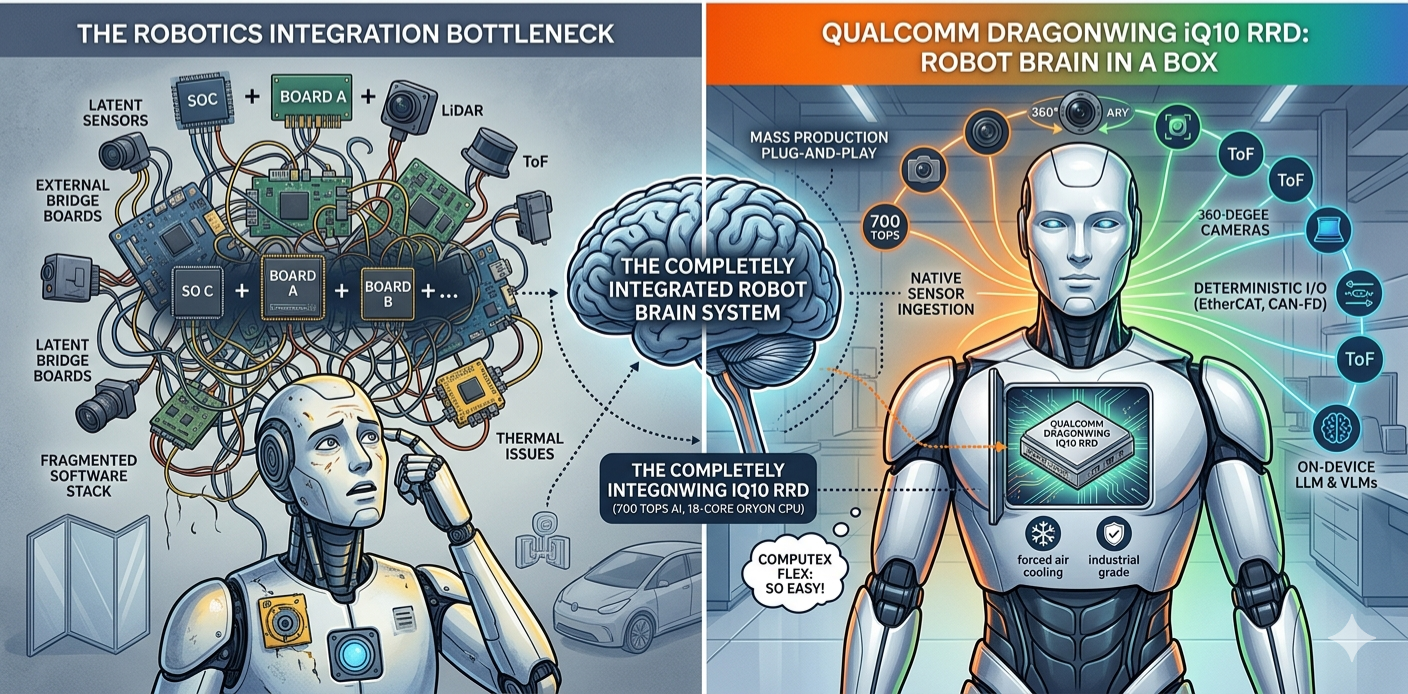
The part I find clever is the sensor side. The IQ10 natively ingests up to 12 GMSL2 high-definition camera streams plus LiDAR, Time-of-Flight depth, and IMUs, with no extra daughterboards needed to translate the data. Anyone who has touched robotics knows that sensor plumbing is where projects quietly go to die. And it ships with on-device AI runtimes, ROS2 support, and cloud-connected fleet management via Qualcomm’s AI Hub, so teams don’t have to build the entire toolchain from scratch either.
Why this matters more than the TOPS number
Here is the thing. Raw compute was never really the bottleneck in robotics. Integration was. Building a robot today means bolting together compute, sensing, networking, safety, real-time control, and a full software stack, and that patchwork adds latency, drives up cost, and adds months to the timeline. Qualcomm’s whole argument with the IQ10 is that it collapses that work into one validated system, so a team can move from prototype to production without tripping over the boring hardware glue at every step.
That is the real pitch behind all the physical AI talk you are going to hear nonstop this year. The models are getting good. The thing holding humanoids back is everything around the model. Qualcomm wants to own everything.
Who is actually building on it
This is where it gets less hype and more real. Early-access partners already include NEURA Robotics, Booster, VinMotion, Advantech, Innodisk, and Thundercomm, among others, and Qualcomm says it is in discussions with Kuka about its next-generation robots. Back at CES, Qualcomm was already demoing VinMotion’s Motion 2 humanoid and Booster’s K1 on the previous-tier Dragonwing IQ9. The family ladders nicely, too: IQ8 around 40 TOPS, IQ9 around 100, IQ10 at the top, with product support promised through 2036. That last detail matters a lot in industry, where nobody wants to design around a chip that vanishes in three years.
The bigger Qualcomm story
Step back, and the pattern is hard to miss. This is the company that put Snapdragon in your phone, now going hard after laptops and robots in the same week. Meanwhile, Nvidia is chasing the PC from the other direction. The phone-chip company is quietly turning into an everywhere-compute company, bringing the same silicon discipline it sharpened on mobile to the factory floor.
As a Snapdragon Insider I am obviously not neutral here, so take this with the appropriate grain of salt. But the IQ10 feels like the honest endgame of everything Qualcomm has been saying about on-device AI for years: run the intelligence where the data is, keep it off the cloud, and make it cheap on power. A humanoid is just the most dramatic version of that same idea.
The skeptic in me says reference designs are easy to announce and hard to ship, and a wall of partner logos is not the same as a wall of shipping products. September will tell us a lot. Watching the company I have followed for decades go from my phone to a robot’s nervous system in a single keynote, that one stops me cold.