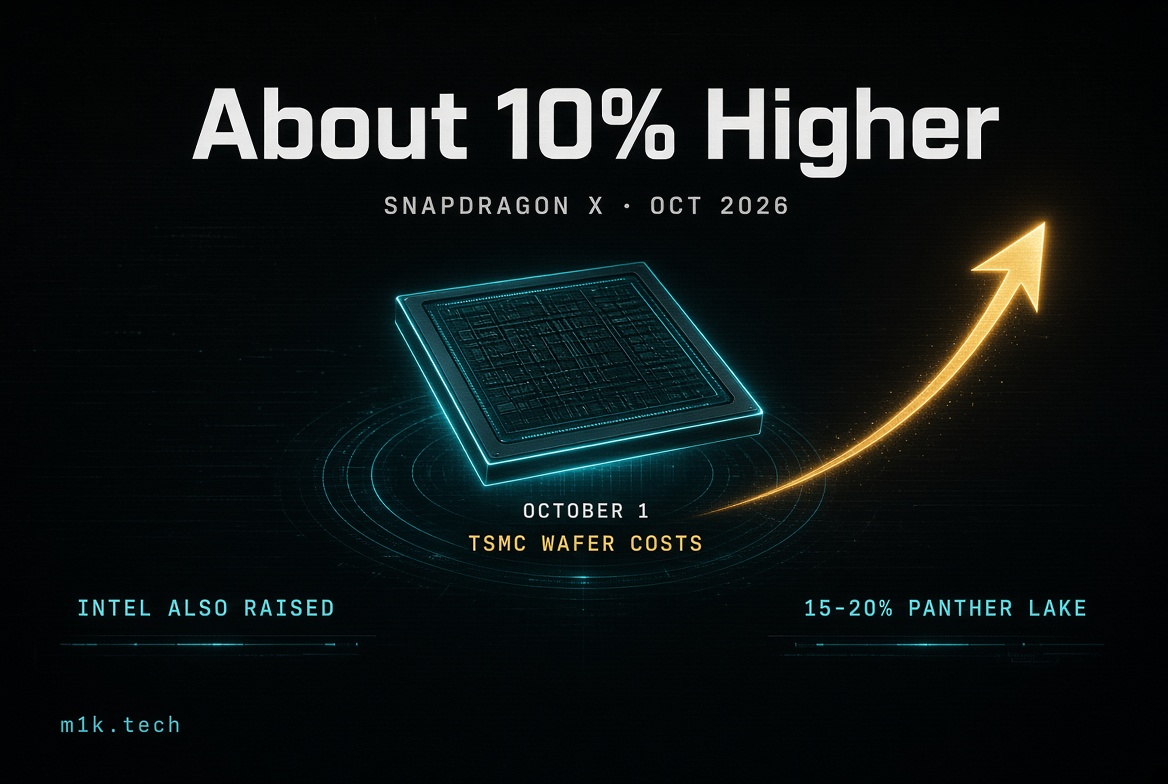
Qualcomm raised quotes on its multi-chip platforms by about 10% on October 1, supply-chain sources told Taiwan’s Economic Daily News, including Snapdragon X and X2 Elite. That is the confirmed-ish part, and it is thinner than the headlines suggest: no Qualcomm statement, no price list, and nothing on whether the 10% reaches OEMs or stops somewhere upstream. I wouldn’t print a laptop price off it.
What interests me more is who gets the blame. Wccftech’s write-up of the same report leads with Qualcomm’s “over-reliance” on advanced wafer nodes and concludes that its cost and efficiency edge over x86 is eroding, adding that Qualcomm moved to TSMC’s N2P node to get ahead of Apple’s A20 Pro. That framing is Wccftech’s. Economic Daily News makes a different argument: wafer costs are pushing every CPU vendor at once. Intel has raised prices in stages since September, according to the same sources, by 15 to 20% on high-end Panther Lake, whose graphics tile is built on TSMC’s N3E, and roughly 5 to 10% on Meteor Lake and Arrow Lake. AMD is said to be preparing increases of its own, though size and timing are unconfirmed.
So a story told as Qualcomm’s strategy backfiring is, in the original, three companies raising prices because the foundry did. I find the first version more fun to read and the second more believable, mostly because Intel is in it and Intel isn’t accused of overspending on nodes. It also leaves the interesting question untouched: if everyone is 10% dearer, Qualcomm still starts from the challenger’s seat, where the pitch was always efficiency at a price OEMs could live with. A rise that is even across the field does not hurt the incumbent and the newcomer equally.
I was already uneasy about this when Surface prices went up $350 around Summit week, and memory has been doing similar damage on the phone side: Samsung’s $100 Galaxy S26 increase came with a warning that supply stays tight into 2028. Add a chip tax on top of a memory tax, and the Windows-on-Arm laptop that was supposed to undercut x86 gets squeezed from both directions. The new Google laptops are the first real test, since Intel’s Googlebooks needed app tuning on launch day and the Snapdragon versions were, in at least one hands-on comparison, the faster ones; a dearer Snapdragon makes that advantage cost something. The same wafer logic runs through Samsung’s LPDDR6 validation on the 8 Elite Extreme Gen 6, where bandwidth was bought with width rather than speed.
I’ll believe the 10% when an OEM quotes it, or Qualcomm’s next earnings call mentions it. Until then it is a Taiwanese supply-chain number, and AMD’s increase is, so far, only something it is said to be preparing.
Sources
- Economic Daily News (Commercial Times), CPU price hikes keep coming as Intel, Qualcomm and AMD follow in turn, with TSMC the biggest driver behind them (translated title), October 12, 2026
- Wccftech, Qualcomm’s Over-Reliance On Advanced Wafer Nodes Eroded Its Cost & Efficiency Strengths Over x86, Company Reportedly Raising Snapdragon X Prices By 10%, October 12, 2026