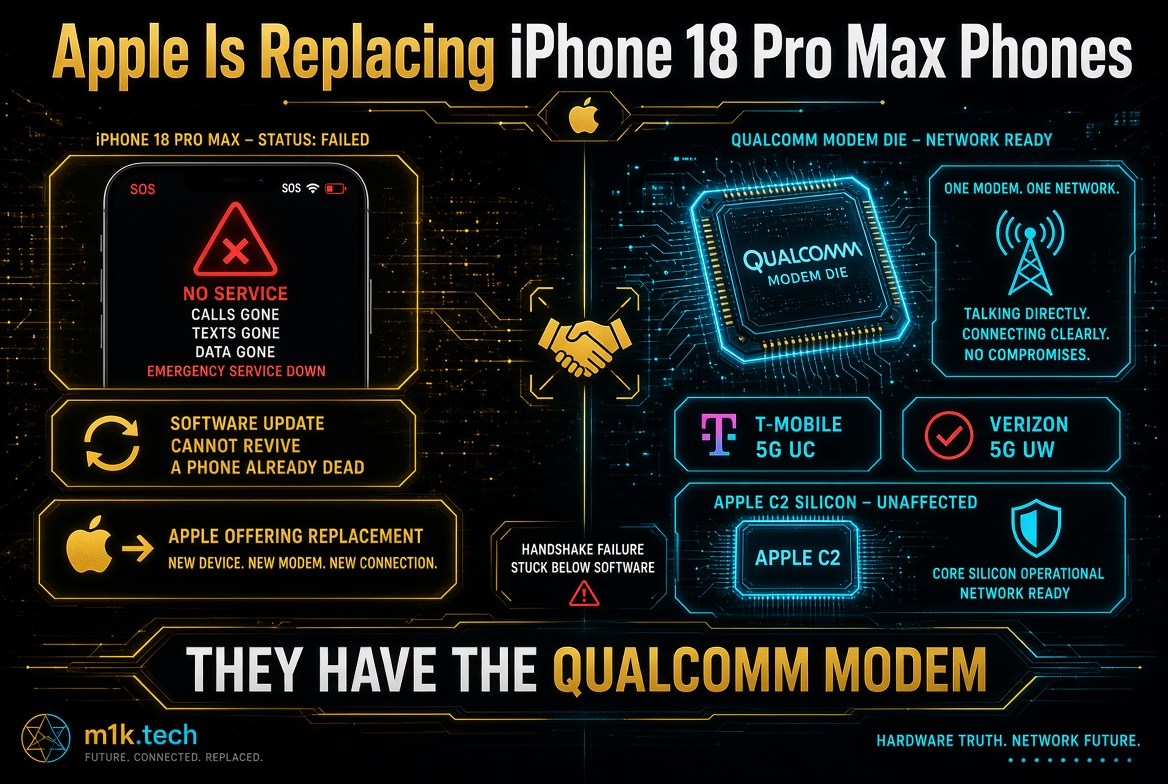
The iPhone 18 Pro Max AT&T problem got its official diagnosis last Friday, and the part that matters is the last sentence of it: software updates will stop the failure from reaching more phones, but a phone that has already dropped off the network will not come back, and Apple will replace it with a new one.
The symptom is blunt. Owners on AT&T see “SOS” in the status bar and lose calls, texts, and data, which CNET points out includes 911. It doesn’t hit every iPhone 18 Pro Max on the network, and Apple calls the group a “small number” of users, though one estimate from AT&T’s own warning text puts it at thousands. I find that gap between “small number” and “thousands” more informative than either figure alone.
The remedy has two parts: iOS 27.0.1, which shipped earlier this week, and a carrier settings update Apple pushed on Friday, downloading automatically over the next 14 days or on demand from Settings, General, About. Some owners on Reddit say 27.0.1 alone did nothing for them, and neither did the iOS 27.2 public beta. That is the group Apple’s replacement offer is really for.
Now the modem, which Apple’s statement never mentions. The iPhone 18 Pro Max sold in the US still carries a Qualcomm modem (a teardown confirmed it on September 19), while the iPhone 18 Pro runs Apple’s own C2 and is not affected. T-Mobile and Verizon told CNET they see no similar reports. Put those together, and the evidence points to one specific modem talking to one specific network, though it cannot tell me which side of that handshake owns the bug. If it were only a carrier configuration mistake, I would expect a carrier settings patch to revive stuck phones, and Apple is saying it cannot. That suggests something is stuck below the layer software can reset. I am inferring that from a single sentence relayed by reporters, so treat it as a hunch.
Timing makes this uncomfortable for Qualcomm in a way no spec sheet would. I wrote earlier this week about Apple renewing its Qualcomm patent license without saying for how long, and the argument there was that Apple’s modem independence is a slow walk, not a switch. This week the one phone that still has Qualcomm inside is the one in the headlines, and the one with Apple’s silicon is fine. Qualcomm has spent the year telling investors it is more than a smartphone chip company, and a free-replacement story about its biggest customer’s flagship does not help that pitch. The part in this phone is also the older one: the X105 I covered from Maui, the modem that can video call over satellite, is a different chip, and nothing reported so far ties it to this fault.
I am not getting into the 911 angle or whether a regulator will care that a phone can silently lose emergency calling. That is its own post and probably someone else’s job. Apple will keep its statement to iOS versions and carrier settings, and I would too in its position. I still cannot tell you if the fault lies in the modem or on AT&T’s side. Ask me when someone tears down a dead unit. Until then, if you own an iPhone 18 Pro Max on AT&T, install the update tonight and do not wait for the SOS to find you.
Sources
- 9to5Mac, Apple confirms iPhone 18 Pro Max AT&T cellular issues, affected devices require hardware replacement, October 2, 2026
- CNET, iPhone 18 Pro Max Can’t Make a Call on AT&T? Apple Says It Will Replace It for Free, October 2, 2026
- MacRumors, AT&T Acknowledges iPhone 18 Pro Max Issues: ‘Update Immediately’, October 1, 2026
- 9to5Mac, iPhone 18 Pro Max still uses a Qualcomm modem in the US, teardown confirms, September 19, 2026