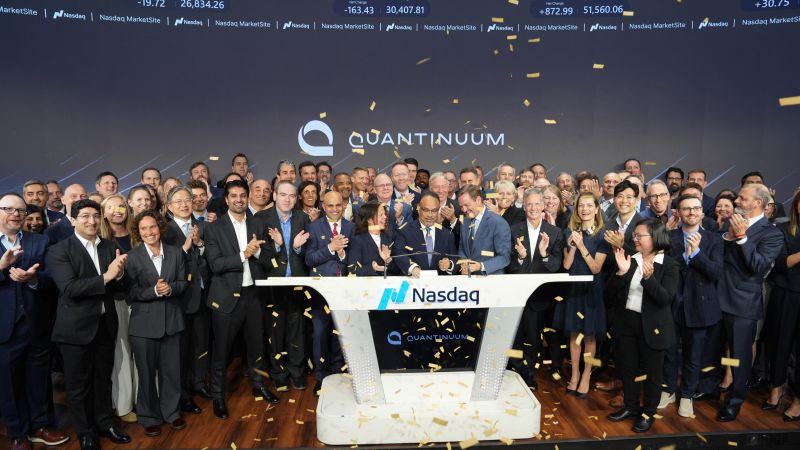
The Quantinuum IPO is the first traditional listing for a full-stack quantum computing company, and the numbers underneath it are going to start an argument. The stock priced at 60 dollars, raised 1.68 billion, and implied a valuation around 14 billion dollars. The revenue backing that valuation? It shrank 73 percent last quarter. Both of those things are true at the same time, and that tension is the whole story.
A bit of history first, because it explains the company
Quantinuum did not appear out of nowhere. It was born in 2021 from the merger of two serious outfits: Honeywell Quantum Solutions, the quantum hardware division of the industrial giant, and Cambridge Quantum, a UK software company focused on quantum algorithms and chemistry. The logic was clean. Honeywell had the trapped-ion hardware, some of the best in the world by several measures; Cambridge Quantum had the software stack to run useful things on it. Put them together and you get what the company likes to call a full-stack quantum platform, hardware and software under one roof, rather than a lab demo or a pure-software bet riding on someone else’s machine.
That full-stack framing matters, because it is exactly what makes this IPO a first. Plenty of quantum-adjacent names have hit public markets through SPACs and side doors over the years, usually pure-play hardware or pure-play software. Quantinuum is the first company doing the whole stack to walk through the front door of a traditional IPO. Honeywell stays majority owner after the offering, around 82 percent of the equity sits with the founding shareholders, Honeywell and Cambridge Quantum Holdings, and Honeywell remains both a strategic customer and partner. So this is less Honeywell cashing out and more Honeywell putting a price tag on an asset it built and intends to keep steering.
What actually happened on the listing
The demand story told itself in the pricing. Quantinuum started with a range of 45 to 50 dollars a share. Then it bumped to 53 to 55. Then it priced above even that, at 60, and sold 28 million shares to pull in 1.68 billion dollars. When a deal keeps ratcheting its own price up before it even opens, that is investors elbowing each other to get in. It listed on the Nasdaq on June 4 under the ticker QNT.
And then, the anticlimax. Shares opened at 68, poked up to 71 and change intraday, and closed basically flat on the day. So all that pre-IPO heat produced a debut that, once real trading started, went nowhere. That is its own kind of signal. The people who had to have it got it in the allocation; the open market took one look and shrugged.
The numbers that should give you pause
Here is where I put the brakes on. Quantinuum did about 30.9 million dollars in revenue for 2025, up from 23 million the year before. Respectable growth in percentage terms, but that is 30 million dollars of revenue against a roughly 14 billion dollar valuation. Run the math and the market is paying somewhere in the neighborhood of 450 times annual sales. For a sense of scale, even the frothiest software IPOs usually top out at a small fraction of that.
It gets bumpier. In the first quarter of 2026, revenue did not just grow slowly, it fell off a cliff: down 73 percent to 5.24 million dollars, from 19.1 million a year earlier. The company posted a net loss of 136.5 million for that single quarter, against a 30.5 million loss in the same quarter a year before. For the full year 2025 the net loss was 192.6 million. So you have a company whose revenue is tiny, lumpy, and currently shrinking, losing money at an accelerating rate, valued like a mid-cap tech darling. Quantinuum would point out that quantum revenue is project-based and lumpy by nature, big contracts land unevenly, and that bookings and pipeline matter more than any single quarter. Fair. But a 73 percent drop is a 73 percent drop, and you are allowed to notice it.
So which is it: a genuine milestone, or froth? Honestly, both. The milestone is real. A full-stack quantum company clearing a traditional IPO and raising 1.68 billion is a legitimate marker that the sector has matured past the science-project phase, at least in the eyes of institutional money. The customer list is not vapor either; the prospectus names the likes of JPMorgan Chase and Amgen, real companies in pharma, materials, and finance kicking the tires on real hardware. But the valuation is running miles ahead of the fundamentals, and it is being carried by belief about where quantum goes in five or ten years, not by what the income statement says today. That is the defining trait of this entire 2026 listing wave, and Quantinuum is the most extreme example of it I have seen yet. Compare it to Anthropic, whose revenue went up roughly 540-fold on the way to its filing. Quantinuum is the mirror image: same investor euphoria, opposite revenue curve. When the market treats both the company growing 540x and the company shrinking 73 percent as must-own AI-era bets, that tells you something about the mood, and not necessarily something reassuring. It is the same froth I flagged in the SpaceX and OpenAI mega-offering wave, just concentrated into the riskiest corner of the market.
The part nobody is talking about enough: the sovereignty angle
This is the detail that made me sit up, and it is the one I have a slightly different vantage point on. Tucked into the amended filing are two things that have nothing to do with qubits and everything to do with geopolitics. First, on May 21, Quantinuum signed a non-binding letter of intent with the US Department of Commerce for an award of up to 100 million dollars under the CHIPS Act, to support technical projects scaled across the United States. Second, and this is the striking one, the company added a covenant to its bylaws requiring that every single member of its board must qualify as a US Person under federal regulations.
Sit with that for a second. A company with deep British roots, Cambridge Quantum is literally from Cambridge, is writing into its own corporate DNA that its board has to be American. That is not an accident, and it is not bureaucratic boilerplate. Quantum computing is now treated as a strategic national-security technology, in the same bucket as advanced chips, and the US government is making access to its money conditional on control staying domestic. As someone whose day job is watching how technology and capital cross borders, I read this as a marker of where things are heading: the era of treating frontier compute as borderless is closing. Governments want the crown-jewel technologies onshore, on their own board, under their own rules. Quantinuum just showed everyone what the price of admission looks like, and it is denominated in sovereignty as much as in dollars.
Where I land
Quantinuum is the most interesting IPO of this wave precisely because it is the least justifiable on paper and possibly the most important in the long run. The technology is real and hard to replicate. The first-mover status as a public full-stack quantum company is real. The strategic backing from the US government is real. And the valuation is, by any normal financial measure, completely disconnected from the business as it exists today. If quantum delivers on even part of its promise this decade, today’s 14 billion will look quaint. If it stays five-years-away for another ten years, a lot of people who bought QNT this week are going to learn an expensive lesson about the difference between a great technology and a good investment. That is the bet the market just made, with 1.68 billion dollars and a straight face.