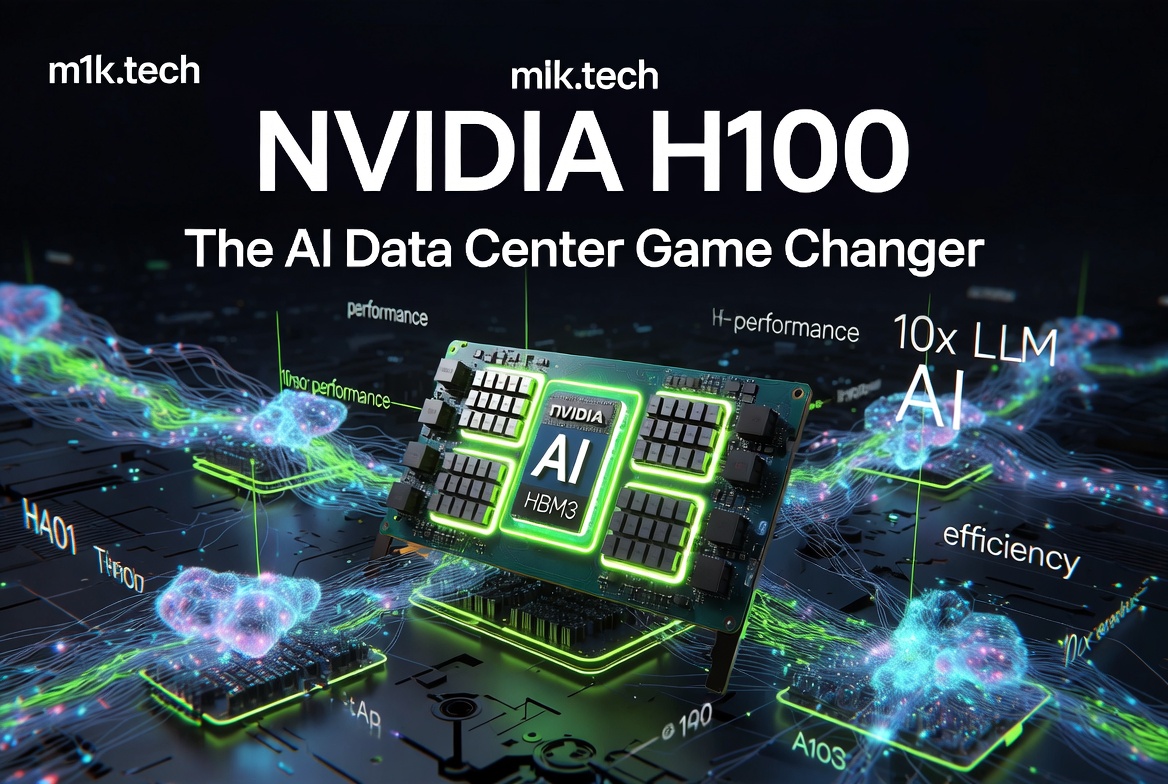
NVIDIA’s data center revenue surpassed $100 billion in fiscal 2026, driven by the Blackwell B200, which delivers approximately five times the inference throughput of the H100. The December acquisition of Groq added purpose-built inference hardware to NVIDIA’s portfolio, extending its reach across every tier of compute.
NVIDIA’s competitive durability stems primarily from the CUDA software ecosystem, built over two decades, rather than hardware specifications alone. US export controls have further entrenched its position by making its chips a government-regulated strategic asset, raising sovereignty concerns for European and other international buyers considering long-term infrastructure dependence.
NVIDIA’s data center revenue cleared $100 billion in fiscal 2026. The Blackwell B200 delivers roughly 5x the inference throughput of the H100 at the same power envelope. The $20 billion Groq acquisition in December closed the one gap Nvidia had: a competitor purpose-built for inference rather than training. None of that is the interesting part. The interesting part is how hard it is to compete with a company that has been laying track for twenty-two years.
CUDA is the reason. Not the chip, not the architecture, not the memory bandwidth. The software ecosystem that two decades of developers have built on top of it: cuDNN, TensorRT, NCCL, NeMo, and thousands of third-party libraries optimized specifically for Nvidia silicon. AMD’s MI300X offers competitive memory bandwidth. The switching cost isn’t the hardware, it’s the engineering hours required to port everything from CUDA to ROCm, and most teams decide those hours aren’t worth it unless the performance delta is overwhelming. It almost never is.
Blackwell extended the lead. The second-generation transformer engine supports FP4 precision for inference, which cuts memory requirements and energy consumption without meaningful quality degradation. RTX Spark brings the same architecture into laptops. DGX Spark brings it to desks. Grace Blackwell Superchips connect CPU and GPU via NVLink-C2C for the data center tier. The Groq acquisition means Nvidia now also owns the inference-specific hardware that was the most credible alternative to repurposed training GPUs. Every rung of the compute ladder, from pocket to rack, is now Nvidia’s stated territory.
The angle most GPU coverage skips: American export controls have made Nvidia’s hardware a strategic asset whose distribution is controlled by the US government. China can’t buy H100s or B200s. The Fable 5 shutdown extended that same logic to the AI model layer. For European buyers, this is the actual question under every procurement conversation: if the underlying GPU is an export-controlled American strategic asset, and the model running on it can be shut down by Commerce Department letter, what exactly are you building on? Mistral’s push for European AI independence includes building its own GPU capacity for exactly that reason. Not because AMD or anyone else is faster, but because ownership is different from access.
Nobody is dethroining Nvidia on training workloads before the end of this decade. The CUDA moat is too deep, the ecosystem too entrenched, and the Blackwell generation is widening the gap rather than narrowing it. The only scenario that changes the picture is a paradigm shift away from transformer architectures entirely, at which point all bets are off for everyone. Until then, Nvidia sets the pace and everyone else optimizes for whatever gap they can find at the edge.