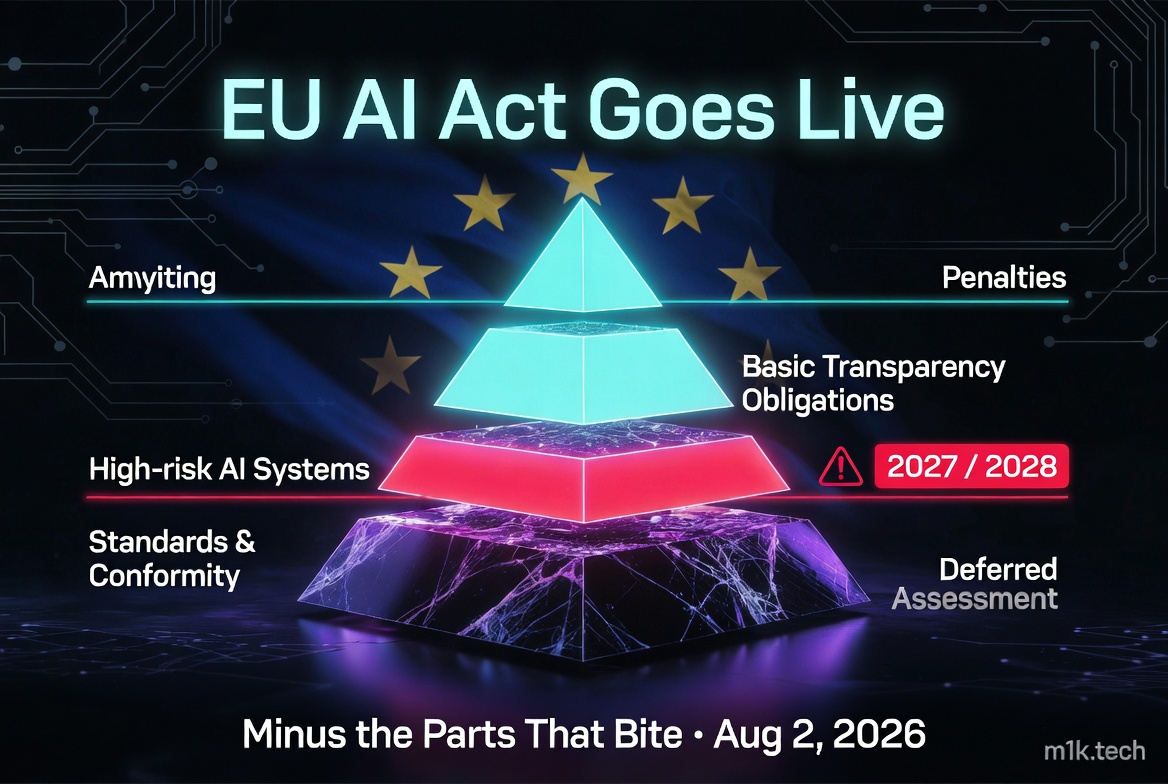
On Sunday, the most consequential AI law on the planet hits the deadline everyone has been circling for a year, and the honest version of the story is that Brussels spent the previous nine months quietly walking back the hardest parts of it. August 2, 2026 was supposed to be the day the EU AI Act stopped being a framework and became an enforcement regime: national regulators empowered, penalties live, the rules for high-risk systems finally binding. Most of that got pushed. What actually arrives this weekend is the scaffolding plus a sliver of the transparency layer, and even that had its teeth filed down on the way in. I want to walk the whole thing this time, because the deadline is only the surface. The real story runs from a proposal written in 2021, before anyone outside a research lab had heard of ChatGPT, through a copyright fight that just claimed its first courtroom casualty, to a three-way split between Brussels, Washington, and Beijing over what governing AI is even for.
Here is what genuinely changes on Sunday. From August 2, member states are meant to have their market-surveillance authorities standing and supervising, which is the machinery that turns the Act from text into something a company can be fined under. The penalty ladder that has technically existed since last August now has a body behind it: up to €35 million or 7% of global annual turnover for the outright banned practices, €15 million or 3% for most other breaches, and €7.5 million or 1% for feeding a regulator bad information. Those are GDPR-scale figures by design, because the entire theory of the Act was to make AI compliance a board-level cost rather than a legal footnote.
The piece with the widest blast radius is Article 50, the transparency layer, and it reaches companies that never touch a high-risk classification. Run a customer-service chatbot, and you have to tell users they are talking to a machine. Generate synthetic images, audio, video, or text, and the output is supposed to carry a machine-readable AI-generated mark. Deepfakes need labeling. Emotion-recognition systems have to disclose what they are doing. This is the rulebook that put ChatGPT and Roblox in the coverage as named services facing tighter scrutiny, and on paper it goes live Sunday.
The catch is that the most visible obligation in it, actually marking AI-generated content, does not. A late amendment handed synthetic-content generators an extra four months, bumping their compliance date to December 2. So the deepfake-labeling rule that is the whole reason a normal person has heard of Article 50 is not in force this weekend at all. It arrives in December, assuming it is not moved again. Hold onto that detail, because it turns out to be a pattern rather than a one-off.
The five-year road from a pre-ChatGPT proposal
The Act was born into a world that no longer exists. The Commission tabled the first draft on April 21, 2021, and the systems it was built to police were CV-screening algorithms, credit-scoring engines, and facial recognition at borders. There were no foundation models in it, because there was practically no ChatGPT to worry about. The whole design rested on a now-famous pyramid of four risk levels: a small tier of banned uses at the top, a larger band of high-risk systems that would need conformity assessments and human oversight, a layer of limited-risk systems that just had to disclose themselves, and everything else left alone. The Commission still presents the law that way on its own site: four levels, fully applicable on August 2, 2026, which is worth remembering once you see how much of that framing the last year has quietly overtaken.
Then November 2022 happened. ChatGPT turned a technical debate about risk categories into a political one about who controls the models underneath everything, and it landed in the middle of a negotiation that had no answer for it. By June 2023 the Parliament had bolted on rules that would have regulated every foundation model regardless of its actual impact, which sent the whole thing into a standoff. France, Germany, and Italy, the three governments with a European lab worth protecting, spent late 2023 fighting to strip those obligations back down to voluntary codes, because Mistral in Paris and Aleph Alpha in Heidelberg were the only continental answers to OpenAI, and neither could carry American-scale compliance while raising a fraction of the money. That fight nearly killed the entire Act in November 2023.
What broke the deadlock was a tiered compromise on general-purpose AI: light obligations for most models, heavier ones only for the largest that pose what the text calls systemic risk, hammered out in a marathon session that ended past two in the morning on December 8, 2023. From there it moved fast. The Parliament adopted the text on March 13, 2024, the Council approved it unanimously on May 21, and it entered into force on August 1, 2024. The dates you actually need are the phased ones that followed: the outright bans and AI-literacy duties kicked in on February 2, 2025, the general-purpose AI obligations and the governance and penalty machinery on August 2, 2025, and then this Sunday was meant to be the big one, high-risk and transparency together. That is the deadline the omnibus came for.
Why a risk pyramid in the first place
The reason it looks like this, rather than like a blanket AI license or a US-style hands-off posture, is that the Act was written as a fundamental-rights instrument first and an industrial-policy one second. The premise is that you do not regulate the technology; you regulate the use, and you scale the burden to the harm. Almost nothing gets banned outright, and the things that do are genuinely grim: government social scoring, systems that manipulate people into decisions against their own interest, untargeted facial-recognition scraping, real-time biometric identification in public spaces by police outside narrow exceptions. The omnibus round even added non-consensual intimate imagery and AI-generated child sexual abuse material to the prohibited list, which tells you the drafters were still finding new floors to nail down years after the first text.
Everything expensive lives one rung down, in the high-risk band: AI used for hiring, credit, insurance, medical devices, education, law enforcement, border control. Those systems are not banned; they are gated, with documentation, risk management, human oversight, and a conformity assessment before they reach the market. That is the part with real compliance weight, and it is the part that just got pushed. The ambition underneath all of it is the Brussels effect, the same lever that made the EU’s crypto rulebook a global template and its cybersecurity directive a continent-wide floor: write the rules first, and because nobody wants to lose access to 450 million consumers, the rest of the world ends up conforming. The AI Act was that lever aimed at the defining technology of the decade. The trouble, which Mario Draghi laid out in his 2024 competitiveness report, is that you cannot run the Brussels-effect play from behind, and on AI compute and capital, Europe is badly behind.
What Brussels quietly deferred, and how the official line still reads
That four-month slip on content marking is the small version of a much larger retreat. On November 19, 2025 the Commission published what it called the Digital Omnibus on AI, a simplification package whose main effect was to push the Act’s hardest deadlines well past where they were written. Stand-alone high-risk systems, the Annex III category covering recruitment, credit scoring, biometric identification, law enforcement, and education, were supposed to be compliant this Sunday. They now have until December 2, 2027. High-risk AI baked into regulated products like medical devices and machinery slid further still, to August 2, 2028. That is a sixteen-month deferral on the core of the law, agreed in trilogue this spring and locked to fixed dates rather than the original trigger, which had tied the start to whenever the technical standards were ready.
Here is the part that gets me. The Commission’s own framework page, the canonical explainer, still tells you the AI Act becomes fully applicable on August 2, 2026, pyramid and all. That sentence is now doing a lot of work, because the same institution that wrote it also wrote the omnibus that moved the substance to 2027 and 2028. The official line and the operative reality have drifted apart, and if you only read the Commission’s summary you would walk away thinking the hard parts land this weekend. They do not.
I go back and forth on whether the deferral is good governance or a rout. The charitable read is real: the harmonized technical standards companies need in order to actually comply do not exist yet, and forcing a legal deadline in front of missing standards produces compliance theater, not safety. The less charitable read is that a wall of industry lobbying worked exactly as intended. Siemens and SAP spent mid-2025 publicly telling Berlin and Brussels the framework had to be rewritten to support rather than obstruct European tech, and they were the polite end of a much louder campaign of European CEOs demanding a pause. Parliament waved the amendments through by a wide margin. Whatever you call it, a landmark law got softened before its own first real deadline, under pressure from the exact companies it was written to bind.
The honest ledger
So is the thing good or not? I keep landing on yes, and also they are blowing it. The case for is stronger than the tech-lobby version admits. A law that forces a company to document what a hiring algorithm does, keep a human in the loop on a credit decision, and prove a medical-device model is accurate before it ships is not red tape; it is the minimum you would want if the system were deciding your mortgage or reading your scan. The bans catch real harms. The transparency rule, once it finally bites, means you get told when a machine is impersonating a person, which is worth having in a year when synthetic media is getting genuinely hard to clock. And first-mover clarity has value on its own, because a company that builds to the AI Act has a defensible global baseline instead of fifty contradictory ones.
The case against is not really about any single provision; it is about weight and timing. The compliance cost lands hardest on exactly the European companies the continent needs to win, because a startup cannot amortize a legal department across the revenue a hyperscaler can. The reach is extraterritorial, so a model trained anywhere falls under the rules the moment it is offered in the EU, which the Commission frames as leverage and everyone outside Brussels experiences as overreach. Some of the core language is still vague enough to litigate, starting with what a sufficiently detailed training-data summary even means. And the flinch itself is a cost. A regulator that moves its own goalposts sixteen months the first time industry pushes hard has taught every future lobby precisely how to win, which is a worse long-run outcome than either shipping on time or not shipping at all.
The copyright fight nobody has settled
The angle I skipped last time, and the one I now think matters more than the Sunday deadline, is copyright. Buried in the general-purpose AI obligations are two provisions that could reshape how models get trained. Article 53 requires any GPAI provider to put in place a policy for complying with EU copyright law, and specifically to honor the opt-outs that rightsholders can register under the text-and-data-mining exception in the 2019 Copyright Directive. The second requirement, in Article 53(1)(d), is the one the labs hate: they have to publish a sufficiently detailed summary of the content used to train the model, on a template written by the AI Office. Recital 107 says that summary should be generally comprehensive rather than technical and line-by-line, but the phrase “sufficiently detailed” is undefined, and the gap between “we trained on a broad mix of publicly available data” and an actual accounting of sources is where the entire fight lives.
What makes this bite is extraterritoriality. Copyright is territorial, training happens wherever the GPUs are, but Article 53 applies to any model placed on the EU market regardless of where it was built, which drags American and Chinese labs into European copyright logic the moment they want European users. The GPAI Code of Practice, the voluntary rulebook meant to make Article 53 workable, has a whole copyright chapter, and it goes further than a lot of providers expected, pushing them to steer clear of known pirated datasets and to actually respect machine-readable opt-outs instead of treating the open web as a free buffet.
And then the courts got there first. On November 11, 2025, the Regional Court in Munich handed down the first real European ruling on AI training and copyright, in a case the German collecting society GEMA brought against OpenAI. The court did something more interesting than a flat win for either side. It accepted that the text-and-data-mining exception generally covers training, but held that when a model memorizes and then reproduces protected work, in this case the lyrics of German songs it could regurgitate on demand, that reproduction is infringement and the mining exception does not save it. That is a narrow ruling with enormous reach, because memorization is not a bug you can fully engineer out of a large model, and it lands right as Article 53 starts asking providers to show their training sources. Getty is fighting Stability in London, the New York Times is grinding through discovery against OpenAI in New York, and the whole industry is learning that we scraped it and it came out transformed is not the settled defense it was assumed to be. If I had to bet on which part of this legal apparatus actually changes model behavior in the next two years, it is not the transparency mark. It is the copyright summary and the memorization question sitting underneath it.
Meanwhile in Washington and Beijing
None of this is happening in a vacuum, and the contrast with the other two AI powers is what reframes the whole European debate. The United States has no comprehensive federal AI law and, under the current administration, no intention of writing one. Trump’s AI Action Plan, out July 23, 2025, is an accelerationist document that wants barriers stripped and data centers built so America wins the race. Congress went further and tried to bar the states from regulating AI at all, tucking a moratorium into the 2025 budget bill, and the Senate stripped it out. So the White House reached for an executive order instead. The December 2025 order, 14365, moves to preempt state AI laws directly and even directs the FTC to treat state-mandated bias mitigation as a deceptive trade practice, with a policy statement due by March 11, 2026.
The catch is that the states did not wait. Colorado’s AI Act, the first broad US high-risk regime, took effect June 30, 2026. California brought in a frontier-model safety law and a training-data transparency statute at the start of the year, Texas and Illinois have their own regimes live, and the result is exactly the patchwork the moratorium was meant to prevent, now with a federal-versus-state fight sitting on top of it. Washington’s answer to AI governance, for the moment, is to argue about whether anyone is allowed to govern it.
Beijing has no such ambivalence. China regulates AI hard and fast, through a stack of measures the Cyberspace Administration enforces rather than a single act: an algorithm registry that services have to file into, the 2023 interim rules for generative AI, and a mandatory labeling regime for AI-generated content that took effect on September 1, 2025. Read that date again against the European timeline. The authoritarian state shipped compulsory AI-content labeling more than a year before the EU’s version, which is now delayed to December 2026, because when the goal is control rather than consensus you do not hold trilogues. The price is written into the rules: Chinese generative AI has to uphold core socialist values, which is a content-control mandate wearing a safety label, and the same registry that flags a deepfake also flags a dissident.
Line the three up and the split is cleaner than any of them would admit. Brussels regulates AI to protect rights and pays for it in speed. Washington mostly refuses to regulate at all, which buys velocity and a fifty-state legal mess in the same move. Beijing regulates hardest of the three, but for control rather than rights, and it does not pretend otherwise. Europe’s real bind is the one I keep circling back to: sovereignty, in the end, comes down to who controls the compute, the models, and the off switch, and the AI Act is Europe legislating the off switch while it still rents the compute and imports the models. That is also why the gigafactory scramble and this law are the same story told from opposite ends, one trying to build the capacity and the other trying to govern the output, both racing a lead the continent did not choose.
The part I am leaving alone, and where this actually stands
I am not getting into the withdrawn AI Liability Directive or the standardization weeds at CEN-CENELEC here, even though those missing standards are half the reason the deadline moved, because that is a procedural rabbit hole and this is already long, so I gave them their own post. What I will say is that the picture on Sunday is narrower and stranger than the headlines suggest. An enforcement apparatus switches on over a law whose most demanding requirements have been pushed to 2027 and 2028, the copyright provisions are quietly the most consequential thing in the text and are already being litigated ahead of the regulator, and the transparency rule everyone associates with the Act does not fully arrive until December. Brussels gets to say the AI Act is now enforceable, which is technically true and mostly hollow. The chatbot disclosure is real and takes effect; the rest is a promise with a new date stapled to it.
GDPR shipped and held. The AI Act is shipping and flinching, and the flinch is the tell. If you run anything that talks to EU users as if it were human, fix that this week, because that part is live and the fines are not theoretical. Everything else was supposed to make this the toughest AI law in the world, and Brussels has already shown it will turn a 2026 problem into a 2028 one under enough pressure. Ask me on December 2 whether the labeling rule survives on schedule. I would not bet on it, and I am no longer sure the people who wrote it would either.
Sources
- European Commission, “AI Act | Shaping Europe’s digital future” (official application timeline and risk pyramid)
- Stanford CRFM, “The EU AI Act enters into force”, August 1, 2024
- TIME, “E.U.’s AI Regulation Could Be Softened After Pushback” (foundation-model fight)
- Business Standard, “EU AI Act: What changes as new transparency rules take effect from August 2”, July 30, 2026
- Reuters, “Siemens and SAP call for EU to revise its AI regulations”, July 13, 2025
- DLA Piper, “The Digital AI Omnibus: Proposed deferral of high-risk AI obligations under the AI Act”
- Freshfields, “EU AI Act unpacked #34: The final Digital Omnibus on AI”
- Gibson Dunn, “EU AI Act Omnibus Agreement: Postponed High-Risk Deadlines and Other Key Changes”
- Cloud Security Alliance, “EU AI Act Digital Omnibus: Enterprise Risk Recalibration”, June 2026
- NicFab, “AI Act: What Becomes Enforceable on 2 August 2026”
- European Parliament (EPRS), “AI and copyright: The training of general-purpose AI”, April 2025
- Clifford Chance, “Copyright compliance under the EU AI Act for GPAI model providers”, October 2025
- Norton Rose Fulbright, “Germany delivers landmark copyright ruling against OpenAI” (GEMA v OpenAI, Munich, November 11, 2025)
- EU Artificial Intelligence Act (independent tracker), “Article 99: Penalties”
- White & Case, “State AI laws under federal scrutiny: key takeaways from Executive Order 14365”
- Tech Policy Press, “Where State AI Legislation Stands Half Way Into 2026”
- China Law Translate, “Interim Measures for the Management of Generative AI Services”