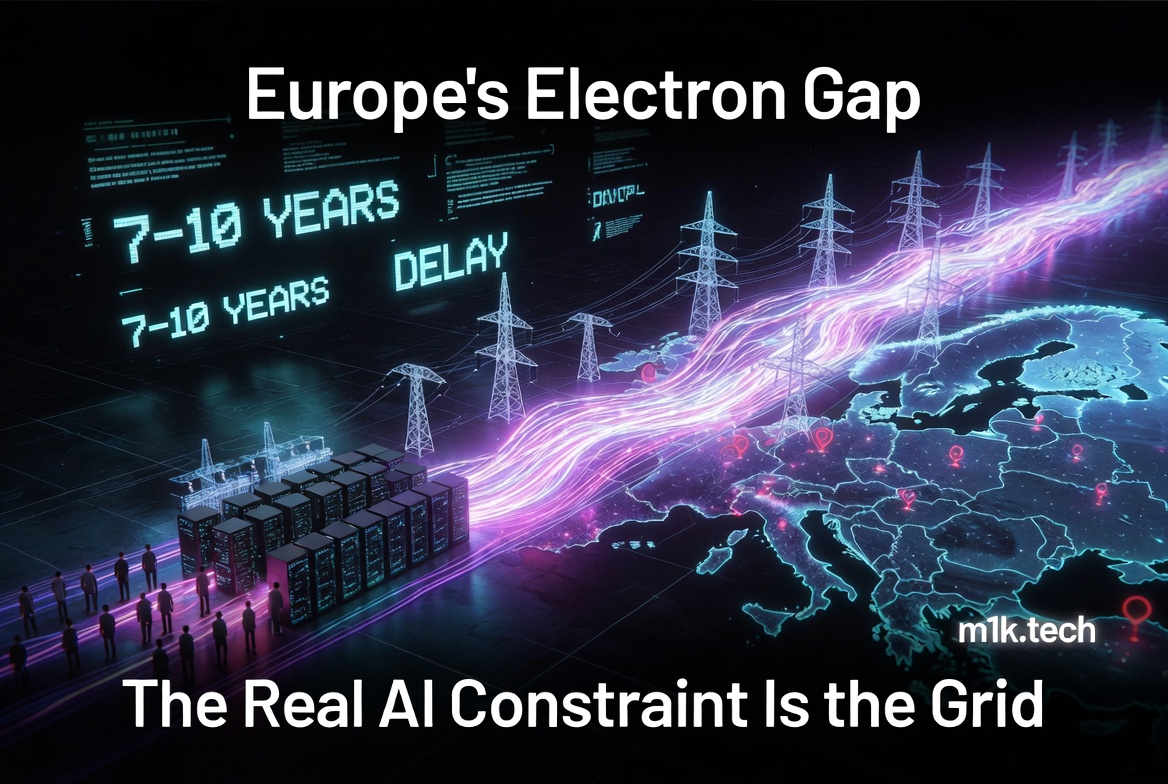
Order 100,000 of the latest AI accelerators today and a vendor will quote you a lead time measured in months. Ask a European grid operator to actually connect the 400 megawatts those chips need, in Frankfurt or Amsterdam or Dublin, and the honest answer is seven to ten years. That gap between how fast you can buy compute and how slowly you can power it is the whole European AI problem, and almost nobody shouting about it is looking at the right number.
The argument you hear everywhere fixates on price. European industrial electricity runs somewhere around two to two and a half times what the same power costs in the US or China, and that figure gets waved around as the reason the next hyperscale build lands in Texas instead of the Rhineland. It is a real gap. Germany sits near $0.18 per kilowatt-hour against roughly $0.08 in the US, which turns the annual power bill for a one-gigawatt data center into something like $1.6 billion in Germany versus $0.7 billion stateside. When a global investment strategist told CNBC in May that if he were building the next $7 billion data center it would go to the US or China, he was saying the quiet part with a shrug. The cost of securing capacity in Europe’s five biggest hubs, Frankfurt, London, Amsterdam, Paris and Dublin, is set to climb another 12% this year.
Here is where I part company with the consensus. The price gap is survivable, and the queue is not, and the two are constantly confused. If electricity were the binding constraint, you would expect it to dominate the build cost, and it does not. An AI data center is overwhelmingly capital expenditure: the GPUs and the IT gear and the concrete, with power a comparatively thin operating line on top. Run the German numbers and the electricity premium comes out around $700 to $900 million a year, which sounds enormous until you set it against the roughly $32 billion of GPUs sitting inside a gigawatt-class facility. Germany is even planning a subsidized industrial electricity price, retroactive to the start of 2026, that trims the gap further. A hyperscaler absorbs that premium out of margin and never blinks. The people insisting Europe cannot compete on power cost are, on the actual math, mostly wrong.
What they are right about is buried one layer down, and it has nothing to do with the price per kilowatt-hour. It is the connection. You can write a check for cheaper electrons. You cannot write a check that makes a transmission upgrade appear in less than the better part of a decade, and that is the wall every European AI build hits. Ember’s grid analysts put the average connection time in Europe’s legacy hubs at seven to ten years, and their headline finding is the one that should be keeping Brussels up at night: countries with lower grid congestion are already pulling in twice the data center growth of the saturated markets, and halving connection time alone would attract about 20% more. Demand for European data center power is projected to jump more than 150% between now and 2035. The grid the continent has today cannot carry that, and the queue to expand it is where the ambition actually dies.
How Europe talked itself into a grid problem
The compute build-out I walked through in the data center incentives piece was always the visible half of the story. EuroHPC caught Europe up on supercomputing, the AI Factories retrofitted what existed, and the seven gigafactories are meant to add frontier-scale capacity. Every one of those programs procures silicon on a schedule a vendor can hit. None of them procures a grid connection, because a grid connection is not something the Commission can put out to tender. It is a physical queue managed by national operators, and it moves at the speed of transformers, substations and rights-of-way, not press releases.
Mario Draghi’s September 2024 competitiveness report told Brussels bluntly that Europe was short on compute and needed to build capacity or accept second-tier status, and the whole gigafactory scramble is the answer to that warning. But Draghi’s diagnosis had an energy half that gets quoted less, because it is less flattering: European power is expensive, the grid is congested, and industrial users carry costs their American and Chinese competitors do not. The IEA has global data center consumption more than doubling to around 945 terawatt-hours by 2030, which is more than Japan’s entire electricity use today, and climbing toward 1,200 by 2035. Europe wants a real slice of the machines driving that curve. It is trying to plug them into a grid that was sized for a continent that stopped electrifying two decades ago.
The workarounds, and the one region that actually works
The smart response, which Ember spends most of its report arguing for, is to stop treating the grid as neutral plumbing and start treating it as the pull factor it obviously is. Offer phased connections so a site can energize in stages instead of waiting for the full upgrade. Offer non-firm connections that trade guaranteed power for a fast start. Designate priority AI zones and site the compute where the wires already have headroom. It is sensible, and it is slow, because it runs into the same permitting and planning machinery that created the queue in the first place. This annoys me more than the price debate does, because it is the fixable part and Europe keeps studying it instead of doing it.
The market is not waiting for the policy to catch up. Some developers are simply routing around the grid entirely, standing up on-site gas generation to power a build independently so they never join the interconnection queue at all, which is a fast fix that quietly torpedoes the clean-energy story Europe likes to tell about its data centers. And the money is voting with geography. The European Data Center Association has quantified what meeting this demand actually costs at roughly €176 billion cumulatively from 2026 through 2031, around €25 to 26 billion a year, and a growing share of it is flowing north. The Nordics are the exception that proves the whole thesis: Sweden pairs hydro baseload with wind to deliver spot prices around €40 to 60 per megawatt-hour with low volatility and, more importantly, connections you can actually get. Cheap power plus an available grid, in the same place, is the entire recipe, and most of continental Europe has neither half reliably.
What the US and China are doing with their electrons
The comparison that reframes everything is not really about who has cheaper power. It is about who treats the grid as a solvable problem. Texas is drowning in interconnection requests, something like 438 gigawatts sitting in the ERCOT queue, and its response was to invent a “Batch Zero” process to sort the serious projects from the speculative ones and get real capacity moving, with a first realistic transmission plan due later this year. That is a grid operator under enormous strain still building. The Trump administration is repurposing federal land to speed data center construction and sidestep exactly the permitting fights that will bog down every European bid. Whatever you think of the politics, the direction is unmistakable: clear the path and pour the concrete.
China is the more instructive case, because China is not trying to out-buy anyone on chips it cannot legally get. It is leaning on the one input it has in surplus. Beijing’s own energy administration projects data center electricity demand hitting the equivalent of 91 gigawatts by 2030, up from 19 last year, and the state has committed to eight mega-clusters out in the energy-rich west where the electrons are cheap, and the land is empty. The proof of concept already exists: Z.AI stood up a full one-gigawatt AI data center running exclusively on Chinese-made chips. I wrote about China building its own DUV lithography tools for exactly this reason, and the pattern is the same here. If you cannot buy the best accelerators, build adequate ones, feed them power nobody else can match, and brute-force the gap. Europe cannot copy that, because Europe leads on neither chips nor energy. It is the only one of the three racing on borrowed silicon and rented headroom.
The bid that is really a bet on RTE
You can watch the electron gap decide a real project in real time. The most interesting French gigafactory bid, ÆTHER, plans two campuses around Strasbourg that start at a combined 42 megawatts, aim to add another 40 within a year of commissioning, and target more than 400 megawatts long term. I dug into the consortium in the gigafactory breakdown, and the engineering is unmistakably European in the best sense, a sovereign CPU designer and a net-negative-carbon pitch on reused industrial land. But read the plan closely and every megawatt of that ramp is explicitly gated by whether RTE, the French grid operator, can actually deliver the power on schedule. The chips are the easy part. AMD, Nvidia and Qualcomm have all signed letters of intent to supply silicon. The whole timeline hangs on a grid connection, which is to say it hangs on the one thing no vendor can promise, and no subsidy can accelerate.
I am leaving the nuclear-and-SMR angle alone here, even though France’s fleet is the strongest card the continent holds and small modular reactors are the obvious long-term answer to co-locating power with compute, because that is its own post and this one is about the wire, not the generator. What I keep coming back to is that the entire European debate is aimed at the wrong target. Argue about price per kilowatt-hour all you like; a hyperscaler will eat that premium and move on. The thing that will actually decide whether Europe has frontier compute before the back half of the decade is not in any chip roadmap or any energy-price chart. It is a transformer sitting in a queue, and no amount of InvestAI money makes it show up faster. Buy all the accelerators you want. The grid is the sovereignty question nobody put on the slide.
Sources
- Ember, “Grids for data centres: ambitious grid planning can win Europe’s AI race”, 19 June 2025 (7 to 10 year connection times, +150% demand, congestion and growth figures)
- IEA, “Energy and AI, Executive summary” (945 TWh by 2030, 1,200 TWh by 2035)
- CNBC, “High energy prices could derail Europe’s AI race with U.S. and China”, 18 May 2026 (price gap, 12% capacity-cost rise, hub list)
- Philip Fox, “Electricity Prices: An Overrated Barrier to European AI Compute”, 8 April 2026 (CapEx-vs-power math, Germany $0.18 vs US $0.08, Industriestrompreis)
- Rabobank, “The great electrification: Can Europe power its AI ambitions?” (on-site gas generation to bypass the queue)
- EUDCA via Avanza Energy, “The $176 Billion Detour” (€176B 2026 to 2031 investment need)
- Forbes, “The Energy Transition Just Hit the Wall”, 30 June 2026 (ERCOT 438 GW queue, Batch Zero)
- techplustrends, “AI Data Center Energy Cost Europe: 2026 Market & Cost Guide” (Nordic spot prices)