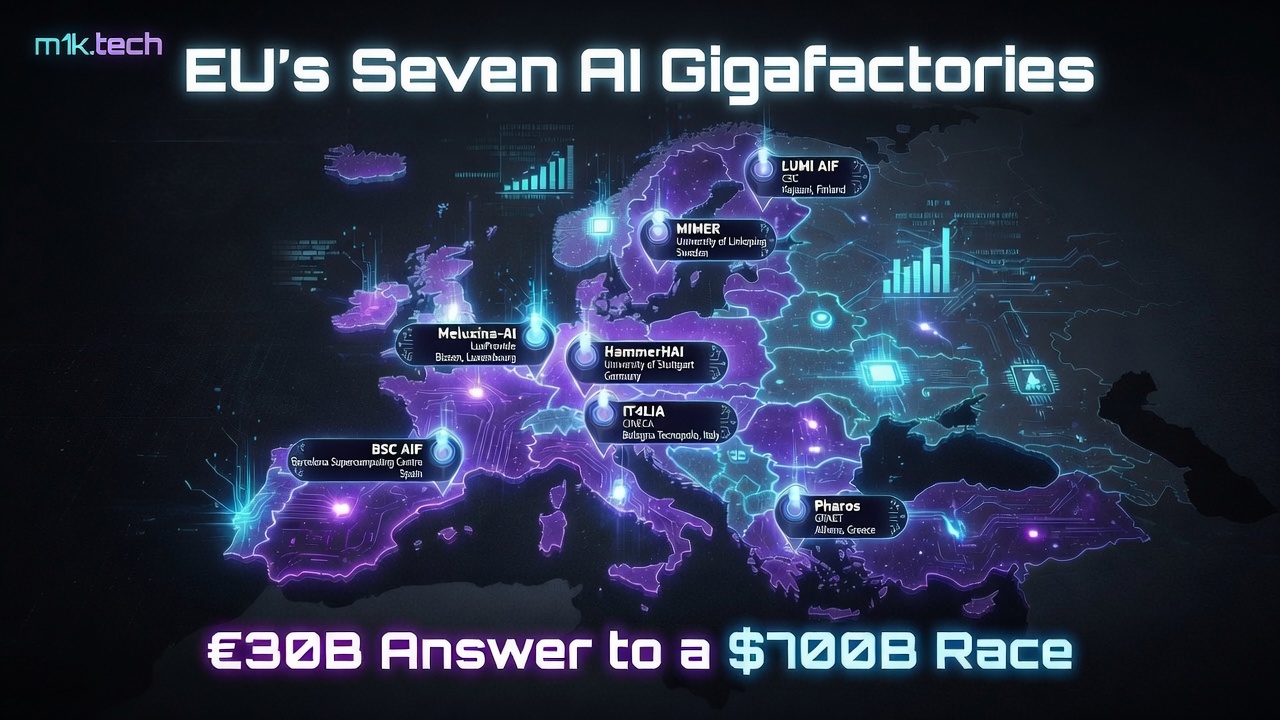
Ten billion euros of public money, seven AI Gigafactories, and a November 12 deadline, wrapped in a press release that leads with the number thirty billion. The gap between those two figures is the whole story, and to understand why it exists you have to go back further than this morning, because Europe has been circling this exact problem for the better part of a decade and keeps hitting the same wall.
The starting point is 2018, when the EU created the European High Performance Computing Joint Undertaking, EuroHPC for short, a funding vehicle whose entire job was to stop Europe embarrassing itself in supercomputing. It worked, up to a point. By 2022 LUMI in Finland and Leonardo in Italy had cracked the global top ten, and this past November JUPITER in Germany became Europe’s first exascale machine, briefly home to the world’s most efficient system. On paper the continent had caught up. The catch is that a classical supercomputer and an AI training cluster are not the same animal, and by 2024 it was obvious the EuroHPC fleet, superb at climate simulation and materials science, was the wrong shape for training frontier language models.
So in early 2024 the Commission bolted a new objective onto EuroHPC. The “AI Factories” amendment, proposed that January and in force by July, let the Joint Undertaking either retrofit existing supercomputers with AI-optimized hardware or build new AI-dedicated ones, bundled with support services for startups and researchers. The first calls went out in September 2024, and by October 2025 six AI Factories were live across the Czech Republic, Lithuania, the Netherlands, Romania, Spain and Poland, with a scatter of smaller “antennas” in seven more member states. That build-out is the 19-node network the Commission now points to when it says today’s gigafactories will more than double European AI compute. The AI Factories were the warm-up. They upgraded what already existed. They did not create the frontier-scale capacity Europe was missing, and everyone involved knew it.
The real pivot came on February 11, 2025, when Ursula von der Leyen stood up at the Paris AI Action Summit and announced InvestAI, a €200 billion umbrella to mobilize European AI investment, with a €20 billion slice carved out specifically for AI Gigafactories: net-new, frontier-scale, built to train the largest models rather than retrofit yesterday’s supercomputers. The Commission called it the largest public-private partnership in the world for trustworthy AI and wrapped it in the usual language of openness and cooperation. The original blueprint was four or five gigafactories at €3 to €5 billion each. A public consultation followed that April, and by summer the informal call for expressions of interest came back with a response that genuinely surprised me: 77 proposals from 16 member states across 60 different sites, collectively asking for something like three million GPUs. Demand was never the problem.
The plumbing took another year. In December 2025 the Commission signed a memorandum of understanding with the European Investment Bank group to help finance the builds. Then in January 2026 the Council amended the EuroHPC regulation again, the legal step that actually created gigafactories as a category, with rules for funding and procurement plus carve-outs to protect startups and scale-ups. Today’s call is the payoff of all of that, and it is also where the ambition quietly shrank. The number of factories went up, from five to seven. The public money went down, from a €20 billion fund to €10 billion in direct funding meant to crowd in €20 billion more. The €30 billion headline is the old €20 billion fund reframed, leaning much harder on private capital than the version von der Leyen sold in Paris. That is not a scandal, it is how European industrial policy works when money is tight, but the plan got more modest even as the press releases got more confident.
An AI Gigafactory is not a metaphor here. Each of the seven is meant to pack at least 100,000 of the latest-generation AI accelerators, roughly four times the compute of anything the bloc runs today, purpose-built to chew through trillions of parameters. The call runs through EuroHPC and is deliberately staggered into two consecutive procurement phases, which is a funding shortage dressed up as sequencing. Applications close November 12, winners get picked in early 2027, and the facilities are supposed to come online within roughly 18 months of signing, which puts the first real compute somewhere around 2028. Bidders can be consortia or special purpose vehicles, the sites can sit in one member state or straddle borders, and AMD, Nvidia and Qualcomm have all signed letters of intent to supply the silicon. I broke down how these subsidy programs stack up internationally in my data center policy piece, and this slots right into the pattern: public money de-risking private builds, with the state taking a smaller stake than the headline implies.
The “why now” is not about the technology, which has been ready for years. It is about fear, and the fear has a document. Mario Draghi’s September 2024 competitiveness report told Brussels in blunt terms that Europe was falling behind on compute and needed to expand capacity or accept permanent second-tier status. Henna Virkkunen, the Commission’s executive vice-president for tech sovereignty, has framed raw compute as a strategic necessity ever since, and the sovereignty language is doing heavy lifting. European leaders keep using the word “weaponized” about foreign tech, and between Trump’s open hostility to EU tech rules and China throttling critical-mineral supply, that fear is not paranoid. I have argued before that sovereignty really comes down to who controls the compute, the models, and the off switch, and the gigafactory call is Europe trying to buy back the first of the three, late, and with less money than it promised.
Where France actually stands
France is the one member state that has behaved as if it already believed the compute argument. Mistral runs one of the largest AI data centers in the EU today at its Paris campus, and while Le Chat has not kept pace with OpenAI or the Chinese labs, it is the closest thing Europe has to a frontier lab sitting on its own iron. On the eve of that same Paris summit, Macron turned the moment into a fundraising event and walked out with a private investment package worth roughly €109 billion earmarked for French AI. France has spent two decades trying to build exactly this kind of sovereign layer, with very mixed results, and the gigafactory call is the biggest test yet of whether the instinct finally has infrastructure behind it.
The concrete bid I would watch is ÆTHER. It is a fully European consortium built around SiPearl, the fabless designer trying to put a sovereign CPU under Europe’s supercomputers, alongside server maker 2CRSi (an Nvidia and AMD Elite Partner), AI-inference specialist Axelera AI, and a construction-and-energy backbone of Equans, Demathieu Bard and Nhood. The project company, ÆTHER Infrastructures, is in advanced negotiations to buy two industrial sites around Strasbourg, FR-SXB1 and FR-SXB2. Strasbourg is not a sentimental choice: it sits on the Rhine corridor, minutes from the European institutions, exactly the political optics Brussels wants stamped on a sovereignty project.
The engineering plan is the part that grabbed me. The two campuses start at a combined 42 MW of electrical capacity, aim to add another 40 MW within a year of commissioning, and target more than 400 MW long term, every megawatt of it gated by whether RTE, the French grid operator, can actually deliver the power. ÆTHER is also pitching itself as the first net-negative-carbon AI gigafactory, reusing existing industrial land instead of paving greenfield, which is a genuinely European answer to a problem most American builds just ignore. FR-SXB1 is meant to be operational during 2027, ahead of the EU’s own timeline, assuming the site acquisition closes by the end of October. That is a lot of weight resting on a grid connection, and grid connections are precisely where European data center dreams go to die.
This is the same reflex I watched when France started racing to protect its quantum startups before they got bought out from under it. The French position is consistent across compute and quantum: build the sovereign layer at home, keep the crown-jewel IP on French soil, treat infrastructure as national rather than something you rent from a server farm in Virginia. Whether that instinct survives contact with a grid queue is the open question.
The number that makes all of this look small
Here is where I deflate a little. The entire EU program, €30 billion in the optimistic scenario where private money shows up, is smaller than what a single American project spends. Stargate, the OpenAI, SoftBank, and Oracle build, carries a $500 billion ambition on its own. Widen the lens to the big five US hyperscalers and 2026 capex is forecast north of $600 billion for the year, about three-quarters of it pouring straight into AI infrastructure. Goldman’s baseline has US AI capex around $765 billion this year and climbing toward $1.6 trillion by 2031. Europe’s flagship intervention, spread across seven factories and six and a half years, is a rounding error next to a fortnight of American spending. The Trump administration is now repurposing federal land to speed data center construction, sidestepping the permitting fights that will bog down every European bid. The asymmetry is not close.
China is the more instructive comparison, because China is not trying to out-buy the US on chips it cannot get. It is leaning on the one resource it has in surplus: electrons. Beijing’s energy administration projects data center electricity demand hitting the equivalent of 91 gigawatts by 2030, up from 19 last year, and the state has committed billions to eight mega-clusters out in the energy-rich west. The tell came when Z.AI stood up a full one-gigawatt AI data center running exclusively on Chinese-made chips. That is the strategy Europe cannot copy, and the US keeps underestimating: if you cannot buy the best accelerators, build your own, feed them cheap power, and brute-force the gap. I wrote about China building its own DUV lithography tools for exactly this reason, and the gigafactory call is Europe arriving at the same logic a couple of years late, with a fraction of the energy headroom.
The framing Brussels will not say out loud is the electron gap. The US leads on chips and China leads on energy, and Europe leads on neither. Every gigafactory bid hinges on grid connections that take three to five years to deliver, on a continent carrying the highest industrial power prices of the three. You can procure 100,000 accelerators on a schedule. You cannot procure a 400 MW grid upgrade the same way, which is why ÆTHER’s whole timeline hangs on what RTE says, not on what any chip vendor promises.
What actually happens next
The near-term calendar is tight. Bids are due November 12, the Commission evaluates competitively and names winners in early 2027, and phase two of procurement opens after that to build capacity gradually across the following years. First real compute is targeted for around 2028, assuming grid connections and site acquisitions land on schedule, which in this sector is a heroic assumption. The honest reading is that Europe will not have frontier-scale sovereign compute online before the back half of the decade, by which point the US hyperscalers will have spent well past two trillion dollars, and China will be pushing beyond 90 gigawatts of data center draw. On this timeline, the gap does not close. At best it stops widening.
For the enforcement angle and the transparency rules landing this weekend, I broke the AI Act down separately. What I keep coming back to is that the gigafactory call is the right instinct arriving late and shrinking on the way. Seven factories that double European compute is a real, useful thing, and I would rather Brussels do this than nothing, especially with a bid like ÆTHER trying to prove Europe can design its own CPU and build and power the campus without importing the whole stack. But calling €10 billion of public money a €30 billion program, then racing a US build-out that burns the entire European commitment every ten days, is not sovereignty. It is a down payment on it. Whether ÆTHER’s Strasbourg campuses actually get their power from RTE on schedule will tell you more about Europe’s AI future than any figure in that press release.