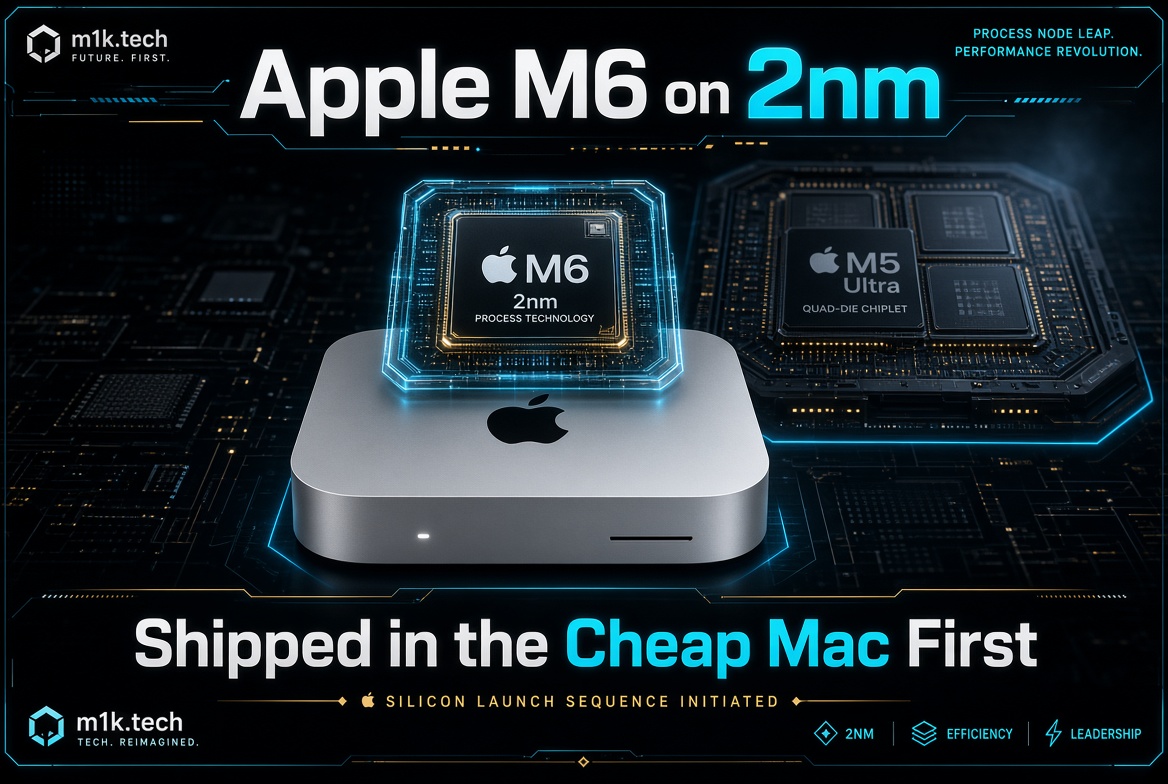
Apple’s M6 chip is a 2-nanometer part, and it launched Tuesday inside an $899 Mac mini, not the machine anyone would have guessed gets the flagship node first.
The M6 carries a 12-core CPU with two super cores, four performance cores, and six efficiency cores; a 12-core GPU with a neural accelerator built into every core; and what Apple is calling a Dual 16-core Neural Engine. Apple’s own numbers are the usual mix of real and unverifiable: the world’s fastest single-threaded performance, up to 30 percent more peak GPU compute for AI work than the M5, up to 170GB/s of memory bandwidth, capped at 32GB of unified memory on this tier. None of that has been independently benchmarked yet. All of it is plausible for a full node jump.
What is actually interesting is where Apple put it. The Next Web reported back in June that this generation would skip a Pro or Max tier entirely for now and lean on the M5 Ultra as a stopgap, and that is exactly what shipped Tuesday. The base Mac mini gets the new node. The higher tier of the mini lineup still runs the older M5 Pro. Debuting a 2-nanometer chip in an $899 consumer box while the workstation tier runs on last generation’s silicon is not how Apple usually sequences a launch, and it suggests the M6 was ready before whatever comes next for the Pro and Max dies was.
The M5 Ultra is the stranger machine of the two. It is Apple’s first quad-die design, two dual-die M5 Max chips fused through UltraFusion at more than 4.4TB/s between them, landing at up to 36 CPU cores, 80 GPU cores, and 512GB of unified memory at 1.2TB/s. Apple has spent a decade insisting its chips stay monolithic wherever it can manage it and stitching dies together only when it has no other option. A quad-die Ultra is Apple formally catching up to the chiplet turn the rest of the AI hardware industry made years ago, where nobody building at this scale is still betting the whole return on one reticle-limited die.
Half a terabyte of unified memory is arriving in the middle of a DRAM shortage that has already emptied Mac shelves and pushed prices up across Apple’s own lineup, the same shortage that had Apple testing memory chips from CXMT this summer and put a hundred dollars on the price of Samsung’s foldables. Apple is shipping its most memory-hungry machine ever at the exact moment memory is the most expensive input in the industry. That reads either as confident timing or as no timing at all, and Apple is not saying which.
Apple says the M5 Ultra can run models with hundreds of billions of parameters entirely on device, and that line is going to matter more in Europe than the spec sheet does. A model that never leaves the machine is a model that never has to answer a data residency question, which is a different kind of selling point than raw throughput. I do not think Apple built the M5 Ultra with European regulators in mind first. I think it gets sold that way anyway, because right now every hyperscaler’s sovereignty pitch depends on convincing someone the cloud is the risk, and Apple just shipped a machine that skips the argument entirely.
I am not spending time here on how this 2-nanometer debut lines up against the angstrom era roadmap TSMC has been racing toward, that comparison deserves its own post once yields are public. What I will say is that this is likely Tim Cook’s last major product launch before John Ternus takes over as CEO, and an $899 Mac mini is an unusual machine to close a tenure on. Maybe it is fitting. The mini has been Apple’s testbed for exactly this kind of AI workload repositioning for two years running, and it got the new silicon before the machines with Apple’s name on the showroom floor did. I will trust the M6’s numbers once someone outside Cupertino runs them, and until then the sequencing is the actual story here, not the chip.
Sources
- The Verge, Apple’s new M6 chip gets more cores and more AI compute, August 25, 2026
- TechCrunch, Apple debuts its most powerful chip ever in M5 Ultra and M6, August 25, 2026
- The Next Web, Apple unveils M6 and M5 Ultra chips with a big jump in AI performance, August 25, 2026
- Reuters, Apple launches faster Mac mini, Mac Studio to tap AI boom, August 25, 2026