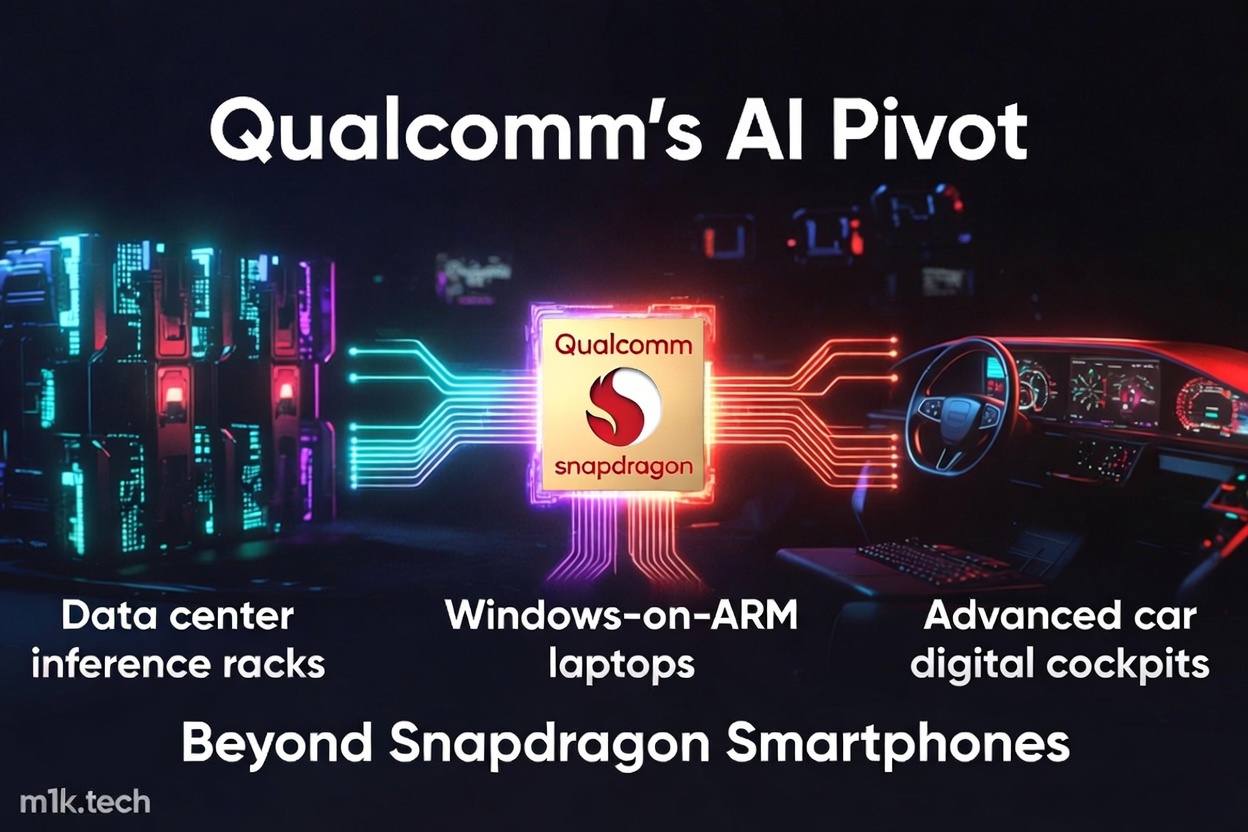
Apple has been quietly building its own cellular modems for years, and the C1 that shipped in the iPhone 16e was the warning shot. Qualcomm’s single most profitable relationship, the modem inside every iPhone, has an expiration date on it now, and everyone in San Diego knows it. So when Qualcomm spends a keynote talking about on-device AI, data-center inference, and car cockpits, I don’t read that as a company chasing shiny objects. It’s a company that ran the numbers on where its revenue goes the day its biggest customer walks, and decided it needed new legs to stand on before the old one gives out.
That reframes everything they’ve shipped this past year. It stops looking like a product roadmap and starts looking like an escape plan. And the interesting question was never whether the individual chips are any good, because mostly they are. It’s whether Qualcomm’s one real advantage, doing more compute per watt than anyone else in the business, survives contact with markets where the incumbents are dug in far deeper than any smartphone rival ever was.
Start where they’re strongest. The Snapdragon 8 Elite Gen 5, which Qualcomm unveiled at its Maui summit last September, is the best Android SoC you can buy, and on the CPU it isn’t close. Third-generation Oryon cores on TSMC’s N3P node, a prime core knocking on 4.6 GHz, and real-world Geekbench 6 runs around 3,830 single-core and past 12,400 multi-core. That beats MediaTek’s Dimensity 9500 on both counts and sits a hair behind Apple’s A19 Pro on single-thread while pulling ahead on multi. The Adreno GPU finally has ray-tracing stamina worth the name, but the Hexagon NPU is the part Qualcomm wants you staring at, because the whole generational pitch is that your phone runs a sizable language model locally instead of round-tripping to a server.
I like that pitch. Making an image or translating a live conversation without shipping your data to someone else’s cloud is a real privacy and latency win, and the quantization-aware training and model compression that shrink a model enough to fit a phone’s memory budget are clever engineering that took years to mature. Here’s the problem with it as marketing: it isn’t Qualcomm’s pitch. Apple sells the same story as Apple Intelligence, with a 16-core Neural Engine and neural accelerators wired into every GPU core. MediaTek sells it too, running the Dimensity 9500’s NPU math inside the memory arrays to kill the energy wasted shuttling data around, and pricing it as a value flagship. When three vendors on the same 3nm process all promise on-device generative AI, the NPU spec sheet stops being a differentiator, and phone-buying collapses back to what it always was: which ecosystem already has you, and how hot the thing gets under sustained load. Qualcomm wins the benchmark. It doesn’t win the argument, because there isn’t one left to win.
Everything to this point is a mature market Qualcomm already leads. The money, and the real danger, sits somewhere it barely has a toehold.
Qualcomm’s Cloud AI 100 is its bid for the data center, and the first thing to get straight is what it actually is: an inference accelerator, not a training chip. That distinction is the whole strategy, and the version of this story I keep seeing, the one where Qualcomm “takes on NVIDIA in training,” has it backward. Nobody takes on NVIDIA in training right now. In the merchant market, NVIDIA holds north of 90% of training silicon, and the reason isn’t the hardware; it’s CUDA: close to two decades of libraries and hand-tuned kernels, plus four-million-odd developers whose muscle memory is a moat no spec sheet crosses. As graphics processors matured beyond gaming into general-purpose compute, that software layer, not the transistor count, became the part you simply couldn’t buy your way past.
Inference plays by different physics. NVIDIA’s share there runs closer to 60-75%, not 90-plus, because serving a trained model is more predictable and far more price-sensitive, and it leans much less on hand-optimized kernels. And inference is now roughly two-thirds of all AI accelerator spending, inside a market pushing past $200 billion. That is the crack, and it’s a wide one. It also happens to be the exact shape of Qualcomm’s mobile DNA, because inference at scale is a performance-per-watt problem, and squeezing compute out of a tiny thermal budget is the one game Qualcomm has been winning for fifteen years, the same efficiency discipline enterprise IT ran into as its workloads moved to the cloud.
Here’s why I’m still not betting the farm. Qualcomm wasn’t the only one who spotted the inference crack, and the fight there is vicious in a way phones never were. The real danger to NVIDIA in inference isn’t a merchant chip at all; it’s custom ASICs: Broadcom-designed accelerators, Google’s TPUs, Amazon’s Trainium, silicon the hyperscalers build for themselves and owe no vendor a dime for. Those are on track to swallow something like a third of inference deployments. Then there’s the detail that should keep Qualcomm’s strategy team up at night. Groq, the best-funded pure-play inference challenger going, the company everyone pointed at as NVIDIA’s actual disruptor, got bought by NVIDIA for around $20 billion at the tail end of last year, a month or so before NVIDIA rolled out its Vera Rubin platform. When the incumbent can just acquire the disruptor and fold it in, “we’re more efficient than an A100” stops being a strategy and turns into a pitch deck for getting acquired. Qualcomm has real inference silicon and a real efficiency argument. What it doesn’t have is a software ecosystem anyone has built a career on top of, or a hyperscaler’s balance sheet to self-fund its own chips, and in this market one of those two is the cover charge.
I owe Qualcomm a partial retraction on this one. I’ve spent years skeptical of ARM on Windows, because every earlier attempt felt like a demo that came apart the second you opened something real. The Snapdragon X2 Elite, which reviewers finally got in April, is where that skepticism broke.
The numbers aren’t subtle. Up to 18 Oryon cores at 5.0 GHz, an 80 TOPS NPU, single-core scores running about 30% ahead of Intel’s Panther Lake flagship, and a 35% single-core jump over the prior Snapdragon generation while pulling 43% less power. Independent testing has the X2 Elite Extreme beating a base Apple M5 by roughly a quarter in multi-core rendering and transcode work. The efficiency piece is the one that actually changes the daily experience: you keep 97 to 99% of that performance unplugged, right where an Intel laptop quietly throttles itself to save its battery. Canalys reckons ARM could take up to 30% of the PC market by year-end, up from around 13% in 2025, and for the first time that forecast doesn’t read as vendor wishful thinking.
I won’t pretend the caveats evaporated, because one of them is a wall. Gaming still breaks on Windows on ARM, and it breaks structurally: most games are x86, they run through Microsoft’s Prism translation layer, and that overhead lands hardest exactly where you have no headroom to spare. Intel’s Panther Lake integrated graphics clear 55,000 in Geekbench OpenCL against the X2’s roughly 45,000, and the anti-cheat drivers gating multiplayer titles still won’t load cleanly under emulation. Apple’s M5 keeps a real single-core lead on top of that, and the M5 Max simply walks off with the high end. So the fair read is narrower than the launch noise: if your day is a browser, Microsoft Office, and whatever’s already been recompiled for ARM, the X2 Elite is now a better thin-and-light than the Intel equivalent and a straight-faced alternative to a MacBook. If you game, or you’re welded to a legacy x86 enterprise app from an earlier era of corporate IT with a driver nobody has touched in fifteen years, it’s still a non-starter, and no amount of Prism tuning changes that this year.
Automotive is where the efficiency-and-integration story pays off cleanest, and also where it slams into the hardest ceiling. The cockpit, everything from the center screen to the voice assistant, is effectively Qualcomm’s already. Snapdragon Cockpit Elite has become the default for premium EV dashboards, with design wins running across BMW, GM, Stellantis, the Sony-Honda Afeela, and the VW Group, and the automotive line is compounding somewhere around 35% year over year. That win landed the way every Qualcomm win lands: they put the 5G modem, the Wi-Fi, the V2X radio, and the compute on a single power-sipping SoC, while NVIDIA, carrying its gaming-GPU thermal habits into the cabin, needs separate parts to keep up.
The ceiling is actual autonomy. Level 4 driving wants something between 1,000 and 2,000 TOPS of perception compute, and that is NVIDIA’s home court. Drive Thor rides the same Blackwell architecture as its data-center silicon, ships with the Omniverse simulation stack attached, and has already locked up the Chinese EV wave: BYD, XPeng, Li Auto, Zeekr. Thor also folds cockpit and ADAS onto one die, which is a direct shot at the integration edge Qualcomm has been selling as its differentiator. And Mobileye is still parked in the third chair with a turnkey perception stack that lets a nervous automaker outsource the entire hard problem. Qualcomm owns the part of the car you touch. Whether it ever owns the part that drives is a far longer bet, and I wouldn’t call it yet.
So here’s where I land. The pivot is real, necessary, and the correct read of a future where the smartphone annuity is running down. The efficiency edge is legitimate, and it travels further than I expected: it already took the car dashboard, it just made Windows on ARM viable, and it earns Qualcomm a seat at the one data-center table, inference, where NVIDIA can actually be beaten. But “a seat” is the ceiling I keep smacking into. In every market that matters most, somebody is dug in behind a moat that silicon alone doesn’t cross: CUDA in the data center, ecosystem gravity in phones, raw compute plus Omniverse in autonomy. Efficiency gets you invited to the table, but on its own it has never once won it.
I’m leaving the patent-licensing machine out of this, the QTL royalty business that quietly bankrolls all of it and drags its own regulatory baggage behind it. For now I’ll say the chips are better than the strategy, and the strategy is better than the odds.