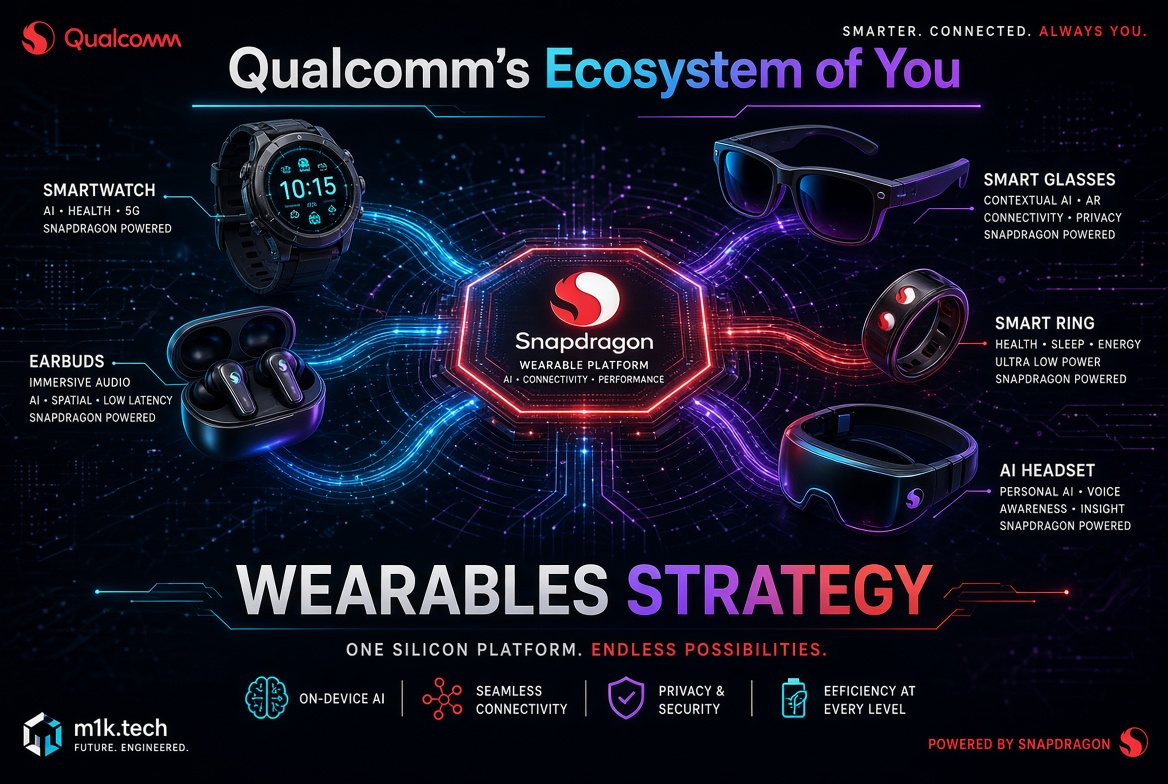
Qualcomm’s Ziad Asghar gave an interview this week that reads like a slide deck with the bullet points sanded off. The pitch, which Qualcomm is calling Ecosystem of You, is that your watch, your earbuds, your ring, and your glasses should all run on Qualcomm silicon and talk to each other, the same way your phone already does. That’s a real strategy, not just a slogan, because the chips backing it already ship: Snapdragon 8 Elite Gen 5 in the phone, Snapdragon Wear Elite in the watch, Snapdragon AR1 Gen 1 in the glasses. Samsung’s entire recent Unpacked lineup runs that exact stack, which is presumably why Qualcomm picked this week to say the quiet part out loud.
What actually stopped me scrolling was two names buried a few paragraphs in: Motoko, described as an AI headset, and Maxwell, a wearable tied to Motorola’s Qira assistant. Neither has shipped. Neither has a spec sheet. I have no idea what Motoko even is beyond the name, which sounds like it’s trying to borrow some Ghost in the Shell credibility it hasn’t earned yet. But naming unreleased hardware inside a strategy interview is a specific kind of confidence, the kind that says we’re far enough along that hiding it costs us more than revealing it does.
I’ve written before about how much of Qualcomm’s 2026 comes down to the same move twice already, a data center push that’s really an inference bet dressed up as a training story, and an Arm license fight that turned out to be about control rather than dollars. Now it’s happening a third time with wearables, an argument for buying one company’s silicon across your entire body instead of picking the best chip for each device. The pattern across all three is the same. Qualcomm keeps trying to sell the platform instead of the part, and the platform pitch only works if you already trust the company enough to pre-commit to hardware that doesn’t exist yet.
I’m split on whether that trust is earned here. On one hand, the AR1 Gen 1 chip has already proven itself twice over; it’s the same silicon running Samsung’s glasses and Meta’s Ray-Bans, so Qualcomm isn’t asking me to believe in vaporware when it comes to the eyewear leg. On the other hand, Motoko and Maxwell are exactly the kind of unnamed, unshipped concept product that gets quietly dropped a year later with nobody outside the company ever explaining why. I’ve watched that happen with wearables before, and Qualcomm doesn’t have a spotless record on shipping every concept it teases at a strategy briefing.
I’m not going to speculate on what Maxwell actually looks like- a watch, a pendant, something stranger- there’s not enough here to guess responsibly, and I’d rather be wrong by omission than wrong by making something up. What I will say is that tying it to Motorola’s Qira assistant is the more interesting half of that pairing, because Qira is Motorola’s own bet on an on-device AI agent, not Qualcomm’s.
What I’ll actually be watching for is whether Qira ships attached to Maxwell as hardware, or ships as software first and picks up a device later. That order tells you whether this is a real product roadmap or a chip vendor borrowing a partner’s AI story to make its own wearables pitch sound more finished than it is.
Sources
DigitalToday, “Qualcomm outlines blueprint for personal AI era with ‘Ecosystem of You'”, August 10, 2026