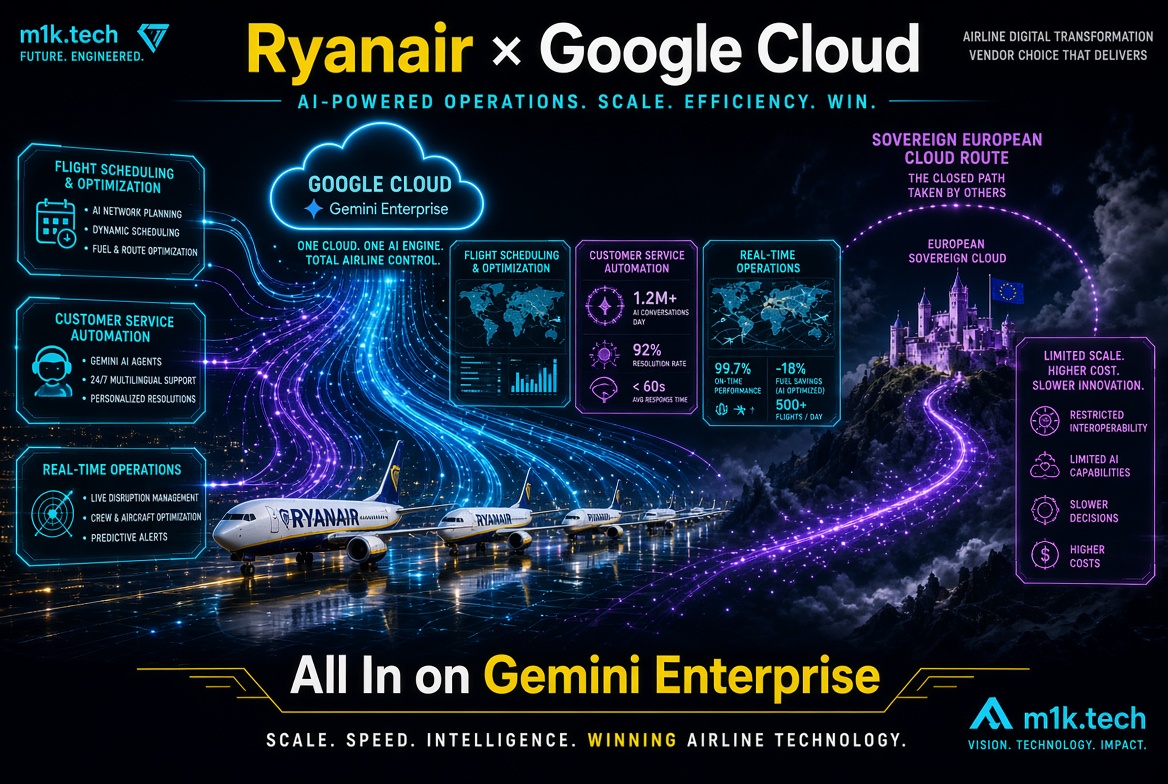
Ryanair signed a five-year deal this week, making Google Cloud, Google Workspace, and Gemini Enterprise the backbone for all 35,000 of its employees, tied explicitly to a target of carrying 300 million passengers a year by 2034. That’s roughly double where the airline sits today. Five years is a long runway to bet the operational stack on one vendor, and Ryanair picked the biggest possible vendor to bet it on.
What makes the timing interesting to me isn’t Ryanair; it’s who did the opposite thing recently. Airbus moved critical workloads off AWS and onto a French sovereign cloud, a decision I’d file next to the AXA Copilot retreat as part of the same pattern: European companies quietly walking back from US hyperscalers over data control concerns, even when the US platform is technically superior or cheaper. Ryanair looked at that same European sovereignty conversation and did the complete opposite, doubling down on Google rather than hedging away from it.
I don’t think Ryanair is being reckless here, and I don’t think Airbus was being paranoid either. They’re just optimizing for different things. Airbus builds aircraft that European governments buy with defense budgets attached, so sovereignty over the data stack is close to a contractual necessity, not a preference. Ryanair sells cheap seats to people who mostly care whether the flight is on time. Nobody’s canceling a Ryanair booking because the backend runs on Gemini Enterprise instead of a Toulouse data center. The sovereignty premium only makes commercial sense when your customer base, or your regulator, actually prices it in.
That’s the tension I wrote about with Mistral and Microsoft a couple weeks back: the European sovereignty push isn’t one unified movement with one outcome, it’s a company by company calculation, and the answer keeps coming out different depending on who’s asking and who’s paying. Ryanair’s answer this week is that scale and AI tooling win, sovereignty loses, at least for a budget airline chasing 300 million passengers with a workforce that needs Gemini doing the boring parts of scheduling and customer service so humans can handle the parts that actually require judgment.
The part I’d flag as a real risk, separate from the politics, is concentration. Five years is long enough for Google Cloud pricing, terms, or product direction to shift in ways Ryanair can’t easily unwind once 35,000 employees and a decade of workflow tooling are built around Workspace and Gemini specifically. Airlines already learned this lesson once with reservation systems that took decades to migrate off. Betting the next chapter of that lock-in on an AI platform that’s maybe three years old as a mature enterprise product is a different kind of risk than the sovereignty debate captures, and it’s the one I’d actually worry about if I were Ryanair’s board.
Whether this ages well depends entirely on Google actually delivering the operational efficiency Ryanair is presumably paying for. I don’t have visibility into the contract terms, so I can’t tell you if this was a good deal. I can tell you it’s a clean, real-time data point in a debate that mostly runs on theory: when a major European company gets to choose between more sovereignty and more scale, at least one of them just chose scale, loudly, in public, the same month everyone else is arguing about the opposite.
Sources
- The Next Web, Ryanair signs five-year AI partnership with Google Cloud, August 12, 2026