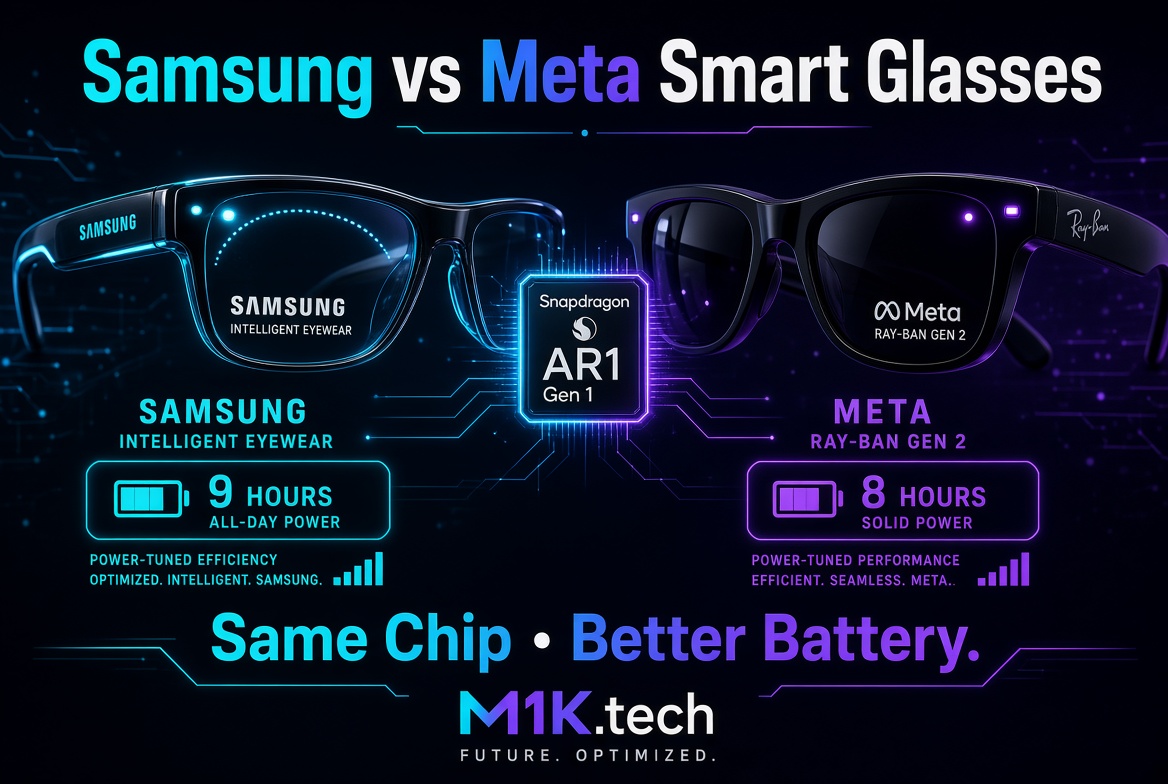
Nine hours on a charge, one more than Meta’s Ray-Ban Gen 2, is the number Samsung has been circulating since Galaxy Unpacked. It’s also almost entirely manufactured, in the sense that both devices are running identical silicon under the hood.
I mean that literally, and it’s the framing that surprised me more than the number itself. Samsung’s Intelligent Eyewear and Meta’s Ray-Ban both ship on the same Snapdragon AR1 Gen 1 chip Qualcomm first shipped back in 2023, which means the extra hour Samsung is claiming has nothing to do with new hardware and everything to do with power tuning. Neither company publishes a battery capacity in milliamp hours, so there’s no way yet to know whether Samsung’s case genuinely holds more cells or its firmware is just less wasteful, but the framing matters: this is the first smart glasses generation where the chip stopped being the differentiator and the software stack became the whole argument.
I keep coming back to the case math, because the underlying claims aren’t even measuring the same thing. Samsung’s charging case is rated for seven additional full charges; Meta’s Gen 2 case covers about six over its 48-hour window. Samsung says its nine hours holds up under active use: Gemini Live, music, notifications, video recording, all running at once. Meta’s eight hours is rated for “typical use,” and the company’s own documentation admits the number drops to five hours with continuous audio or calls. Compare the marginal case instead of the marketing case and Samsung’s advantage widens considerably.
Where this gets more interesting than a spec sheet is what Samsung bundled in alongside the battery claim, because it’s the same list of features that’s been driving the trust conversation this whole category has been having for weeks now. Both devices carry a recording LED that can’t be defeated: no video captures if it’s blocked or taped over. Samsung goes further. Point the glasses at a whiteboard and it pulls the contents straight into Samsung Notes, and Gmail, Calendar, and Maps all work day one, which is more than Meta can say since even its Display model runs navigation on Meta’s own mapping instead of Google’s.
And then there’s the part nobody at either company is putting in a press release. A GSMArena reader poll this week found fewer than 5% of respondents are actively using smart glasses at all, and the comments did most of the talking: people calling camera-equipped glasses creepy, some saying outright they’d shun anyone wearing a pair in public. That’s the Google Glass “glasshole” stigma resurfacing more than a decade later, on hardware that looks nothing like the 2013 original. Meanwhile in Australia, Kmart’s AU$89 Anko camera glasses sold out fast enough that the federal Attorney-General asked the privacy commissioner for an urgent review of whether the country’s fragmented privacy law can even reach the problem. Mostly, it can’t. The Privacy Act covers what companies do with the data, not what a person wearing the glasses does with footage of someone else, and consent-to-record rules vary state by state. Two legal academics laid this out plainly over the weekend, and buried in their piece is the detail that stuck with me: Meta is reportedly working on “super-sensor” glasses that record even when nobody is actively interacting with them.
That’s the gap Samsung’s battery claim doesn’t close and can’t. Meta still holds the overwhelming share of this market, Samsung and Google are both entering with real backing and Qualcomm has its next-generation XR silicon already lined up behind both of them, and none of it explains why fewer than one in twenty people who saw that GSMArena poll bothered to say yes. An extra hour of battery is a real, measurable win. I don’t think it’s an answer to the question everyone watching this category actually has about a camera on someone’s face.
Sources
- SlashGear, “Samsung Says Its Smart Glasses Will One-Up Meta’s On Battery Life”, August 8, 2026
- GSMArena, “Weekly poll results: smart glasses are a solution looking for a problem”, August 9, 2026
- 1News NZ / The Conversation, “Do current privacy laws protect us from the risks of smart glasses?”, August 9, 2026