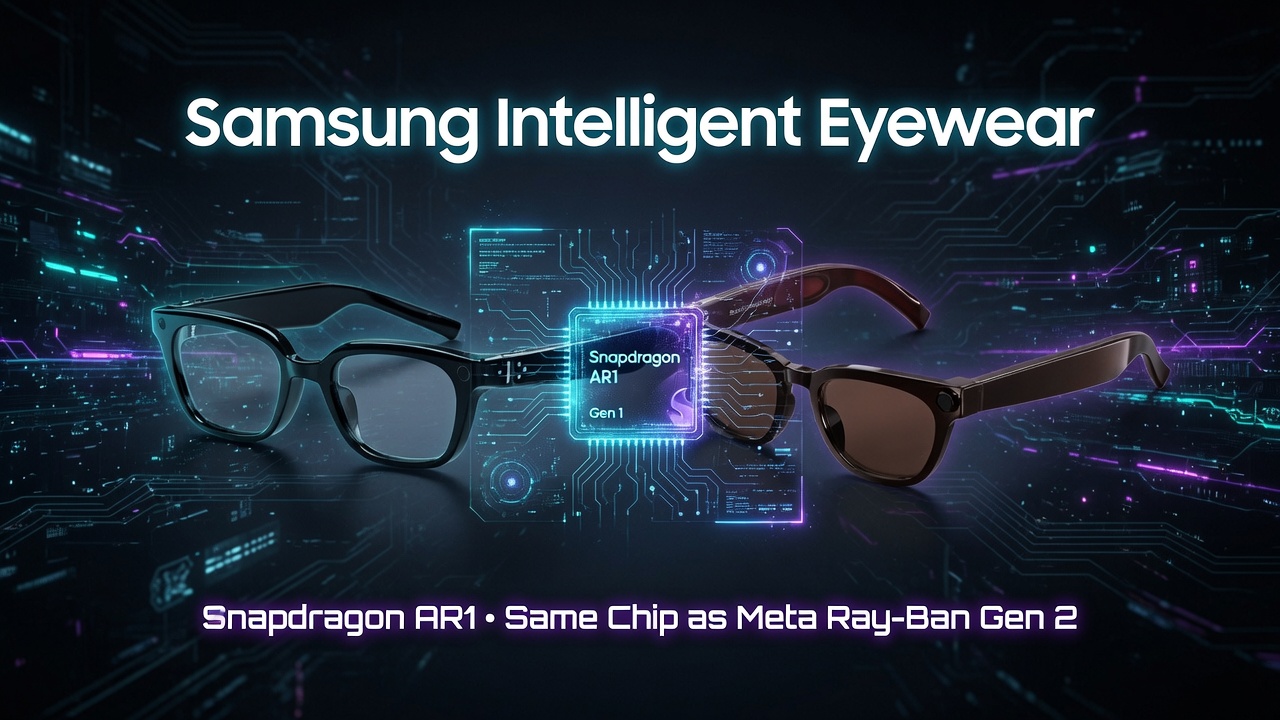
Samsung intelligent eyewear landed at Galaxy Unpacked in London today, and the specification that tells the real story is not the camera, the nine-hour battery, or the Gemini integration everyone is leading with. It is the processor. Samsung is shipping a Qualcomm Snapdragon AR1 Gen 1, which is the same part Meta put inside Ray-Ban Gen 2 in September 2023.
Three years is a long time in mobile silicon. In that window Qualcomm has moved its phone platform through several generations and rebuilt its XR line from the ground up. Yet the second genuinely serious entrant into AI glasses, from a company with its own foundry, its own Exynos program, and every reason to differentiate on silicon, picked the chip that was already there. I wrote about the AR1 when it first appeared in Ray-Ban Gen 2, and the argument then was that Qualcomm had quietly built the reference design for a category nobody had proven yet. Samsung just confirmed it.
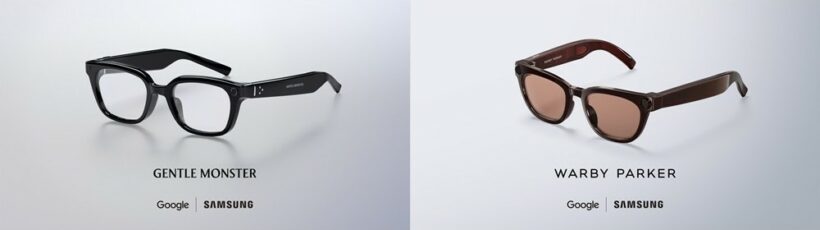
Here is what Samsung actually announced. The glasses run Android XR with Gemini and Bixby, weigh roughly 50 grams, and carry a 12-megapixel Sony IMX681 camera with autofocus, open-ear directional speakers, dual microphones, and Bluetooth 5.3. Battery is quoted at up to nine hours, with a case that holds around seven more full charges. There is a hardware LED that lights whenever the camera is recording, an action button, and a physical power switch. Paired with a Galaxy Watch9, you can drive the thing with hand gestures. Frames come from Gentle Monster and Warby Parker, with wider collections promised this fall. Samsung is calling the product intelligent eyewear; the leaks have been calling it Galaxy Glasses, and the internal codename doing the rounds is Jinju.
No display. No lens projection, no waveguide, no overlay of any kind. This is an audio-and-camera device with an assistant attached, which puts it in exactly the same product class as the Ray-Ban line rather than the class Samsung’s own headset work has been pointing at. That is a deliberate choice, and I think it is the correct one. Waveguides are where the weight, the cost, and the battery drain live. Skipping them is how you get to 50 grams and a price that normal people might pay.
The competitive picture is harsher than the launch coverage suggests. When I looked at this category in March, Meta was sitting above eight units in ten, and current estimates put it closer to 84 percent on more than seven million units shipped through 2025. Meta also has three years of iteration, EssilorLuxottica’s distribution, and a starting price that has come down to around $299. Samsung has not announced pricing, but the leaked range is $379 to $499. So Samsung is entering late, on the incumbent’s silicon, at a higher price, against a rival with the optical retail network already built.
What Samsung does have is the assistant and the ecosystem. Gemini against Meta AI is not a close contest right now, and the cross-app continuity into Maps, Calendar, and the rest of Google’s surface is a real advantage rather than a marketing line. The autofocus camera beats Meta’s fixed-focus module. And unlike almost everything else Samsung ships, these work with an iPhone, which matters more than it sounds.
The strategic read for me is about where Android XR has ended up. Google and Samsung built that platform for headsets, and the headset story has been slow. The eyewear story is the one with volume behind it, and now the platform has a shipping device in the segment that is actually selling. Qualcomm sits underneath both, which is the position it has been engineering toward for years. Snapdragon Reality Elite was the loud version of that ambition; the AR1 quietly showing up in every serious pair of glasses on the market is the version that pays.
The thing I will be watching is whether Samsung refreshes the silicon before launch (I don’t think so on this one). Shipping a 2023 part in a late-2026 product is defensible for a first generation, particularly when the workload is voice and a camera pipeline rather than rendering. It becomes much harder to defend in the second generation, especially if Qualcomm puts a newer XR part on the table and Meta takes it first. Samsung has bought itself a seat in this category. It has not yet bought an advantage.
Sources
- Samsung Newsroom, Galaxy Unpacked 2026 intelligent eyewear announcement, 22 July 2026
- TelecomLead, Qualcomm Snapdragon powers Samsung Galaxy Z Fold8, Z Flip8, Watch9, Ultra2 and XR smart glasses, 22 July 2026
- Tech Times, Samsung Galaxy Glasses land in a market that just banned smart glasses from courts, 22 July 2026
- The Shortcut, Samsung unveils two new pairs of smart glasses from Warby Parker and Gentle Monster, 22 July 2026
- Hindustan Times, Samsung reveals Intelligent Eyewear with Gemini AI and Android XR, 23 July 2026