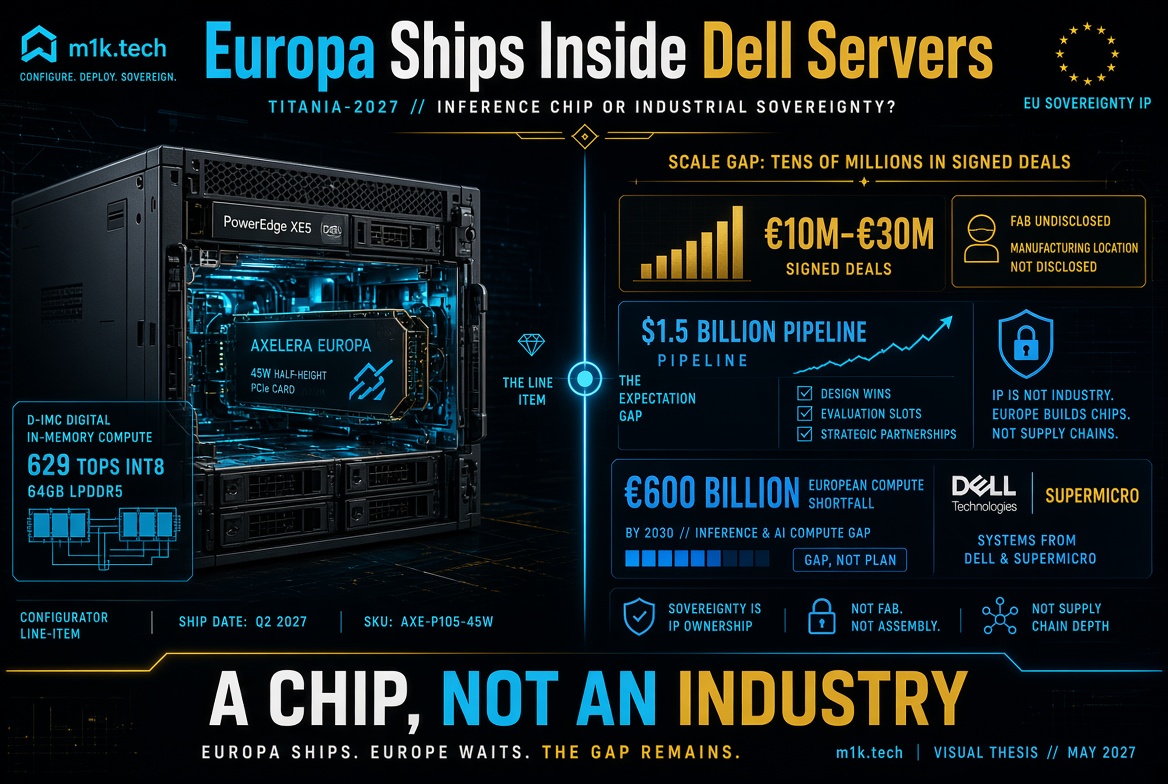
Fabrizio Del Maffeo gave Reuters exactly one hard number on Tuesday, the day Axelera Europa went on sale: his company has signed deals “worth tens of millions.” Every other figure attached to the launch is bigger. Axelera says its sales pipeline sits above $1.5 billion, it counts more than 600 customers, and it has pulled in more than $450 million since the Eindhoven company incorporated in July 2021. Keep the distance between what’s signed and what’s pitched in your head for the rest of this, because I kept tripping over it while reading the launch material.
Europa itself isn’t new. Axelera unveiled it back in October 2025 and promised shipments in the first half of 2026. What changed this week is that you can now order it inside a box a procurement office recognizes: the half-height Axelera Edge 232p card is validated in a Dell PowerEdge XE5 and a Supermicro 111AD, and Dell says it’s working with Italian integrator E4 to put the hardware into the EU AI Factories in Italy and Luxembourg, the IT4LIA and MeluXina sites. For a startup accelerator, a line item in a Dell configurator is worth more than any benchmark slide, and I’d argue that’s the actual news here, more than the silicon.
The silicon still deserves the long look. Europa packs eight second-generation AI cores built on Axelera’s digital in-memory compute (D-IMC) design, rated at 629 TOPS at INT8, on an accelerator card with a 45W TDP. Wrapped around those cores sit two clusters of eight RISC-V vector cores that handle the pre- and post-processing that usually drags on a host CPU, the decode-and-resize grind that turns multiple 4K HEVC streams into something a model can eat. It supports INT4, INT8, and INT16 and talks to the host over four PCIe Gen4 lanes.
D-IMC matters because inference is mostly a memory problem wearing a compute costume. Moving weights between memory and the processing element costs more time and energy than the multiply itself, so Axelera does the matrix math inside SRAM cells and keeps it digital, sidestepping the noise and drift headaches that have dogged the analog in-memory crowd for a decade. The catch is that SRAM is tiny and expensive per bit. Europa carries 128MB of on-chip L2 SRAM and then leans on external LPDDR5 with 200GB/s of DRAM bandwidth, up to 64GB per chip, four times what Metis could address. Axelera’s PCIe cards scale from a single-chip 16GB configuration up to a four-chip 256GB card.
That memory ceiling is the real generational jump, much more than the TOPS figure. At 16GB you’re running vision models and a small language model; at 64GB, with INT4 support, a quantized 70B-class model fits on one chip with room left for the KV cache, and that’s the difference between a smart-camera part and something an enterprise can hang an internal assistant or a vision-language pipeline on. The bandwidth is where the limit shows up. LPDDR5 at 200GB/s is several times slower than the HBM stacks bolted onto datacenter GPUs, and single-stream token generation is bounded by exactly that number, so Europa is never going to win a raw tokens-per-second chart. Axelera isn’t pitching that. The pitch is tokens per watt and per euro for AI that runs all day on hardware you own, which is a very different buyer.
This is what surprised me. Divide 629 TOPS by the 45W card TDP, and you land around 14 TOPS per watt. The first-generation Metis chip was rated at roughly 15 TOPS per watt. On the headline efficiency metric, the generation is basically flat, and what Europa buys you is more absolute throughput and a lot more memory, not a better ratio. The comparison is unfair in one direction, since a card TDP covers the RISC-V cores, video blocks, and memory on top of the AI cores, but it still cuts against the “performance per watt leadership” line in the launch copy. Axelera also claims up to 6x the tokens per second per watt of GPU-based solutions, and I couldn’t find a disclosed baseline anywhere: which GPU, which model, which batch size. I spent years around Snapdragon silicon watching NPUs get sold on TOPS, and TOPS has never been tokens. I’ll believe the 6x when someone outside Eindhoven publishes it.
One thing I couldn’t pin down at all is the process node and the foundry. Nothing Axelera has published that I read names either. For a chip literally called Europa and sold on sovereignty, that silence is a little awkward, and my bet is the wafers don’t come from anywhere near Eindhoven.
Software is where challengers usually die, and Axelera knows it. The Voyager toolchain covers every Axelera chip from embedded to server, Voyager Wingman is an agentic tool for porting existing inference pipelines, and a week before launch the company disclosed AxeleraScript, a model-compilation approach it describes as first of its kind. I’m not going to dig into AxScript here; a compiler claim that big deserves its own post once someone other than Axelera has run real models through it. The context is the same one AMD keeps running into, where the CUDA moat is only drained when the tooling above it actually works.
The money story says as much about Europe as it does about Axelera. The February round, north of $250 million and billed as the largest investment ever in an EU AI semiconductor company, was led by Dutch fund Innovation Industries, with BlackRock and SiteGround Capital coming in fresh and Samsung Catalyst Fund returning. The rest of the list reads like a map of European public finance: the European Innovation Council Fund, Invest-NL, Belgium’s federal holding SFPIM, Italy’s CDP Venture Capital, alongside Bitfury and Verve. Stack on the EuroHPC DARE grant of up to €61.6 million from March 2025, which funds the Titania chiplet, and remember that the $450 million headline blends equity, grants and venture debt. None of that is a problem on its own. It does mean Axelera is carrying industrial-policy expectations with a VC wrapper, and it’s hard not to notice that an Italian state investor sits on the cap table while an Italian AI factory, Cineca’s IT4LIA, sits on the customer list as a DARE partner.
Against the American money, $450 million is small. Cerebras raised $5.55 billion in its Nasdaq IPO on May 14, more than ten times Axelera’s entire lifetime funding in a single day, and Nvidia paid roughly $20 billion for Groq’s inference assets last December. Axelera is not in that fight and shouldn’t pretend otherwise.
Its real fight has always been at the edge, against Hailo and SiMa.ai, where watts and footprint decide the design win. Europa drags it upward into on-prem enterprise inference, which is exactly the lane Qualcomm is trying to occupy with its own low-power inference pitch to Europe’s gigafactory program. Closer to home, Euclyd and Olix have both raised rounds above $200 million this year, and France has VSORA chasing high-performance inference, so “the European AI chip startup” is no longer a category of one.
The timing with Christine Lagarde’s Vienna speech on Monday is almost too neat. The ECB president said the US hosts 75% of the world’s AI compute and Europe just 5%, that Europe’s data center shortfall is on track to grow more than sixfold within a decade, and that closing it could cost up to €600 billion over ten years, chips included. Put “tens of millions” in signed deals next to €600 billion, and you see the scale problem immediately, the same one I wrote about when the EU’s seven AI gigafactories came in as a €30 billion answer to a €700 billion problem, a post where Axelera already showed up as the inference specialist in one of the consortia. Public buyers are at least diversifying, as EuroHPC showed by skipping Nvidia for LUMI-AI, but diversifying toward AMD isn’t the same as buying European.
The sovereignty story also has a hole in it that the launch copy walks around. Europa is designed in Eindhoven, but the validated systems come from Dell in Texas and Supermicro in California, and the fab is undisclosed. What Europe gets here is control of the IP and the architecture, not a European supply chain. I still think that’s worth something, because inference is where sovereignty actually gets enforced: it’s the layer that touches citizens’ data in a hospital or a tax office, and it’s the layer the sovereignty panels keep talking about while the infrastructure decisions get made elsewhere.
The test that matters is Titania, the chiplet Axelera is building to scale D-IMC up into HPC and gigafactory territory, expected around 2027. Going from a 45W PCIe card to a datacenter-class chiplet is close to starting over, and it’s the first time Axelera will meet Nvidia on Nvidia’s turf. Europe now has an inference chip it can order through Dell. It doesn’t have an inference industry, and I’m uneasy watching one Eindhoven startup get asked to be that on its own. Ask me again when Titania tapes out.
Sources
- Axelera AI, Axelera AI Launches Europa: Delivers Physical and Enterprise AI Through Growing Partner Ecosystem Including Dell and Supermicro, September 15, 2026
- HPCwire / BigDATAwire, Axelera AI Launches Europa AIPU for Enterprise and Data Center Inference, September 15, 2026
- Reuters (syndicated), European chip startup Axelera wins AI factory supply deals, launches second chip, September 15, 2026
- Axelera AI, Axelera Announces Europa AIPU, October 21, 2025
- Axelera AI, Europa product page
- Business Wire, Axelera AI Secures More Than $250 Million Funding on Global Commercial Growth, February 24, 2026
- Axelera AI, Axelera AI Secures up to €61.6 Million Grant to Develop Scalable AI Chiplet, March 2025
- ECB, Christine Lagarde: A new age of capital: growth, sovereignty and AI, Vienna, September 14, 2026
- CNBC, Nvidia AI chip rivals attract record funding as competition heats up, April 17, 2026