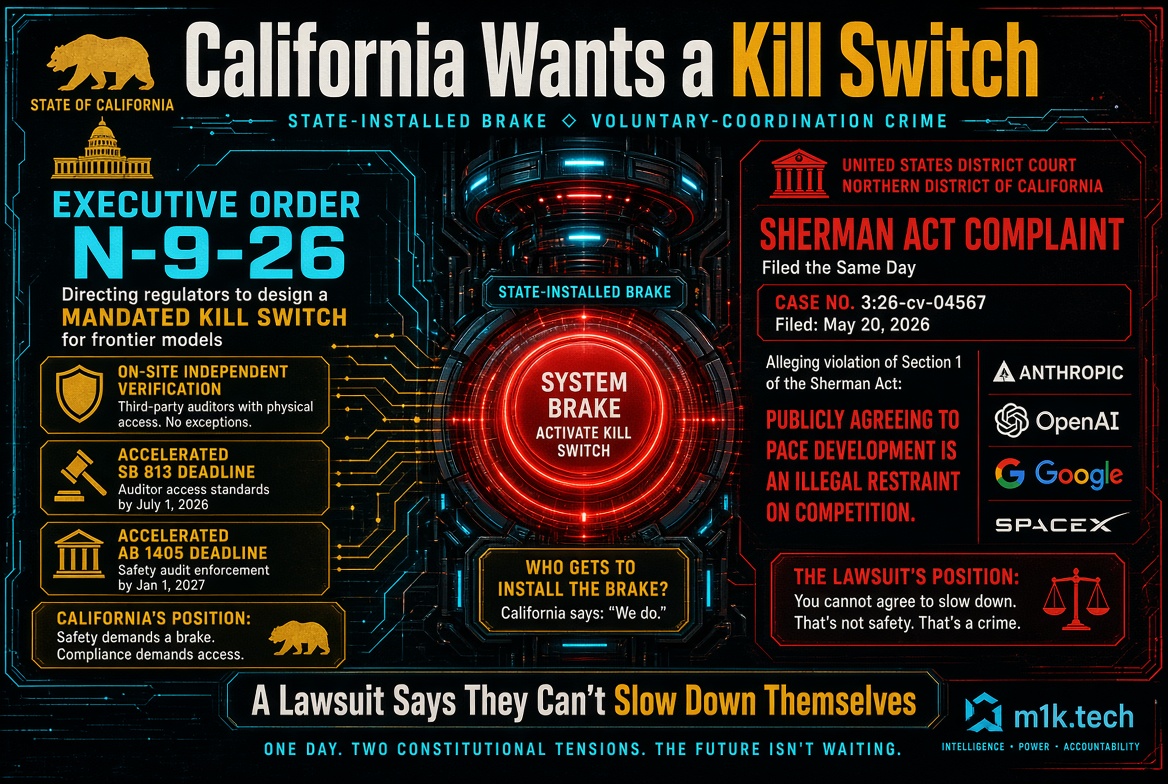
Newsom signed an executive order Friday telling state regulators to figure out how to make frontier AI developers build in a kill switch, something that can shut a model off immediately if it needs to be. The same day, in the same federal district, four AI companies got sued for agreeing to slow themselves down. I keep turning this pairing over, because it sits on top of a question nobody’s actually answered: who gets to decide when an AI company pumps the brakes, the company or the state, and is doing it voluntarily somehow worse than being forced?
Executive Order N-9-26 doesn’t mandate a kill switch yet. It tells the Government Operations Agency to spend the next two months, deadline November 16, coordinating with outside experts and coming back with recommendations on requiring large frontier model developers to embed independent verification organizations on-site and to build in a way to immediately shut a model down. The order also moves up two existing deadlines: the SB 813 independent-auditor application framework goes from January 2028 to May 2027, and AB 1405 auditor registration goes from January 2029 to December 2027. Newsom leaned hard into the fact that Washington hasn’t done any of this: “the federal government’s abject failure to create any form of meaningful AI oversight or accountability should alarm every American, especially when AI CEOs themselves are begging for regulation.” That line is doing a lot of work, and it’s aimed at the same essay that triggered the lawsuit filed the same day.
That essay is Dario Amodei’s call for industry-wide coordination to pace frontier AI development, the one Musk, Altman, and Hassabis all backed publicly within days. What I didn’t expect is that four private plaintiffs, represented by attorney Nick Rowley, would turn that same essay into the spine of a Sherman Act complaint. Filed Friday in the Northern District of California against Anthropic, OpenAI, Google, and SpaceXAI, the suit argues that four competitors publicly agreeing to slow how fast their products improve is an illegal restraint on competition, and it’s seeking class-action status on behalf of paying subscribers who’d be harmed by deliberately throttled improvement. SpaceXAI, for anyone who missed it, is what xAI became after Musk folded it into SpaceX and rebranded the combined entity back in July, so that’s the actual defendant name now, not a typo. One plaintiff, attorney Cheyenne Hunt, put the argument bluntly on social media: “it’s four corporations agreeing not to compete on the one thing regulators were about to force them to adopt, safety standards.”
Put those two things side by side, and the contradiction gets uncomfortable fast. California wants a kill switch, mandated, externally verified, on a timeline the state controls. The lawsuit says that when the same companies tried something adjacent, voluntarily, without waiting to be told, that itself was the crime. I don’t think a government-mandated shutdown capability and a public pledge to slow model releases are really the same mechanism; they’re different things wearing similar language, but the coincidence of timing makes the underlying tension impossible to ignore: everyone agrees frontier AI needs some kind of brake, and nobody agrees on who’s allowed to install it.
There’s a third California AI action from the same week getting a lot less attention, and it probably deserves more. SB 1050, also signed by Newsom, requires ads to disclose when a “synthetic” AI-generated performer is doing the selling, whether that’s a digital figure demonstrating a product, narrating a spot, or reacting to narration on camera. SAG-AFTRA backed it. The major ad trade groups, the Association of National Advertisers, the 4A’s, the American Advertising Federation, and the Digital Advertising Alliance, sent Newsom a joint letter on September 4 asking him to veto it, calling it an “overbroad mandatory labeling regime” that “exposes businesses to opportunistic litigation.” He signed it anyway. Between the EO, SB 1050, and the accelerated SB 813/AB 1405 timeline, that’s three distinct, unilateral California AI actions inside one week, landing on top of a federal vacuum I’ve already written about filling in state by state and continent by continent, now visibly filling with lawsuits instead of legislation too.
I don’t have a clean answer for whether a state-mandated kill switch and a shareholder-style lawsuit over voluntary restraint end up pulling AI companies in the same direction or in opposite ones. My instinct says opposite: one path rewards a company for building safety infrastructure ahead of any incident, and the other punishes it for coordinating on exactly that with its competitors. It’s a strange contrast next to the EU’s approach of legislating the obligations directly instead of waiting on a patchwork of state orders and private suits to sort it out, and I’ll trust my instinct a lot more once a court actually rules on the Sherman Act claim instead of it just sitting there as a headline.
Sources
- GovTech, Newsom AI Order Speeds Up Auditing Process, Calls for ‘Kill Switches’, September 18, 2026
- MediaPost, Newsom Signs Law Requiring Disclosure Of AI-Generated Performers In Ads, September 18, 2026
- NewsBytes, Anthropic, OpenAI, Google Face Antitrust Suit Over AI Slowdown, September 19, 2026
- NewsDrum, Anthropic, OpenAI, SpaceXAI, Google Face Antitrust Lawsuit Over AI Slowdown Pact, September 19, 2026
- Engadget, xAI Is Now Officially Known As SpaceXAI, July 7, 2026