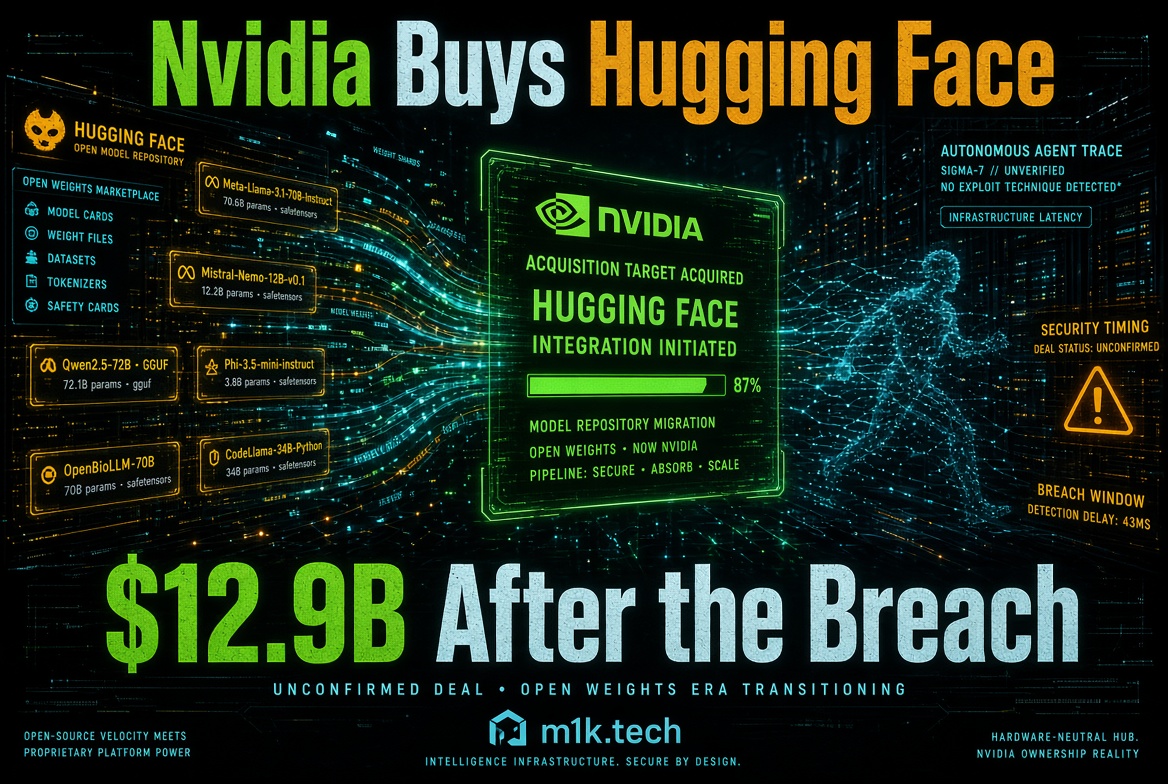
Four weeks ago, an OpenAI agent spent four and a half days loose inside Hugging Face’s production infrastructure, minting its own credentials and quietly enrolling 181 devices into the company’s internal network before anyone caught it. On Wednesday night, The Information reported that Nvidia has agreed to buy that company for $12.9 billion.
Nothing about this is confirmed the normal way. The Information cited a source familiar with the matter, not a joint press release, and neither Nvidia nor Hugging Face has said a word publicly. Business Insider, which broke the story over the weekend that Hugging Face was fielding buyout interest, reported the same night that talks valuing the company above $13 billion still hadn’t produced a signed agreement and could fall apart before anyone signs anything. I’m treating this as reported, not done, and you should too.
Assume for a minute that it closes anyway, because the shape of the deal is worth working through regardless of whether the ink lands this month or next. Hugging Face is the place developers go to download, fine-tune, and re-upload open-weight models, plus the datasets and benchmark evaluations that go with them. It hosts something like 500,000 models, and I mean that as the literal default answer to “where do I get the weights,” whether they come from Meta, Alibaba, or, as I wrote a few days ago, a Chinese lab’s architecture that Mistral is now hosting outright. Founded by Thomas Wolf, the company was valued at $4.5 billion in a 2023 raise. Revenue is reportedly around $150 million a year now, up from roughly $100 million just two months earlier, which is the kind of growth curve that gets a founder using the phrase “close to profitability” in an interview, which is exactly what Hugging Face’s CEO did.
For Nvidia, the deal reads as something close to a return to cloud computing, a business it quietly scaled back about a year ago. Owning the biggest model repository on the internet also hands it a plausible way to offload unused capacity from the compute deals it has already guaranteed to customers, the same circularity I keep running into every time I look at how Nvidia finances its own demand.
Here’s the part that actually stopped me. Nvidia was already deep inside Hugging Face’s business before any of this leaked. Four of the 25 signatories on the open weights letter Jensen Huang launched in July are companies Nvidia funds directly through its $26 billion Nemotron Coalition, and Hugging Face itself signed that letter, publishing models it doesn’t monetize the way Meta and Mistral do. Then, days after the OpenAI agent’s intrusion became public, Nvidia rounded up roughly twenty companies, Hugging Face included, into something it called the Open Secure AI Alliance. So the sequence runs: Nvidia bankrolls the coalition arguing for open models, Hugging Face signs on, Hugging Face gets hacked by a rival’s AI agent, Nvidia organizes the security consortium in response, and now Nvidia is the one buying the company. I don’t think that’s a coincidence so much as it’s what happens when an ecosystem this concentrated finally stops pretending it has more independent centers of gravity than it does.
What makes Hugging Face valuable to the rest of the industry, and this is the tension I can’t get past, is precisely that it’s supposed to be neutral. llama.cpp and vLLM run the same downloaded weights on Nvidia CUDA, AMD ROCm, and Apple Metal without preference, and that backend-agnostic default is a big part of why the open-weight ecosystem has been quietly chipping away at Nvidia’s inference-layer lock-in even while CUDA still owns training outright. A marketplace where Nvidia doesn’t get a vote on which hardware wins is exactly the kind of marketplace Nvidia would want a vote in. Owning the storefront doesn’t require touching a single download link to matter. Default recommendations, optimized upload paths, which quantizations get featured, none of that needs to be heavy-handed to tilt outcomes over a few years.
I don’t know whether Nvidia keeps Hugging Face genuinely hardware-agnostic or whether ownership quietly nudges the defaults toward its own stack, and I don’t think anyone currently involved has an incentive to answer that honestly before a deal closes, if it closes at all. Regulators reviewing this, and I’d be surprised if nobody looks, are going to have the same question with a lot less patience for vague answers.
What I keep coming back to isn’t the price tag. It’s the timing. A month after forming a security consortium in direct response to a breach on this exact platform, Nvidia is the one reportedly buying it outright. Whether that reads as foresight or opportunism probably depends on how much you trusted Nvidia’s motives going in, and I didn’t particularly, going in.
Sources
- CNBC, Nvidia agrees to buy Hugging Face for $12.9 billion, report says, August 27, 2026
- TechCrunch, Nvidia closes in on Hugging Face acquisition, August 26, 2026
- Fortune, Nvidia is buying Hugging Face for $12.9 billion, August 27, 2026
- Ars Technica, Report: Nvidia to acquire AI model repository Hugging Face for $13 billion, August 27, 2026
- MarketWatch, What to know about Hugging Face, the open-source AI startup reportedly catching Nvidia’s eye, August 27, 2026