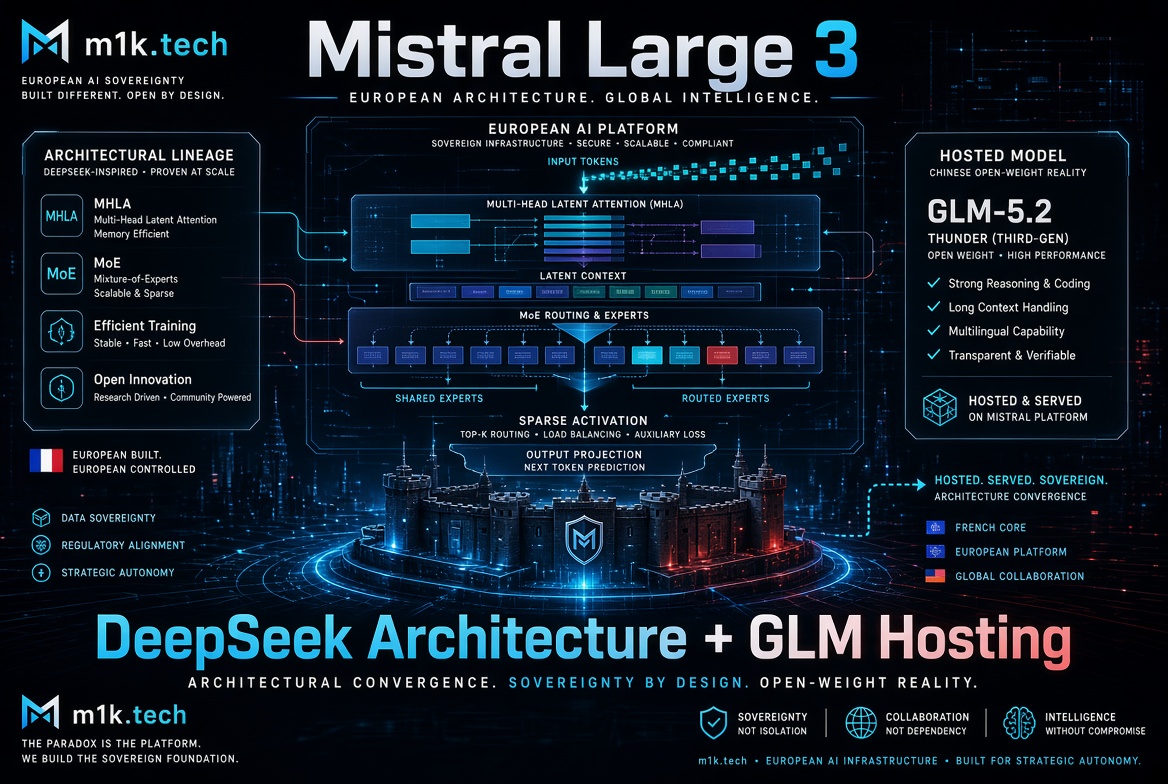
I spent a chunk of Sunday reading the Mistral Large 3 config file, which tells you something about how I spend weekends, and came out of it with a different view of European AI sovereignty than the one I went in with.
The file is params.json in the Mistral-Large-3-675B-Instruct-2512 repo on Hugging Face. Hidden dimension: 7168. Sixty-one layers. The first three are dense; the remaining fifty-eight are mixture-of-experts. Multi-head latent attention with a KV compression rank of 512 and a query compression rank of 1536, split into 128 non-positional dimensions and 64 rotary ones per head. Every one of those numbers matches DeepSeek V3.
That was already an uncomfortable fact for a company whose whole pitch is that Europe should not have to borrow its intelligence from anyone. On 11 August it got worse, because Mistral began hosting GLM-5.2 from the Beijing lab Z.ai, formerly Zhipu, on its own platform. Served unmodified. No fine-tuning, no adaptation, no European contribution beyond building the GPUs it runs on. CTO Timothée Lacroix told VentureBeat it was a great model that everyone loves, it is open-weight, and there was “no good reason for us not to do it.”
He is right if you are a hosting company, which is exactly the problem.
A chronique in Journal du Net read the whole arc as a renunciation and claimed Large 3 copies DeepSeek’s configuration line by line. The framing lands. The line-by-line claim does not survive ten minutes with the actual file, and I want that part right before agreeing with the conclusion, because getting the technical half wrong is how a good argument decays into a dunk.
Where the two configs stop matching
| Mistral Large 3 | DeepSeek V3 | |
|---|---|---|
| Total / active params | 675B / 41B | 671B / 37B |
| Layers | 61 (3 dense + 58 MoE) | 61 (3 dense + 58 MoE) |
| Hidden dimension | 7168 | 7168 |
| Dense FFN width | 16384 | 18432 |
| Routed experts | 128 × 4096 | 256 × 2048 |
| Experts per token | 4 + 1 shared | 8 + 1 shared |
| MLA ranks (kv / q) | 512 / 1536 | 512 / 1536 |
| Vocabulary | 131,072 | 129,280 |
| Vision encoder | 2.5B, 48 layers | none |
The dense feed-forward width differs, 16384 against DeepSeek’s 18432. Positional scaling differs: YaRN at a factor of 36, stacked on a Llama-4-style beta term. The config supports 294,912 positions, and it actually serves 262,144. And Large 3 carries a 48-layer, 2.5-billion-parameter vision encoder that DeepSeek V3 does not have at all, which makes “the only structural modification is expert granularity” plainly false rather than arguably imprecise.
Mistral’s Patrick von Platen said as much on Hugging Face back in December: the model is not trained on top of DeepSeek; it uses different RoPE scaling, selects fewer experts per token, and carries an integrated vision tower, while being heavily inspired. Both halves of that are true. The weights are Mistral’s, trained from scratch on 3,000 H200s, with their own tokenizer at 131,072 entries against DeepSeek’s 129,280. Nobody laundered a checkpoint.
Fewer, fatter experts, and what that trade actually costs
Here is the interesting bit, and it is the only part of Large 3 I would call original engineering.
Expert capacity per layer is identical in both models. 128 experts at 4,096 intermediate width comes to 524,288 units; DeepSeek’s 256 at 2,048 comes to exactly the same number. What changed is routing. DeepSeek picks 8 of 256 per token, which is roughly 4 x 10^14 possible expert combinations. Mistral picks 4 of 128, about 1.07 x 10^7. Seven orders of magnitude less compositional diversity out of a model with the same nominal expert capacity, which is a real bet about where a model’s expressiveness comes from.
In exchange, you halve the number of routing destinations per token, and that is the thing that actually hurts in expert-parallel inference, where a token’s chosen experts may live on different GPUs, and the all-to-all shuffle eats the wall clock. Fewer destinations mean fatter GEMMs and less time waiting on the interconnect. Active feed-forward width per token even goes up slightly, 20,480 units against 18,432, which is part of where 41B active comes from against DeepSeek’s 37B.
So the claim that the expert change buys throughput rather than capability holds up, even though the sentence built around it in the JDN piece does not. Mistral markets this as a “granular” MoE, which made me laugh, because granularity in the literature means more and smaller experts. This is the opposite move, wearing the fashionable word.
The inherited part nobody writes about is doing the heavy lifting. 576 cached values per token per layer, 512 latent plus 64 decoupled rotary, across 61 layers, works out to about 35,000 values per token or roughly 35KB in FP8. At the full 256K window, that is around 9GB of KV cache instead of the couple hundred gigabytes full multi-head attention would demand at this width. That is the entire reason this model fits on a single node of eight H200s or B200s. Mistral did not invent multi-head latent attention. Taking it was the correct call, and pretending otherwise would be its own kind of dishonesty.
Two smaller config details are worth noting. The FP8 quantization ignore list deliberately keeps the embeddings, the lm_head, the routing gates, the vision stack, and critically the MLA down-projections at higher precision, which is right, since error in those low-rank bottlenecks propagates through every head downstream. And that YaRN factor of 36 stretches from an original 8,192 positions, which is aggressive extrapolation and shows: the NVFP4 checkpoint that lets you run this on H100 or A100 nodes matches FP8 below 32K and degrades past 64K. The cheap deployment path stops being the 256K model.
I am not going near the benchmark tables here, because I do not trust most of them.
Sovereignty of the building
Architectural convergence is not scandalous by itself. Kimi K2 runs the same skeleton. Llama 4 borrowed the playbook. Transformer variants converge because the search space is small and the winners look obvious in hindsight. If Mistral were an ordinary lab, “we adopted the best available MoE template and retuned it for our serving economics” would be a boring and completely defensible engineering post.
Mistral is not an ordinary lab. It is the entity Paris and Brussels have spent three years holding up as proof that Europe can build its own intelligence instead of renting someone else’s, and that changes what the config file means politically while changing nothing about what the config file does.
The GLM-5.2 decision makes the redefinition explicit. Mistral’s own framing is that customers need model choice alongside control over where inference runs, so a Chinese model executing on French metal under EU data residency still counts as sovereign. That is a coherent position. It is also a different position from the one that earned the company its political cover, and somebody should say that out loud rather than pretend the goalposts stayed put. I made a version of this argument when the Microsoft partnership expanded and Azure became the main distribution channel, and the same tension shows up from the customer side in AXA’s Copilot rollout.
Under the AI Act the question gets sharper than a branding fight. Obligations attach to whoever places a general-purpose model on the EU market. Mistral serves GLM-5.2 unmodified, so it is not the model provider in the ordinary sense, but it is the entity holding the European commercial relationship, the SLA, and the billing surface. Where the transparency and copyright-policy duties land in that arrangement is not something I have seen answered cleanly by anyone, and “public preview” is doing an enormous amount of work in the meantime.
The balance sheet was always going to win this argument
Mistral’s annualized revenue went from about $20M to north of $400M in a year, and Mensch committed publicly at Davos to passing a billion by the end of 2026. Against that sit roughly €2.4bn in equity, an $830m debt facility taken in March for 13,800 Nvidia GB300s at Bruyères-le-Châtel, a €1.2bn Swedish build with EcoDataCenter, and a target of 200MW by the end of 2027, rising to a gigawatt by 2030. Capex this year runs around $1 billion.
You cannot fund that from model licensing. So the August announcement bundled five anchor customers, ASML, Amadeus, Capgemini, Caisse des Dépôts and CMA CGM, into multi-year prepaid compute commitments of about five years with no early exit, denominated in something called European Compute Units. That is not how software gets sold. It is how you finance an LNG terminal: aggregate enough long-dated offtake to make the capital expenditure bankable, then build. Microsoft, an American hyperscaler, is an anchor tenant of the sovereign European compute, which I still find remarkable every time I write it down.
Hosting GLM-5.2 fits that business perfectly and fits a research lab not at all. Inventory breadth is what turns an API into a platform. Whether the margin is any good is a separate question, because reselling somebody else’s free weights is a commodity business whose only defensible feature is jurisdiction.
If you are in Vibe, or shipping against the API
For someone in the chat app, very little changes beyond a better model picker. GLM-5.2 lands as zai-glm-5-2 in public preview with a one-million-token context and 128K maximum output, priced at €1.19 per million input tokens, €0.119 cached, and €3.74 per million output. That is a strong long-context coding model at a price Mistral’s own frontier tier cannot comfortably match, which is the same pressure DeepSeek has been applying to everybody’s price list all year.
Developers should read the fine print harder than the announcement. Regional endpoints carry a 10% surcharge, the Priority Tier with its 99.5% uptime SLA runs at 1.75x list, and those regional endpoints do not support Batch, Agents, or the Files API, with function calling as the only in-region tool available. The compliance configuration and the feature-complete configuration are not the same configuration, which is exactly the sort of gap that surfaces three weeks after somebody promised a regulator something specific.
If you want the true sovereign option, it hasn’t changed. Large 3 is Apache 2.0, so download the weights, run them on eight H200s, and there is no vendor anywhere in the loop. Almost nobody will.
The scenario nobody at Mistral wants to game out
Suppose access to Chinese open weights closes. That is not a fringe hypothetical in 2026. Washington has been pressuring signatories of its AI framework to choose a side against China’s bloc, US states have started restricting Chinese models on government systems, European procurement rules could follow, and one security incident traced back to a Chinese-origin model would compress that timeline into a fortnight. China took the open-weights lead precisely because nobody stopped it, and that is a policy condition rather than a law of nature.
Mistral is exposed on two fronts if that happens. The platform loses its best inventory, and the pitch that made the platform interesting, one place to run any open model under European control, collapses back into one place to run Mistral models, which is what it already was in July. The second front is worse. The architecture lineage stops being a technical footnote and turns into a procurement question. Nobody serious will claim Large 3 is a Chinese model. Somebody in a defense ministry will absolutely ask why the sovereign flagship’s attention stack has a Hangzhou return address, and “the weights are ours, the shape is borrowed” is a true answer that takes four minutes to explain, which is three and a half minutes too long for that meeting.
The compute business survives all of that intact. GPUs do not care whose weights they run, and a European inference estate with five anchor tenants on five-year terms is a real asset under any policy regime. What does not survive is the story, and the story is what has been buying Mistral its political oxygen since 2023.
I do not think any of this is a betrayal. I think it is a company that looked at several trillion dollars of global data-center capital expenditure and concluded that owning European inference capacity is more defensible than out-training labs with fifty times the money, and they are probably right about that. What bothers me is the vocabulary. If sovereignty now means jurisdiction over the building, then say jurisdiction over the building, and let the three years of state backing and the AI Act carve-outs be argued on those terms instead of on a promise about intelligence that quietly stopped being the product.
Ask me again when Large 4 ships. If it arrives on a fresh architecture, I will happily eat this post.
Sources
- Mistral AI, In-region inference, open models, and new European infrastructure for sovereign AI
- Mistral-Large-3-675B-Instruct-2512 model card and params.json
- Hugging Face discussion: “Was this built on DeepSeek V3 0324?”
- Mistral Docs, Z.ai GLM-5.2 model card
- VentureBeat interview with Timothée Lacroix
- DeepSeek-V3 Technical Report
- Journal du Net, Pierre-Louis Biojout’s chronique