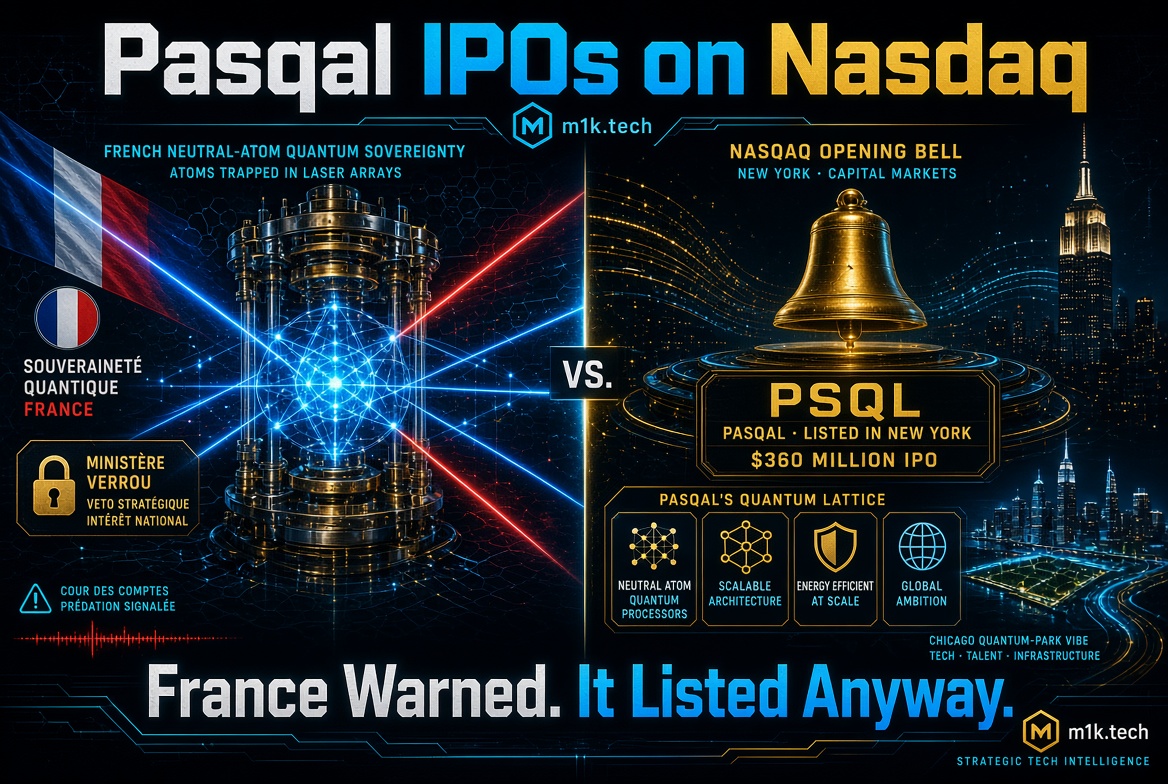
Pasqal began trading on Nasdaq Friday under the ticker PSQL, and the number that matters isn’t the ticker or the debut pop. It’s $360 million, about $140 million short of the roughly $500 million its own SPAC filings said the company expected to raise. The gap is redemptions: shareholders in Bleichroeder Acquisition Corp. II, the blank-check company Pasqal merged with to go public, took their cash back instead of riding along. That shortfall is the least flattering number in an otherwise triumphant press cycle, and it’s the one Pasqal can’t spin away.
Here’s what makes the whole thing land strangely for me. A few weeks ago I wrote about France’s Cour des Comptes warning that companies exactly like Pasqal faced what it bluntly called predation: foreign capital picking off strategic quantum IP built on French public money, sliding in under the radar through licensing deals and minority stakes that never trigger a formal screening review. Pasqal was one of the firms that the report leaned on hardest to make its case. And Pasqal’s answer to needing serious capital wasn’t a French raise or even a straight Euronext listing. It was an American blank-check merger, priced in dollars, on the same exchange every quantum company that’s gone public this year has chosen over Paris.
To be fair to both Pasqal and France, this isn’t quite the predation scenario the Cour des Comptes was actually worried about. Nobody bought Pasqal. The deal includes a hard veto: any significant non-French or non-EU stake still needs sign-off from the Ministry of the Economy, an unusual clause to carry onto an American exchange and a real constraint rather than a symbolic one. Alain Aspect, the Nobel laureate who co-founded the company, chairs the board in a non-executive capacity. Bpifrance holds a board seat through Nicolas Berdou. The French center of gravity is still on paper. What changed is where the money comes from, and CEO Wasiq Bokhari has said plainly that choosing Nasdaq over Paris was about capital depth, not allegiance. I don’t think that’s spin: Europe’s entire quantum sector raised something like €1.05 billion across all of 2026, and Pasqal’s cash pile from Friday alone sits close to a third of that, concentrated on one balance sheet instead of scattered across a continent’s worth of smaller raises.
The debut itself is worth sitting with too. Pasqal shares surged 54.7 percent at the open, to $15.14, on the same Friday morning that every other publicly traded quantum name (IonQ, Rigetti, D-Wave, Quantum Computing Inc.) was down somewhere between 2.7 and 6 percent. A stock that opens against the grain of its entire sector either means real conviction or a thin float doing what thin floats do. I lean toward some of both.
Now the valuation, which is the part I’d flag if I were grading this on the numbers instead of the symbolism. The SPAC deal was struck back in March at a $2 billion pre-money valuation against 2025 revenue of just €16.5 million, something like 100 times sales, and the filings themselves concede that commercial traction for quantum computing may never actually materialize. That’s not a hedge buried by outside lawyers. That’s the company saying it in writing. I ran nearly identical math on Quantinuum’s IPO back in June, another quantum listing priced on belief rather than an income statement that was shrinking 73 percent quarter over quarter at the time, and the two prospectuses read like siblings: real deployed hardware, a genuinely differentiated technology, and a market cap that assumes the science wins outright inside a specific, unproven timeframe.
What Pasqal has going for it, unlike a lot of the froth I’ve covered this year, is that the deployed part is real and not a demo built for a press release. Seven neutral-atom quantum processing units are already in the field, with three more in production, supporting more than 25 commercial and research projects across energy, financial services, and materials science. Saudi Aramco’s machine, Saudi Arabia’s first quantum computer, runs on Pasqal hardware. It also works for Crédit Agricole CIB and LG Electronics. Neutral-atom computing traps individual atoms in arrays of laser light instead of chasing the extreme cryogenics superconducting qubits need, and Pasqal cleared 1,000 atoms in a single processor back in 2024, a genuine engineering result rather than a marketing number.
I’ve also written about the other half of Pasqal’s American bet: the $65 million commitment and 50 jobs it put into Chicago’s Illinois Quantum and Microelectronics Park, choosing to plant its US headquarters on the same 440 acres as PsiQuantum and IBM rather than expand at home. Line that decision up next to Friday’s Nasdaq debut and the pattern stops looking like a coincidence. Twice this year, the company France was most anxious about losing chose to grow on American soil and in American capital markets, with Paris getting a promised dual listing on Euronext that still hasn’t happened.
I don’t think this is the predation the Cour des Comptes warned about. Ownership stayed French, the veto is real, and a Nobel laureate is still running interference from a non-executive chair. But a sovereignty strategy built around keeping strategic technology anchored at home doesn’t get much comfort from watching its flagship company build its balance sheet, and now its second headquarters, somewhere else, no matter whose name stays on the door.
Sources
- Reuters, France’s quantum computer maker Pasqal surges on Nasdaq debut, August 28, 2026
- The Next Web, France’s Pasqal is public, with $360M and a valuation of about 100 times revenue, August 28, 2026
- TS2 Tech, Pasqal Shares Surge 54.7% at Nasdaq Debut After $2 Billion Quantum Merger, August 28, 2026
- Quantum Zeitgeist, Pasqal (PSQL), The Complete Commercial History Since 2019, August 28, 2026