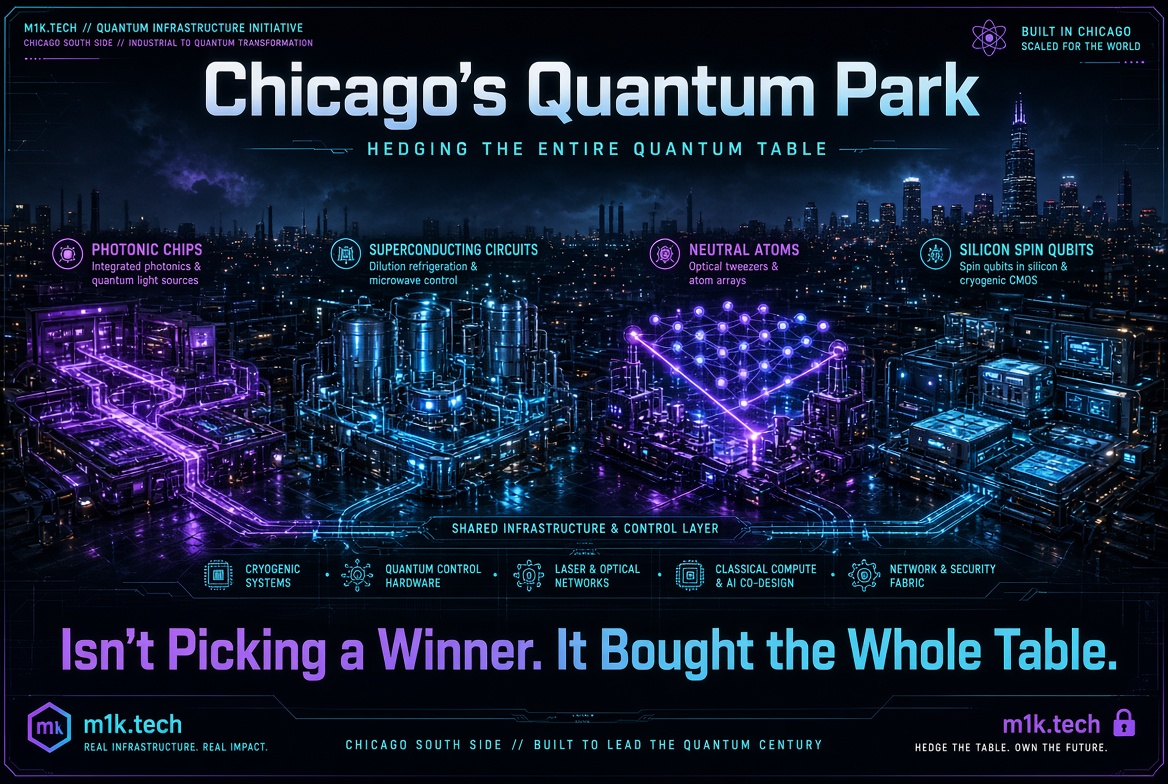
Photonic qubits, superconducting qubits, neutral atoms suspended in optical tweezers, electron spins trapped in silicon: four physical approaches to quantum computing that fundamentally disagree about what a qubit should even be, and all four are moving onto the same 128 acres of a dead steel mill on Chicago’s far South Side. A University of Illinois dean walked through the current numbers on the Illinois Quantum and Microelectronics Park in the Chicago Tribune late last month, and the detail that stuck with me wasn’t any single company. It’s that Illinois quietly stopped trying to back the winning horse in quantum and instead rented stalls to the entire field.
The anchor is still PsiQuantum, and it’s still the most audacious and least verifiable bet on the site. The company broke ground last September on the former U.S. Steel South Works, where it plans to build a 300,000-square-foot operations center and, inside it, the first U.S.-based utility-scale, fault-tolerant quantum computer. That’s the polite phrasing. The blunt version is a million physical qubits built out of single particles of light on silicon-photonic chips, an approach that needs far less cooling than superconducting rivals but has to solve error correction at a scale nobody has demonstrated. Illinois put roughly $200 million of incentives behind it. PsiQuantum promises around 150 jobs. What it has not done much of is show its work: Aram Harrow at MIT has publicly noted there just aren’t many demonstrations to judge them by, and the company’s reputation for secrecy means even sympathetic observers are half-guessing about how far along it really is. I want it to work. I also can’t tell you it will, and neither can anyone outside the building.
IBM is the counterweight, and this is where the Tribune framing compresses two different things into one sentence. The machine and the payroll are separate commitments. The machine is an IBM Quantum System Two, the modular design that bolts quantum processors to classical control; it heads to the University of Chicago this fall and relocates to the park once the building is finished, where it anchors the National Quantum Algorithm Center announced back in late 2024. The 750 jobs are a different animal entirely: IBM’s FutureNow Chicago delivery hub, a $19 million tax-credit package spread over ten years, plus a 500-slot apprenticeship program run with City Colleges of Chicago. Those roles are in cybersecurity, AI, and data science, not qubit engineering, and that distinction matters more than it sounds. I dug into what IBM’s billion-dollar quantum “revenue” actually represents a couple of weeks ago, and the pattern holds here too: the number that touches real people on the South Side isn’t the quantum computer; it’s the delivery hub next to it. That’s not a knock. That’s the point of putting it there.
Then there’s the startup bench, and it’s deeper than the headlines suggest. Pasqal, the French neutral-atom company, is planting its U.S. headquarters here on a $65-million commitment with 50 jobs, backed by the state’s MICRO chip-incentive program and a $15-million climate-bank loan; that a European quantum firm chose Chicago over staying home is its own quiet story, given how hard France is fighting to keep its own quantum startups from being bought out or lured away. Infleqtion, another neutral-atom shop, is bringing an NVIDIA-linked quantum-supercomputing setup that I broke down when the 50-logical-qubit plan landed. I’ve covered both of those, so I’ll keep them short.
The one I keep circling back to is Diraq. It builds qubits out of electron spins in silicon quantum dots, which means it can ride the same CMOS manufacturing base that already prints every processor you own, and that’s the closest thing quantum has to a manufacturing shortcut. Sitting next to it is Quantum Machines, which doesn’t make qubits at all. It makes the control hardware, the OPX systems that most of the industry already uses to actually run the things, and it’s Diraq’s existing partner. Put those two facts together, and the park’s logic gets obvious: you don’t just recruit qubit vendors, you recruit the layer that makes every vendor’s qubits usable, and then you let them sit thirty feet apart.
That co-location instinct is the actual thesis, and it shows up most clearly in the least glamorous tenants. Zero Point Cryogenics and Ability Engineering Technology are anchoring a supply-chain cluster the park calls the FaQtory: custom cryogenic hardware and precision vacuum engineering, built next door to the machines that consume it, specifically to shorten the loop and cut the reliance on overseas components. Above that sits the single line item I find most telling in the whole $500-million state package: the $200 million earmarked for a shared cryogenic plant. Nobody funds a communal refrigerator because it’s exciting. They fund it because a startup will move across the country for infrastructure it could never afford to build alone. That’s the whole play. The park isn’t a product; it’s an agglomeration, and the cold is the bait.
For Chicago and Illinois, the stakes underneath the physics are almost aggressively physical. This is the far South Side, the South Works site that sat empty for decades after the mills closed and took a generation of jobs with them. The broader “Quantum Shore” vision folds in a replacement for Advocate Trinity Hospital and new housing, with backers floating a $20-billion economic-impact figure. I’d treat that number, and the comparisons to the Manhattan Project and early Silicon Valley that get thrown around, as advocacy rather than forecast; they’re the language you use to justify a half-billion in public money, not a spec sheet. What’s real and already moving is the workforce layer, which is why PsiQuantum putting $250,000 into South Chicago classrooms while it pours foundations next door matters more than any single valuation slide. The pipeline is the part that survives even if a modality doesn’t. For the full ground-level picture of how the site came together and what the state actually committed, I laid it all out inside the Illinois Quantum and Microelectronics Park earlier this year.
I’m not going to pretend to adjudicate whether any of these machines will hit real quantum advantage on a problem that matters. That’s a physics argument; it deserves its own post, and honestly nobody can answer it yet without guessing.
Here’s what I actually respect, and it isn’t PsiQuantum’s million qubits or IBM’s headcount. It’s that Illinois built the road, the power, and the refrigeration, and then declined to bet on which physics wins. Photons, atoms, superconducting loops, silicon spins: let them fight it out on top of shared infrastructure, and whichever one crosses utility scale first does it on ground the state already owns. If one of them hits, Chicago is standing under it. If none of them do for another decade, the South Side still ends up with a supply chain and a trained workforce it didn’t have in 2023, which is more than most moonshots leave behind when they miss. I still don’t know whether the winning qubit gets built here, or anywhere, this decade. The steel mill it’s replacing took longer than that just to finish dying.
Sources: Chicago Tribune op-ed (July 27, 2026); PsiQuantum groundbreaking announcement (Sept. 30, 2025); IBM FutureNow Chicago, via Capitol News Illinois and Block Club Chicago (April 29, 2026); Pasqal U.S. HQ release (Jan. 2026); Quantum Machines flagship-hub release (Feb. 2026); IQMP FaQtory, via Quantum Computing Report (2026).