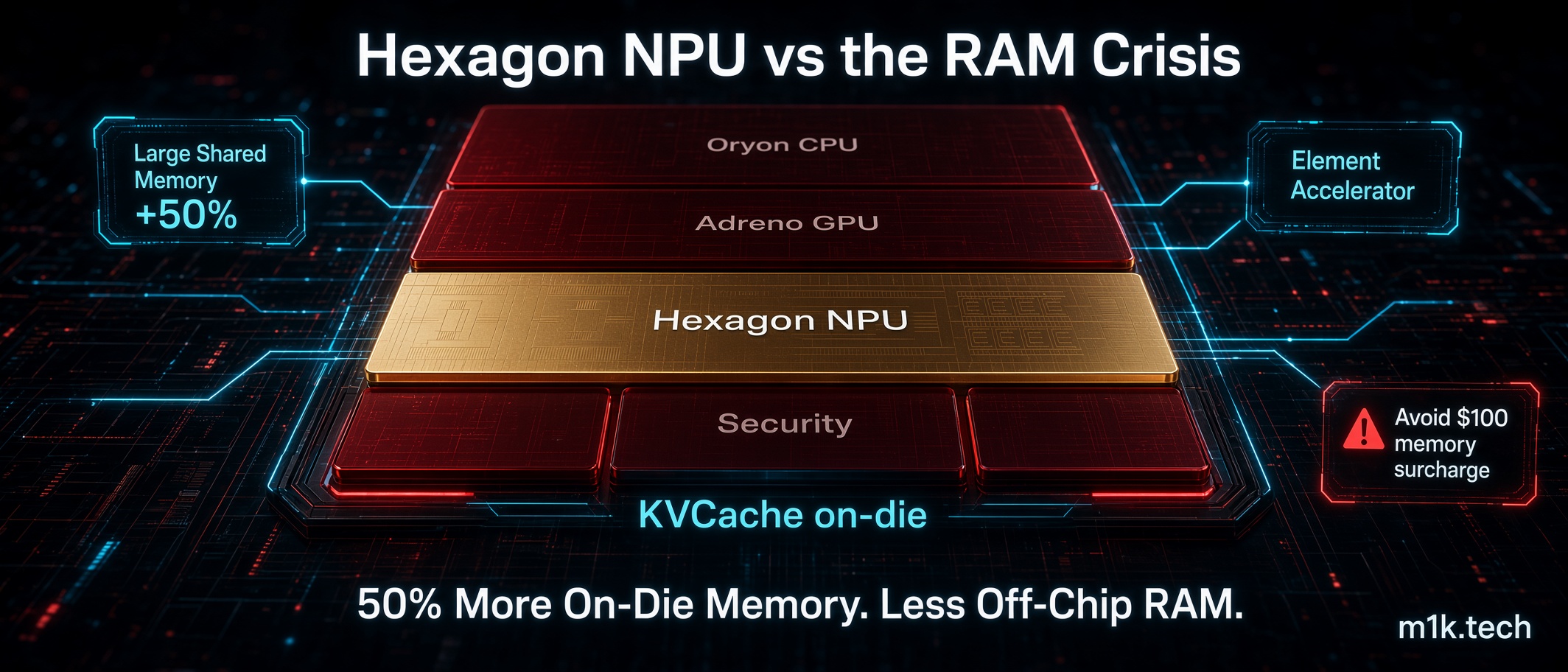
Fifty percent more Large Shared Memory tucked inside a Hexagon NPU Qualcomm still hasn’t named. That’s the detail buried under the world’s first 5GHz mobile CPU headline in Wednesday’s OnQ blog post, and it’s the one I keep rereading while everyone else argues about clock speeds.
Qualcomm dropped the third piece of its pre-Summit reveal this week, and this one touches the part of the phone that’s actually been making headlines all summer: memory. The redesigned Hexagon NPU gets a new Element Accelerator for AI operations plus that 50 percent jump in Large Shared Memory, which Qualcomm says keeps model state, context, and KV-cache data closer to the accelerators so the chip makes fewer trips to external memory. Strip out the press-release language, and the message is simple: this chip is built to want less RAM, not more, right as RAM became the thing every phone maker on the planet is fighting over.
I already covered the CPU half of this reveal, the first mobile core to clear 5GHz, and the Adreno GPU half, where Adreno Neural Fusion put AI matrix cores inside the graphics pipeline a year after Apple got there. The NPU is the piece that actually ties the story together, because it’s the only one of the three whose entire pitch is memory efficiency, and that’s not a coincidence given what’s happened to memory prices since spring.
Look at what’s already run through this blog’s own coverage. The Poco F9 Ultra skipped an entire Snapdragon generation specifically over memory costs. Samsung passed a flat $100 memory surcharge onto every foldable at Unpacked, despite selling the memory itself on the other side of that transaction. Samsung’s own Exynos 2700 pitch leans harder on its 2nm foundry story than on benchmarks, because foundry yield sets cost these days, not chip-design cleverness. And on the AI accelerator side, Huawei has marked up its Ascend 950DT by 20 to 50 percent in two months as HBM supply gets scarcer, Reuters reports. Qualcomm shipping an NPU whose headline feature is needing less external memory isn’t a nice-to-have this generation. It’s a response to a market where the silicon design has quietly become the cheap half of the bill of materials.
I’ll admit the FlexCache language reads a little like marketing dressing up a cache reorganization as a breakthrough: a dynamically allocated pool shared across heterogeneous cores is a real architectural choice, but it’s not a new idea in computing broadly. What’s different is the timing. Qualcomm is shipping this exact framing at the moment the RAM shortage stopped being an abstraction on an earnings call and started showing up as a line item on a spec sheet. Whether that 50 percent memory figure holds up against real on-device agent workloads, instead of Qualcomm’s own demo numbers, is something nobody outside San Diego can check yet.
The chip itself still doesn’t have a name, and won’t get one until Snapdragon Summit runs September 22 through 24. A leaked photo already circulating shows what’s likely the Pro variant switching to a side-by-side die layout instead of the stacked design Qualcomm has used before, which should help thermals and will definitely force phone makers to redesign board layouts around a physically bigger part. I don’t know yet why this generation needed a separate Pro tier. That’s a pricing and positioning story for whenever it actually leaks.
What I do know is that Qualcomm chose to lead its own marketing with memory efficiency instead of raw speed, three blog posts in a row, and that’s not something a chipmaker does unless the constraint is real. When the company selling you the chip starts advertising how little RAM it needs, the RAM crisis stops being a supply chain story and becomes a product design one.
Sources
- TechRadar, The next flagship Snapdragon chipset could reduce reliance on RAM while delivering exceptional performance, September 9, 2026
- Reuters, China’s AI chipmakers raise prices as high-bandwidth memory shortage bites, September 10, 2026
- AndroidHeadlines, Leaked Photo Shows Just How Big the Snapdragon 8 Elite Gen 6 Pro Really Is, September 9, 2026
- Qualcom, https://www.qualcomm.com/news/onq/2026/09/hexagon-npu-agentic-ai-architecture, September 10, 2026