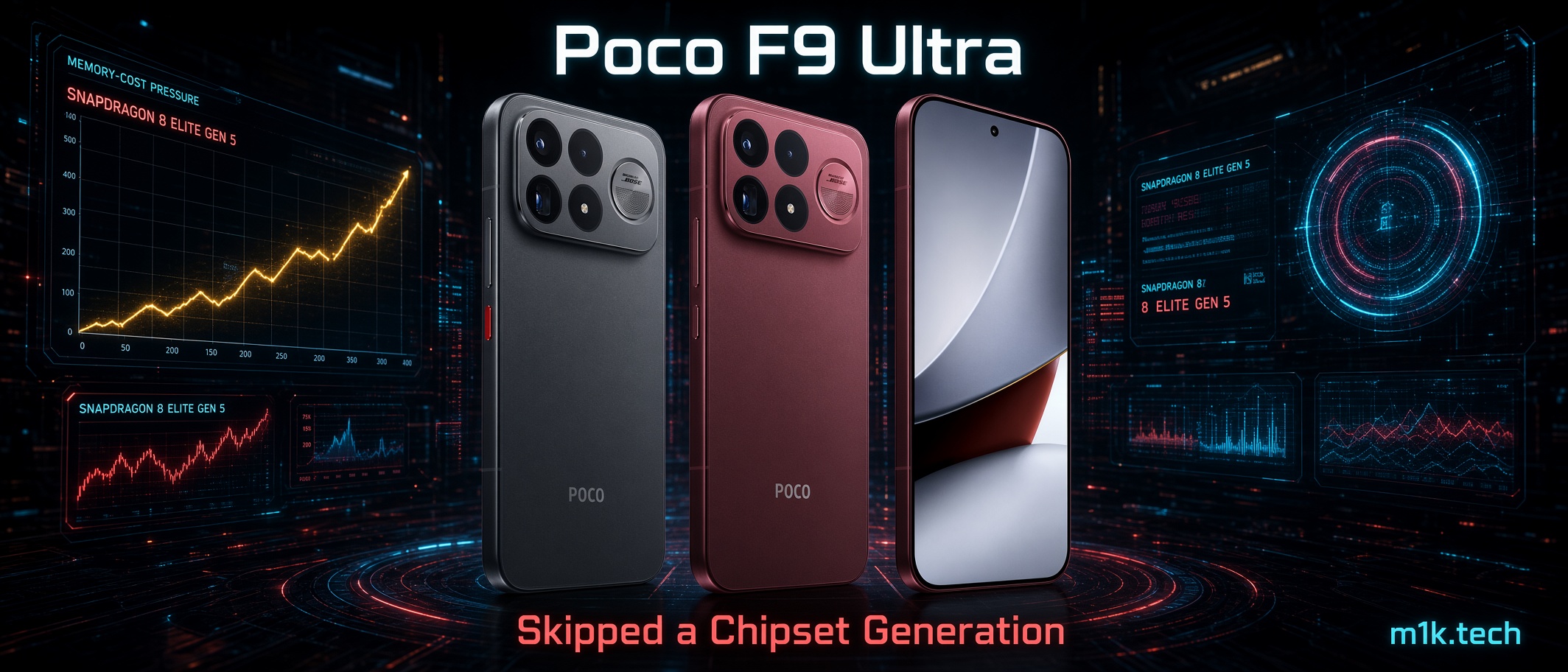
The Poco F9 Ultra ships with the exact same Snapdragon 8 Elite Gen 5 chip as last year’s F8 Ultra, and Poco’s senior product manager Kang Lou said the quiet part out loud about why: “The overall situation is that rising memory costs are putting a lot of pressure on all of us in the smartphone industry. Poco is not escaping these costs.” That’s not a line you usually hear from a phone brand at its own launch event.
Poco flagships have gotten a new Qualcomm chipset every single year since the sub-brand existed. This is the first time that streak breaks, and Poco isn’t dressing it up as a design choice made for its own sake. Lou said chasing the newest Snapdragon adds real cost to a phone, and with RAM and NAND prices climbing through most of 2026, that’s why Poco decided not to carry this generation. Global PR lead Olivia Jiang backed it up from the same stage: the company isn’t locked into a chipset-roadmap calendar, and it ships “when we believe they are ready to deliver the performance our users expect,” not the moment a newer Snapdragon happens to exist.
I believe them, mostly because the rest of the spec sheet backs up the story. The F9 Ultra gets a bigger 6.9-inch AMOLED panel at 185Hz and 4,500 nits, a 50MP periscope telephoto (ISOCELL JN5) and 50MP ultrawide (OV50M) sitting next to the same 200MP 1/1.56 inch main sensor Poco has used before, up to 16GB of RAM and a full terabyte of storage, and 100W wired charging. Those are real, expensive upgrades. Xiaomi’s other engineering teams are leaning the opposite way on cost control right now, betting on in-house silicon instead of paying Qualcomm’s premium, but that’s a different fight for a different phone. The processor here just isn’t the upgrade.
F8 Ultra launched at $729. F9 Ultra opens at $799, and that’s before the 16GB/1TB configuration, which runs $1,199 at full price ($1,059 during the early-bird window). This is the same memory-price pass-through that hit Samsung’s foldables back in July, except this time it’s landing on the brand that built its entire identity around not doing that. Poco’s little brother, the F9 Pro, gets hit proportionally harder: it keeps the Snapdragon 8 Elite Gen 5 V Series, a version with one fewer GPU slice on the Adreno 840 than the chip in the Ultra, and it still starts at $699.
The battery numbers are harder to defend as a pure memory story. The Chinese version of this phone, sold as the Redmi K100 Pro Max, ships with a 9,070mAh cell. The global F9 Ultra gets 8,050mAh, over a thousand milliamp-hours smaller. The gap is worse on the Pro: the domestic Redmi K100 Pro carries a battery reported above 8,500mAh, while the global F9 Pro drops to 6,330mAh, a cut of more than a quarter. Nobody at the press conference explained that one the way Lou explained the chip, and I’d love to know whether it’s cost or a thermal and certification tradeoff nobody bothered to walk through, because the silence is doing a lot of work here.
The DRAM shortage has been writing this same story across the hardware industry all year, not just phones. I’ve been tracking how the same price spike is reshaping console and PC gaming budgets, and the supply-side pressure behind it isn’t easing on its own timeline. What actually matters here is that a brand that’s spent years chasing the newest Snapdragon before almost anyone else just told its customers, on the record, that it skipped a generation because the memory attached to it got too expensive to justify. A phone getting more expensive isn’t news. Poco admitting the shortage reached deep enough to rewrite a product roadmap is.
Whether $799 still counts as a Poco price is something I keep going back and forth on. Early-bird pricing knocks it back to $729, exactly where the F8 Ultra started, and that tells me Poco knows the sticker shock is real and is using launch discounts to paper over it instead of just holding the line.
Sources
- GSMArena, Poco F9 Pro and F9 Ultra announced, September 1, 2026
- Yahoo Tech / TechRadar, ‘Rising memory costs are putting a lot of pressure on all of us’: Poco explains why its new F9 Ultra phone doesn’t come with a chipset upgrade, September 2026
- GSMArena, Redmi K100 Pro Max will pack a 9070mAh battery, 2026
- Gizmochina, Redmi K100 Pro Series Unboxing & Hands-on, August 12, 2026