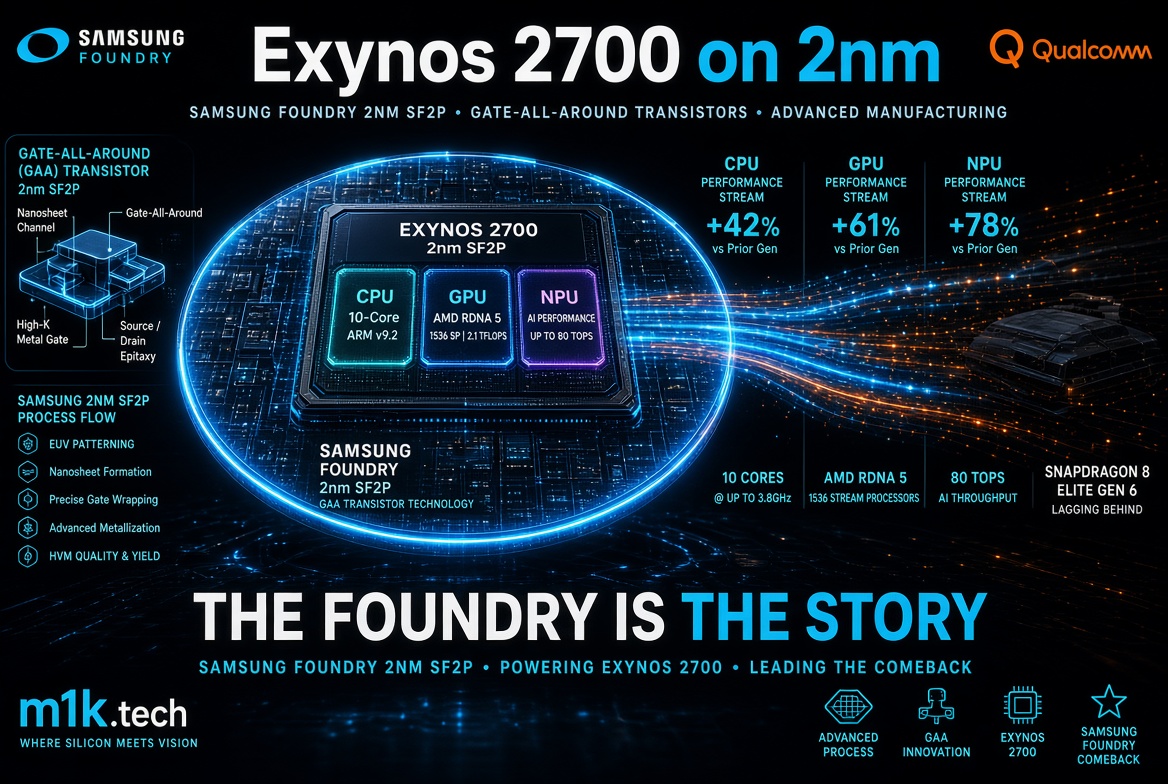
Nineteen percent. That’s how much faster Samsung’s internal Geekbench 6.5 runs say the unreleased Exynos 2700 is in multi-core CPU work than Qualcomm’s next flagship, the Snapdragon 8 Elite Gen 6, according to numbers reported by Yonhap and picked up by SamMobile this weekend. Against the higher-binned Snapdragon 8 Elite Extreme Gen 6, the gap narrows to 9.5 percent, still a win. The GPU numbers lean the same way, and so does the NPU. I’ve read a lot of Samsung-beats-Qualcomm claims over the years, and normally I’d file this under marketing noise and move on. This time I actually paused, because the chip behind these numbers is the first Exynos built on Samsung’s 2nm SF2P node, and the foundry story underneath the benchmark story is the part worth taking seriously.
Some context for anyone who tuned out of Exynos after the last few generations, which is a reasonable thing to have done. Samsung killed global Exynos entirely for the Galaxy S23 in 2022, after the Exynos 2200’s AMD RDNA2-based Xclipse GPU turned in performance nobody wanted to defend and thermal throttling that got worse the harder you pushed it. Snapdragon took over every S23 market worldwide, which is the kind of admission a company doesn’t walk back on a whim. Exynos crept back into some regions with later generations, but the pattern held: whatever Samsung’s own chip team built, it usually lost to whatever Qualcomm’s team built, on the same phone, sold in different countries depending on modem availability and yield. So when a leak says the newest one wins across CPU, GPU, and NPU simultaneously, my first reaction is skepticism, not excitement.
The specific numbers, since they’re worth having in front of you before I get to why I don’t fully trust them yet: 19 percent faster multi-core CPU than the 8 Elite Gen 6, 9.5 percent faster than the Extreme variant. The Xclipse 970 GPU is 5 percent ahead of the Extreme chip at peak, and pulls further out, 22 to 24 percent, once you cap both chips at a 2.5-watt power budget, which is the number that actually matters on a phone that has to survive a day of use rather than a five-minute benchmark run. The NPU claims an 18 percent edge over the Extreme Gen 6 running Llama 3.1 8B locally. All of it traces back to a Geekbench listing showing a 10-core CPU and 12GB or more of RAM, paired with sourcing that Yonhap attributes to people familiar with Samsung’s internal testing, not an independent lab, and not silicon anyone outside Samsung has touched yet.
Here’s where I think the story is more interesting than “chip beats chip.” Samsung’s SF2 node has been positioned as the foundry’s comeback bid since it started sampling last year, gate-all-around transistors built to close the efficiency gap that’s dogged Samsung Foundry against TSMC for most of the last decade. If the Exynos 2700’s power-capped GPU numbers hold up in retail silicon, that’s not really a story about Samsung’s chip design team suddenly out-executing Qualcomm’s. It’s a story about Samsung Foundry finally shipping a process node that lets a merely competent chip design look competitive, because for years the design team’s work has been getting undercut by a manufacturing process a full generation behind whatever TSMC was running for Qualcomm. That’s a fixable problem in a way that “our architects are worse” isn’t, and it’s why I’m not dismissing this outright.
I also can’t shake the parallel to Xiaomi’s Xring O1 from last year, because it’s the same shape of story with a different ending. Xring O1 beat the Snapdragon 8 Elite on AnTuTu when it launched, a real result on a real benchmark, and then it turned out the chip quietly leaned on a licensed modem rather than a fully in-house one, which didn’t erase the CPU win but did puncture the “Xiaomi doesn’t need Qualcomm anymore” framing that came with it. Vendor benchmarks aren’t lies, usually. They’re just optimized for the one number that makes the press release, and the number that doesn’t make the press release is the one you find out about six months later. Samsung’s own history makes this specific pattern worse than usual: Exynos W quietly died in the Galaxy Watch line entirely earlier this year, replaced by Snapdragon Wear Elite, which tells you Samsung’s own product teams weren’t willing to bet a wearable on in-house silicon even as this smartphone chip’s numbers were reportedly already looking good internally. That doesn’t prove the Exynos 2700 numbers are wrong. It’s a reason to wait for someone outside Samsung to run the same test.
None of this is architecturally novel in the way a new node sometimes is. Nobody’s claiming a new core design or a radical NPU rethink, just a familiar Exynos design finally paired with a foundry process that isn’t apologizing for itself. That’s almost more convincing than a flashy architecture claim would be, because “the manufacturing finally caught up” is a boring, believable story in a way “we suddenly out-designed Qualcomm” isn’t. Qualcomm hasn’t formally announced the 8 Elite Gen 6 yet either, so the comparison numbers could shift once Qualcomm’s actual retail specs land, and Samsung’s internal target could easily be chasing a moving benchmark.
Where this lands, if the numbers survive contact with independent testing, is a Galaxy S27 where the chip allocation question actually matters again for the first time since 2022, instead of being a formality where everyone just assumes Snapdragon wins and Exynos gets the leftover markets. I’m not betting on that yet. I’ve seen this specific headline before, and the last two times it didn’t survive first contact with a phone in someone else’s hands. But the foundry story underneath it is real regardless of how the chip performs, and I do believe that.
Sources
- SamMobile, Galaxy S27’s Exynos 2700 could outpace Snapdragon in speed and efficiency, August 23, 2026
- Yonhap News Agency, original sourcing on Samsung’s internal Exynos 2700 benchmark comparisons, August 21, 2026