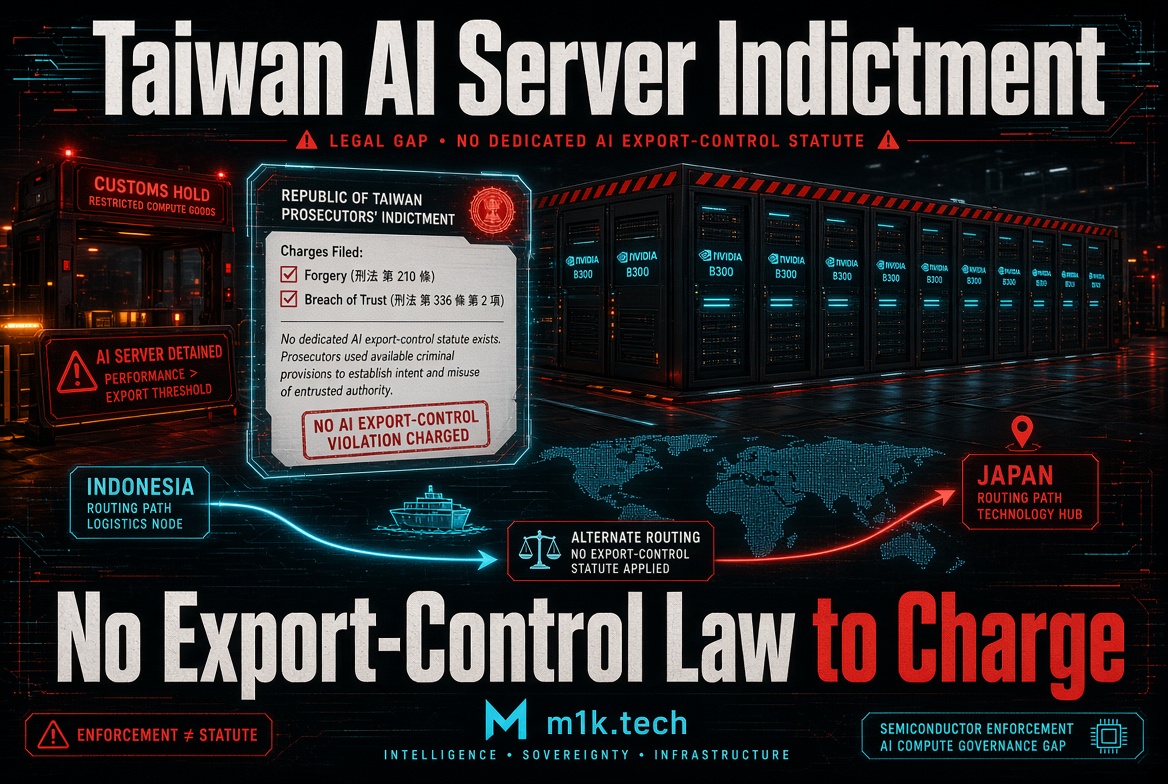
Chang Deng-Lung ran sales for Nvidia’s Taiwan division. Prosecutors in Keelung say he helped move seventy-four AI servers built on Nvidia B300 chips into China by routing them through Indonesia and Japan, and when they indicted him and eight others this week over the AI server smuggling scheme, they couldn’t charge any of them with breaking an export-control law. Taiwan doesn’t have one that covers this. Prosecutors used forgery and breach-of-trust statutes instead, because those are the tools sitting in the drawer.
The mechanics read like a customs manual. Fifty servers went out through Indonesia, eight through Japan, the rest shipped straight to China, and Taiwanese customs still caught fifty-six more at the border before they left. Two of the defendants, both former Super Micro Taiwan employees, allegedly netted more than twenty-one million dollars in profit reselling chips they knew Nvidia and Super Micro kept under rigorous export controls, according to the indictment’s own language. I keep coming back to that profit figure. Twenty-one million dollars is real money for the people involved and a rounding error against what a smuggling channel at real scale would need to move, which suggests opportunism within an existing sales relationship, not a purpose-built pipeline. The alleged mastermind, a server trader named Chen O. Chieh who ran a company called Feihu Technology, is still at large.
What makes this case different from the last one is the badge. In March, the US government charged Super Micro co-founder Wally Liaw with running a scheme allegedly worth $2.5 billion, and both companies were able to treat that as an outside-actor problem, a founder gone rogue, nothing that touched daily operations. This time Chang worked inside Nvidia’s own Taiwan sales division, not adjacent to it. Nvidia’s statement that it will work with Taiwanese authorities to resolve the allegations sounds like a company trying hard to make this seem like it isn’t its problem, and I don’t blame them for trying, but it reads thin with a current employee sitting in the indictment.
I don’t think nine people forging paperwork proves Nvidia has a smuggling culture, and Super Micro’s own internal investigation reportedly found no evidence senior management knew anything. But the rogue-employee defense gets harder to lean on every time the rogue employee turns out to have worked the actual sales desk instead of some loosely affiliated reseller three steps removed. Qualcomm built an entire edge-silicon business specifically shaped to stay inside export lines instead of testing them, and it’s hard not to notice the contrast: one company treated the restrictions as a design constraint from the start, the other is now explaining why an employee treated them as a paperwork problem to route around.
The demand side isn’t a mystery either. China’s integrated circuit exports were already up 88.7 percent this year, a number that only makes sense if a meaningful slice of restricted compute is finding its way in through routes exactly like this one instead of the ones anyone is tracking cleanly. B300 sits at the top of Nvidia’s Blackwell line, chips that are already scarce and expensive on the legal market, which is exactly the condition that makes a twenty-one-million-dollar black-market premium worth forging paperwork over.
Malaysia went a different direction than Taiwan entirely, building its own licensing requirements around AI chip transshipment before Washington even had to ask, precisely because it sits on one of the routes chips like this move through on the way to China. Taiwan’s problem isn’t that it doesn’t see the same traffic; it’s that the traffic runs through a jurisdiction whose legal system was never built around the assumption that exporting AI hardware would become a Taiwanese crime scene.
What actually changes here is narrower than the headlines will make it sound. Taiwan still doesn’t have a law against exporting restricted AI hardware, only laws against lying about it, and lawmakers there have reportedly been saying that gap needs closing for a while without doing much about it. Keelung’s prosecutors caught this one because customs flagged fifty-six servers at the border, not because the law gave them a clean tool to work with. I’d want to know how many shipments didn’t get flagged before I called this the moment Taiwan closed the loophole, because right now it’s still open. Prosecutors are just getting creative about what they charge people with when someone walks through it.
Sources
- Ars Technica, Nvidia senior manager linked to Supermicro scheme smuggling AI servers to China, August 24, 2026
- BigGo Finance, Taiwan Charges Nine, Including Nvidia and Super Micro Staff, in AI Server Smuggling Scheme, August 24, 2026
- Silicon Republic, Taiwan indicts nine for allegedly exporting AI servers to China, August 25, 2026
- GIGAZINE, Taiwanese prosecutors have indicted nine employees of NVIDIA and Supermicro on suspicion of smuggling AI servers into China, August 25, 2026