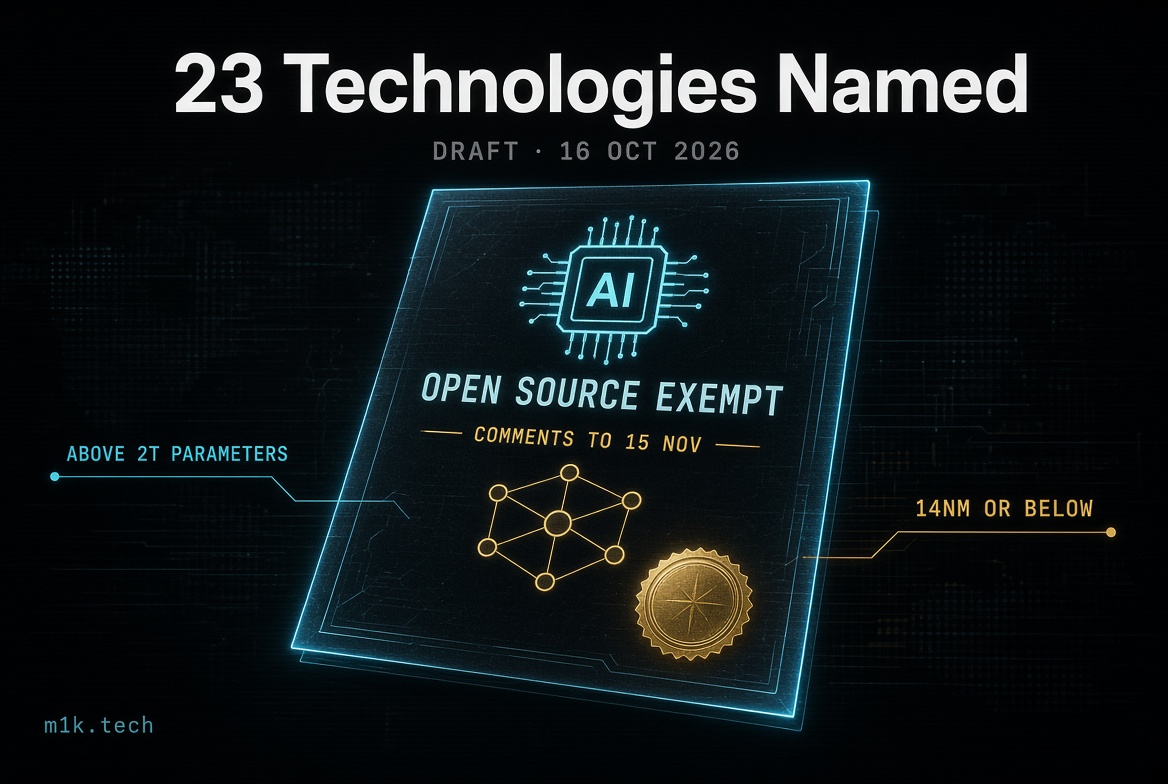
China’s draft AI export controls list 23 technologies Beijing doesn’t want sold abroad, from a list of 40 items that also includes solar and biomedicine.
The commerce and science ministries published the draft on Friday 16 October, with public comment open until 15 November. A temporary registration rule took effect the same day, so anyone exporting something on the list must register first, including for deals that haven’t closed. Until the comment period ends, none of the list is final.
For large models, the controls would reach weights, source code, and other core components, but only above 2 trillion parameters or for models ranked in the world’s top ten on performance and safety tests, as Bloomberg reads the text. The draft names no model; Moonshot’s Kimi K3 and Alibaba’s Qwen3.8-Max are reported to sit over the line. That second name bothers me, because in August I wrote about Qwen3.8 Max going open weights and Alibaba beating Meta to the laptop model. The ministry says open-source code and published research are exempt, yet weights that are already public are a messier case, and nothing in the coverage I’ve seen explains how the draft treats them. I’d want the full text before calling that settled.
The chip side is blunter. The list includes design know-how for AI chips at 14 nanometres or below, or built with 2.5D or 3D stacking, plus some memory designs. That is the same territory as the Ascend 960DT roadmap Huawei pulled forward and Alibaba’s Zhenwu V900, though the draft names neither company, and the ministry insists it targets no country or firm. I can’t tell yet whether the aim is blocking copies or stopping design houses from selling IP to anyone who might later land on a US sanctions list.
Services stay open. Apps, websites and APIs are untouched, so someone in Lyon can still call a Chinese model, but running a covered model on servers abroad counts as an export, with automatic licenses possible for firms hosting it on their own cloud. Anyone in Europe building on hosted Chinese weights should read that clause twice. To me, it also reads like the mirror image of Washington’s Pax Silica letter, which treated AI alliances as a loyalty test; now Beijing is drawing its own line around what counts as inside.
One wrinkle in the counting: one outlet describes 14 technologies facing outright bans and 26 more facing new restrictions, while another counts 23 AI items inside the 40. They may be different cuts of the same annex. I can’t reconcile them from the summaries.
Comments close 15 November. My bet is that the open-source exemption survives and the chip-design clause takes the fight.
Sources
- The Next Web: China proposes export controls on its advanced AI models and chip designs, 16 October 2026
- Bloomberg: China Plans AI Tech Export Curbs to Manage Security Risks, 16 October 2026
- South China Morning Post: China mulls new tech export bans covering AI, biotech and solar power, 16 October 2026