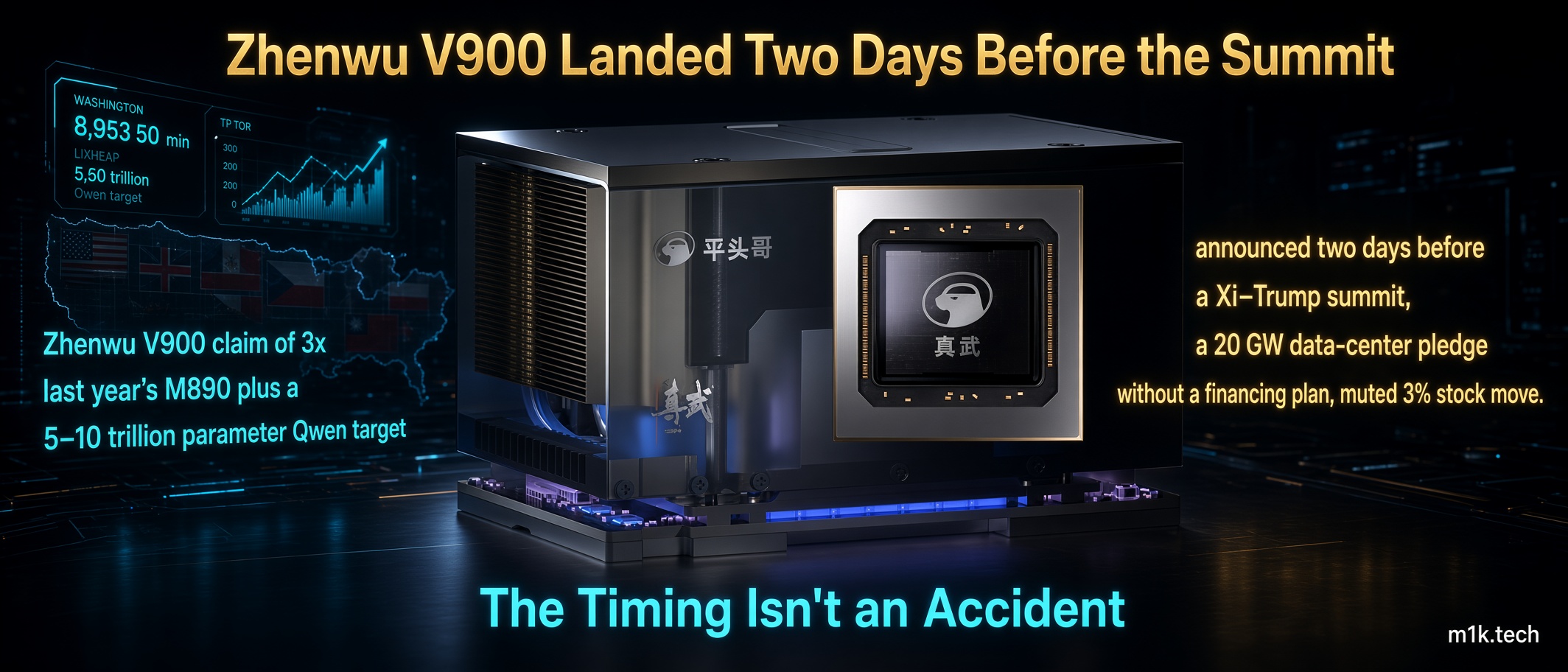
Eddie Wu stood up at Alibaba’s Apsara Conference in Hangzhou this week and unveiled the Zhenwu V900, a new AI chip Alibaba says triples the performance of last year’s Zhenwu M890, then asked everyone to believe an even bigger number alongside it: a Qwen model somewhere between 5 and 10 trillion parameters, more than double the 2.4 trillion already running in Qwen3.8-Max. I’ve read the Zhenwu V900 announcement a few times now, and I still can’t tell which number is supposed to carry the pitch, the chip or the model, because Alibaba needs both to be true for either one to matter on its own.
The chip claim is the one nobody outside Alibaba can check yet. “Three times faster” tells you nothing about the workload it was measured against, and the wire coverage didn’t come with a benchmark methodology attached. The parameter target is easier to sit with skeptically, because going from 2.4 trillion to 5 or 10 trillion isn’t a tuning pass. It’s a different training run with different memory requirements and a training bill Alibaba hasn’t detailed anywhere in the announcement.
Then there’s the 20 gigawatt data center target by 2032, and that’s the number that actually made me raise an eyebrow. Alibaba raised $10.2 billion in a single afternoon last month, and at the burn rate the company was already running, that money buys about one quarter of the AI infrastructure spend it’s committed to. Six years is a long runway to hide a financing gap behind, and Alibaba isn’t saying how it plans to close it.
Shares moved about 3% on the news, which is a modest pop for a company that’s made a habit of AI announcements this year, and I think the muted reaction says something. Investors have seen this shape before: a chip claim paired with a model roadmap paired with a data center commitment, all timed to land right when it’s useful. The timing here isn’t subtle. Xi Jinping arrives in Washington on Wednesday for a summit with Trump, and a domestic AI chip announcement two days ahead of that meeting reads less like a product launch and more like a card Beijing wanted on the table before anyone sat down. Treasury Secretary Bessent had already floated a bilateral AI incident notification mechanism to Vice Premier He Lifeng over the weekend. Chip capability is part of what gets negotiated, even when nobody says it out loud.
What makes the Zhenwu claim worth watching rather than dismissing outright is the company it’s keeping. Meta’s own custom inference chip landed from TSMC on September 1 and started running DeepSeek’s models within days, proof that wanting your own silicon instead of paying Nvidia’s margins isn’t a China-only impulse anymore. TSMC just raised its own 2nm and CoWoS capacity guidance to meet exactly this kind of demand, from customers on both sides of the export control line. If the Zhenwu V900 is real and not just a slide, it’s built somewhere in that same supply chain or a domestic substitute for it, and either answer matters more than the announcement itself.
The parameter race is the part I actually believe, because DeepSeek already proved you can undercut everyone else’s pricing by an order of magnitude without matching Western labs’ compute budgets, and Mistral is now hosting Chinese model weights outright instead of pretending the split between Western and Chinese open models doesn’t exist. A 10-trillion-parameter Qwen slots into a race that’s already running. The chip and the data center figure are doing PR work for an audience in Washington this week, not for anyone who actually has to train the thing.
Sources
- CNBC, Alibaba unveils new AI chip, plans model with 5 to 10 trillion parameters, September 22, 2026
- Reuters, Alibaba plans AI model with 5 trillion to 10 trillion parameters, unveils new chip, September 22, 2026
- AP News, US proposes AI notification mechanism to China ahead of Trump-Xi summit, September 21, 2026