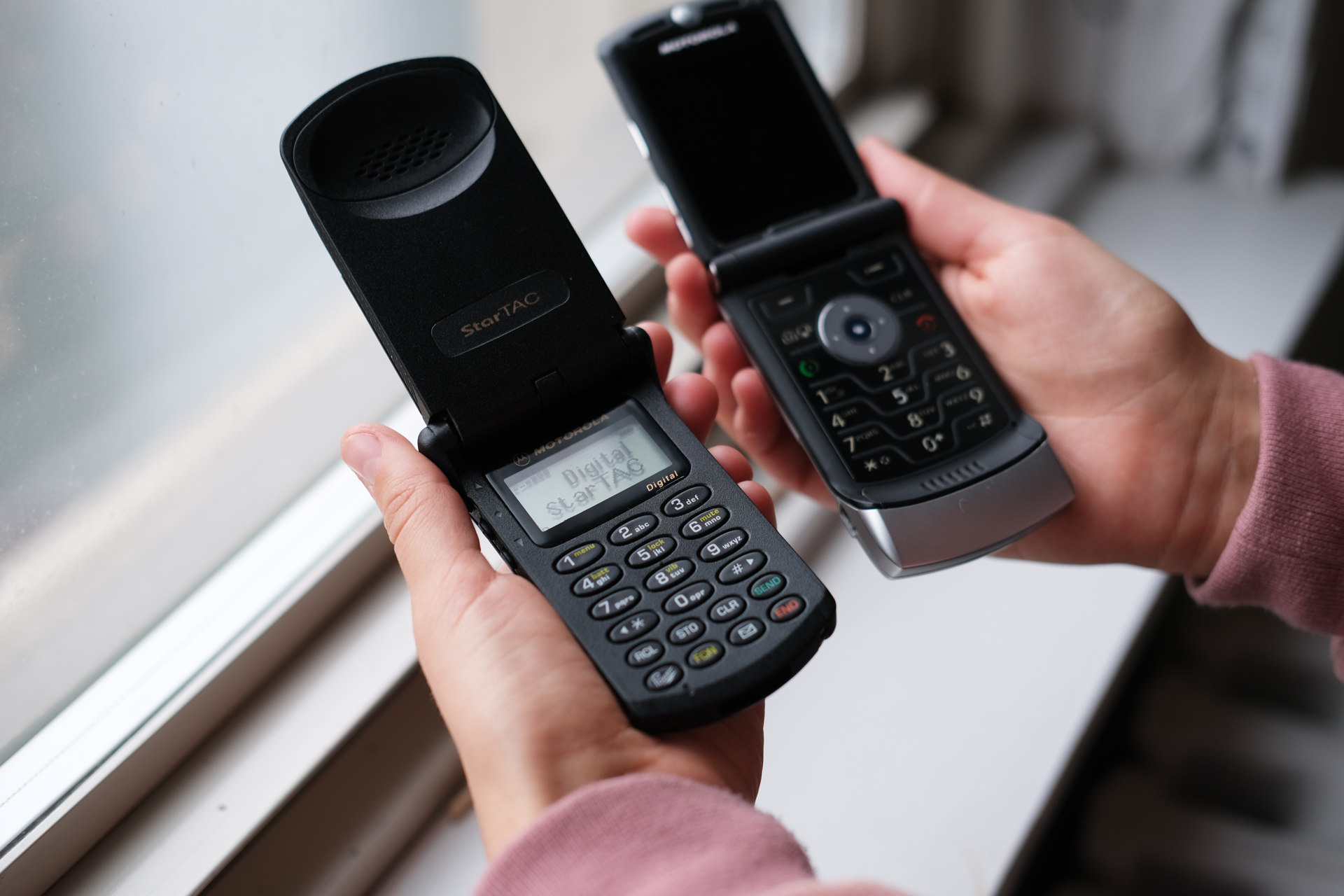
The Razr has now sold somewhere north of fifty million units, and I want to sit with that number for a moment, because it is genuinely absurd.
Fifty million is not a successful phone. It is a phone that has escaped its category and become an object people buy the way they buy sunglasses. Motorola launched it at around five hundred dollars in late 2004 as a halo product, a demonstration that the company could still do something extraordinary after years of being comprehensively out-executed by Nokia. It was never meant to be the volume seller. It became the volume seller anyway, and it did so while getting cheaper every quarter.
What made it work was not any single feature. The Razr has an unremarkable camera, a screen that was fine in 2004 and is now merely adequate, and software I will come back to. What it has is a shape. The aluminium, the etched keypad, the way the hinge sounds when it closes. Somebody at Motorola understood that a phone spends most of its life being looked at rather than used, and designed for the looking.
The company’s share has climbed accordingly and Ed Zander has been credited with a turnaround that is, to be fair to him, real. Motorola went from an afterthought to the second largest handset maker on the strength of one industrial design decision.
Here is what worries me about it, and I do not think it is a small thing.
The Razr’s price has fallen from five hundred dollars to free on a contract in about eighteen months. That is what happens to fashion products, and Motorola has responded by making more of them: thinner Razrs, coloured Razrs, the Pebl, and a flattened candybar version. Every one of those is the same design language in a different aspect ratio. The company has essentially one idea and is monetising it very hard.
Compare that to how Nokia operates. Nokia ships an enormous number of different phones because it does not know which one a given customer wants, and it does not need to know, because one of the forty will fit. That is a portfolio strategy and it is boring and it is extremely robust. Motorola’s approach is to be certain, and being certain works beautifully until taste moves.
Taste always moves. Nobody in fashion has ever avoided it. When the clamshell in brushed metal stops reading as desirable and starts reading as the phone your dad has, Motorola does not lose a product line, it loses the reason anybody was buying from it. There is no second pillar. The software has never been good enough to retain anybody, the enterprise business belongs to RIM, and the operating system is licensed from Microsoft on the devices where there is one.
I would enjoy being wrong. A strong Motorola makes this a better industry, and the Razr is the most likeable object anybody has made in this category for years. But a company whose entire competitive position rests on one silhouette is running a clock it cannot see, and the clock has been running since November 2004.