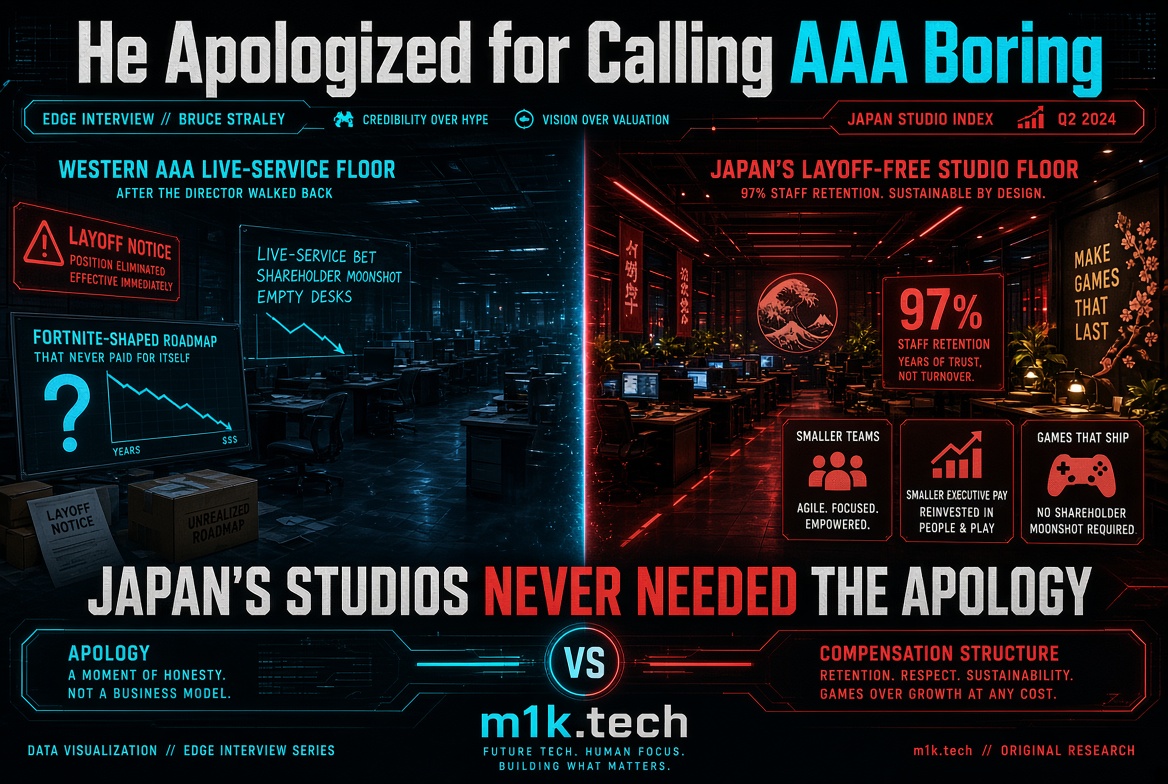
Bruce Straley didn’t need to apologize for saying AAA games are boring, not when Japan’s studios are dodging the very layoffs crisis gutting the rest of the industry. The director of The Last of Us and Uncharted told Edge that most AAA games bore him now, used God of War Ragnarok: Laufey as his example of gorgeous but forgettable, and by the time anyone at Santa Monica Studio had a chance to respond, he was already walking it back, insisting his real target was the industry’s chase after Fortnite-shaped live-service hits, not any one game. The apology reads like a man who forgot, for a second, that saying something true about AAA out loud now gets treated as an attack on the people still working inside it.
I don’t think he was wrong the first time. The apology, though, might be the more interesting data point, because it tells you how thin the ice is under every studio still betting on a live-service hit that hasn’t landed yet. Amazon just handed Lost Ark and Throne and Liberty back to their Korean owners rather than keep operating them, which is one western publisher admitting the GaaS math never worked for a title it didn’t build. Halo Studios cut people days after Campaign Evolved actually succeeded, because a good launch doesn’t pay down years of live-service infrastructure spend that came before it. The pattern isn’t that AAA studios keep failing. It’s that they keep building for a business model only a handful of games on earth actually support, then act surprised when the odds catch up.
Which is what makes the other interview making the rounds this week land so hard. Amir Satvat, who used to run business development for Tencent Games, told Edge that Japanese publishers, Nintendo, Konami, Capcom, are sitting at something like 97 percent staff retention while North American and European studios go through what he calls an ’83-crash-level contraction. His explanation isn’t culture or luck. It’s compensation and appetite. In his framing, Japanese executives are paid two or three million dollars instead of the thirty million a Western studio head can pull, which means no personal fortune is riding on chasing a live-service moonshot before the next earnings call. Smaller teams and smaller bets, and nobody with nine figures of unvested equity pushing the roadmap toward whatever a shareholder deck says is trending this quarter.
I want to be careful here, because “Japan does it better” is exactly the kind of clean, symmetrical takeaway that should make you suspicious of yourself for reaching it. Japanese publishers have had their own disasters, and Capcom spent years grinding out mediocre sequels before the Resident Evil remake era turned things around. The retention numbers Satvat cites also cover a period when the Western industry’s live-service crash was unusually bad, not proof of a permanent structural gap. But the executive pay comparison is the piece I keep chewing on, because it’s the only explanation in either interview that isn’t about talent or timing. It’s about whether the person greenlighting the project has anything real to lose if the bet fails.
Sony won this console generation by mostly not chasing what Microsoft was chasing, and Blizzard is now making its own version of that same gamble with a StarCraft shooter that won’t ship until 2030, four years of runway to prove a genre pivot works before anyone can call it a mistake. That’s either patience or exactly the kind of long, expensive bet Straley apologized for pointing at. I couldn’t tell you which one it’ll turn out to be, and neither can anyone at Blizzard right now, whatever the roadmap says.
Sources
- Video Games Chronicle, The Last of Us director apologises to God of War Laufey team, September 19, 2026
- GamesRadar+, The Last of Us director apologizes for using God of War Laufey as an example of lack of innovation in AAA, September 19, 2026
- PC Gamer, Japanese devs aren’t facing the same layoff crisis, September 19, 2026