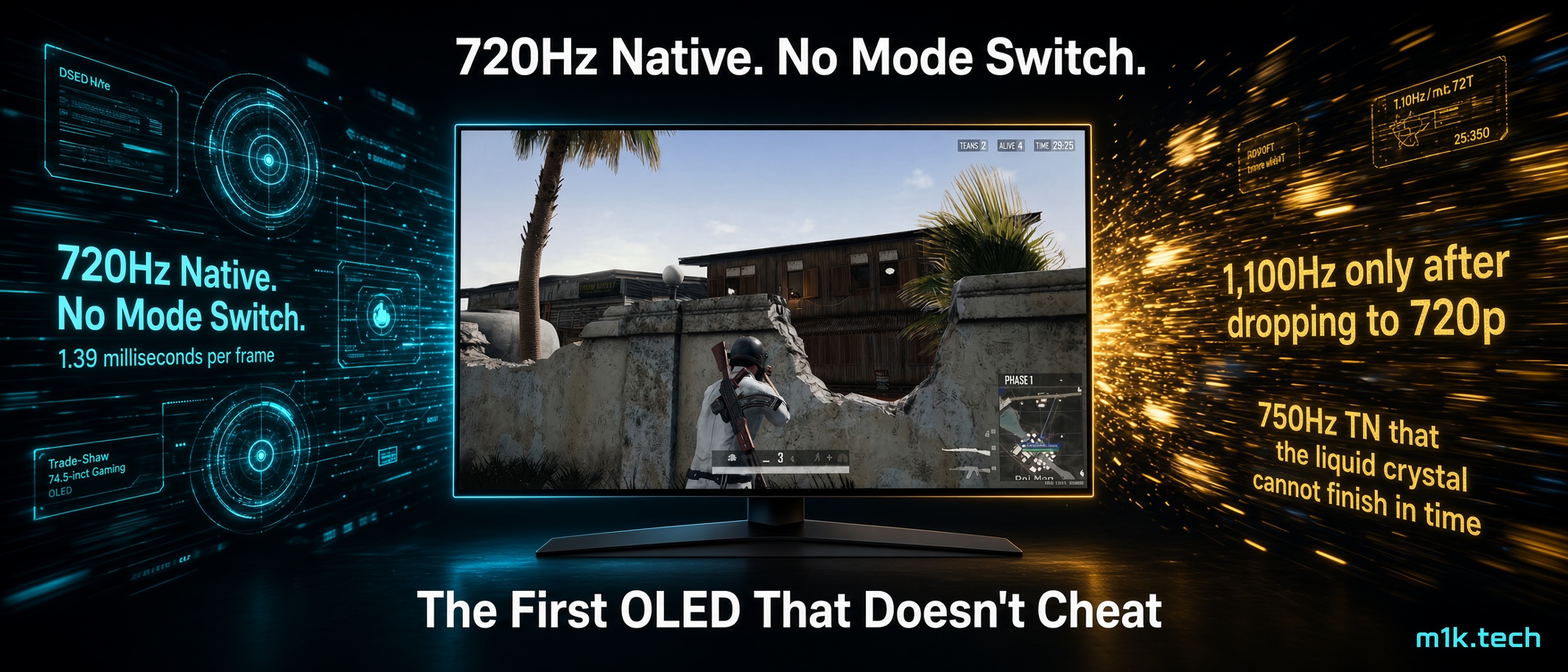
1.39 milliseconds. That’s how long each frame sits on screen on the 720Hz OLED panel LG Display says it has started mass-producing, and it’s the only number in the whole announcement I actually trust. The panel is 24.5 inches, runs at 1920×1080, claims a 0.02ms response time, and LG Display is pitching it as the first OLED built specifically for esports rather than a gaming TV panel cut down to monitor size.
The launch partner isn’t a mystery either, even though the press release leans coy about it. It’s ASUS, and the monitor is the ROG Swift OLED PG259QWS Ace, which ASUS announced last month without saying whose panel was inside. For a few weeks, the assumption was BOE, because ASUS rolled out three 24.5-inch OLEDs at once and one of them does carry a BOE panel. The 720Hz flagship is LG Display tandem WOLED. I’ll admit I half-believed the BOE story too, mostly because it would have made for a more interesting headline.
What makes this worth a post is the word “native.” Refresh-rate records have turned into a shell game over the past eighteen months. Samsung’s Odyssey G6 advertises 1,100Hz, but only after you drop it to 720p; at QHD it tops out at 600Hz. ASUS’s own ROG Swift OLED PG27AQWP-W is a 540Hz QHD panel. Dual-mode displays, including LG Display’s own DFR (Dynamic Frequency and Resolution) parts, trade pixels for frames and then print the bigger number on the box. This panel does 720Hz at its full 1080p resolution, with no mode switch and nothing thrown away, and that’s the actual achievement here.
The OLED material was never the bottleneck. Organic emitters switch in microseconds, which is why OLED response-time specs have been absurd for years. The hard part is the electronics that address the pixels. At 720Hz you get 1,389 microseconds per frame to program 1,080 rows, which works out to roughly 1.3 microseconds per row before you subtract any blanking interval. An OLED pixel isn’t a simple switch, because each one has a drive transistor whose threshold voltage drifts and needs compensating every time you write it, and my read is that shrinking the per-row window is exactly where a naive design falls apart: less time to compensate means more non-uniformity, which shows up as mura and gray-level banding. LG Display credits a proprietary driving algorithm plus an integrated design spanning the panel and its drive system. Translated out of press-release language, the timing controller and driver ICs were the engineering problem, and LG’s large-panel WOLED lines already run on oxide TFT backplanes, which gives it more electron mobility to play with than the amorphous silicon that LCD panels at this size still lean on.
Then there’s the 0.02ms figure, which I’d ignore. Twenty microseconds is a vendor best-case gray-to-gray transition under vendor test conditions, and it stopped being the limiting factor on OLED about three generations of monitors ago. On a sample-and-hold display, motion blur comes from how long each frame is held on screen while your eye keeps moving, and that’s set by the frame interval, not the pixel transition. The math is easy to run. Track an enemy moving at 2,000 pixels per second (a fast strafe across a 1080p screen) and a 240Hz display smears it across about 8 pixels. At 360Hz it’s closer to 5.6. At 720Hz it’s under 3.
That’s also why OLED at 720Hz is a different proposition from LCD at 720Hz, and the difference is the entire competitive argument. An LCD only delivers its frame-interval clarity if the liquid crystal finishes every transition inside the frame. At 600Hz that window is 1.67ms, and even Fast TN panels don’t complete their slow transitions in that time, which is precisely why BenQ’s Zowie line leans so hard on DyAc backlight strobing to hide the smear. OLED gets the full benefit of the refresh rate without strobing, overdrive tuning, or inverse ghosting when overdrive is pushed too hard.
| Monitor | Panel type | Resolution | Max refresh at native res | Headline refresh |
|---|---|---|---|---|
| ASUS ROG Swift OLED PG259QWS Ace | LG Display tandem WOLED, 24.5″ | 1920×1080 | 720Hz | 720Hz |
| Samsung Odyssey G6 | OLED (dual-mode) | 2560×1440 | 600Hz | 1,100Hz at 720p |
| ASUS ROG Swift OLED PG27AQWP-W | OLED, 27″ | 2560×1440 | 540Hz | 540Hz |
| BenQ Zowie XL2586X+ | Fast TN | 1920×1080 | 600Hz | 600Hz |
| AntGamer ANT257PF | Fast TN (HKC) | 1920×1080 | 750Hz | 750Hz |
So no, 720Hz isn’t the biggest refresh rate you can buy. AntGamer ships a 750Hz TN monitor on an HKC panel, and AOC and AntGamer both have 1,000Hz TN displays penciled in for this cycle. LG Display’s claim is carefully worded as the highest refresh rate among gaming OLEDs, and on a per-pixel-clarity basis I’d take a 720Hz OLED over a 750Hz TN every day of the week, because the TN panel is quoting a refresh rate its liquid crystal can’t fully keep up with.
The size choice is the part that tells you who this is for. Competitive players settled on the 24-inch class a decade ago because you can take in the entire screen without moving your eyes, and that’s why the pro circuit stayed on small 1080p TN panels while everyone else drifted to 27-inch QHD. It’s the last big monitor category OLED never cracked. ASUS is wrapping the panel in 1,700 nits of peak brightness, Dolby Vision, 99.5% DCI-P3 coverage, and a position sensor that logs height, tilt, and swivel so a player can reproduce the exact same setup between a practice room and a tournament stage. That last feature is the most esports thing I’ve read all month. It ships early in Q4 at $1,099 (€1,149).
The spec sheet matters less than the booking, though. The PG259QWS Ace is the official monitor of the PGL Counter-Strike 2 Major in Singapore, the first PGL Major played on OLED. Tournament stages are where esports hardware reputations get made, and they’ve been Zowie territory for about as long as I can remember. If a room full of CS2 pros sits down in front of an OLED and nobody complains, the “TN is still king for competitive” advice that every buyer’s guide repeats goes stale overnight.
Whether they’ll complain comes down to burn-in, and I’m not fully convinced LG Display has put that to bed. Esports is close to a worst case for OLED wear: a static HUD, a static minimap, a static kill feed, the same game for eight hours a day. Tandem WOLED stacks help because each emitter layer runs at lower current for the same brightness, and ASUS has shipped OLED care routines for years, but a pro practicing one title all day is a very different duty cycle from a gamer who switches between Cyberpunk and YouTube. Nobody has published long-term wear data on this panel, because it’s been in mass production for about five minutes.
There’s also the question of who can feed it. Counter-Strike 2 and Valorant at 1080p on low settings can push a high-end CPU and GPU into this range, and that’s basically the whole list. Frame generation doesn’t rescue anyone here, because interpolated frames add latency, and latency is the one thing a 720Hz esports monitor exists to remove. Upscalers are where GPU vendors keep finding cheap performance, and Sony’s PSSR 2.0 rework is a good example of how clever that engineering has gotten, but none of it produces a real rendered frame every 1.39 milliseconds. Neither does the growing pile of matrix cores bolted onto GPUs for neural rendering. For a pro, the CPU is the ceiling. For everybody else, a 720Hz panel will spend most of its life waiting.
I’m not getting into the cable question here, and it’s a real one: 1080p at 720Hz is roughly 45 Gbit/s of raw 10-bit pixel data before blanking, well past what DisplayPort 1.4 carries without compression, and I haven’t seen ASUS spell out which link and which DSC mode it uses. That’s its own rabbit hole for when review units land.
What interests me more is the business behind the launch. LG Display booked a ₩975 billion net loss in the first half of 2026 while it kept pouring money into OLED capacity, and it’s openly framing this panel as the start of “mainstreaming” OLED across esports monitors. Halo panels like this one have a habit of reappearing eighteen months later in mid-range models, minus the brightness, minus the sensor, at a third of the price. That’s the product LG Display actually needs, and it’s the one that would put Zowie’s whole business model under pressure. ASUS already knows how to sell a halo object (the wraparound-AMOLED Astral RTX 5090 Edition 20 was pure theatre), but this one has a job beyond looking good on a show floor.
I think OLED will take the esports stage within two years, and I think the refresh rate will be the least important reason why. Clarity per frame is what wins, and TN can’t match it at any refresh rate without strobing.
Sources
- LG Display, LG Display launches 24.5-inch 720Hz Gaming OLED Panel, September 2026
- ASUS ROG, New 24.5-inch ROG monitors bring OLED panel tech to the esports arena
- Hardware Busters, The 720Hz OLED Panel Is LG Display’s, Not BOE’s, September 21, 2026
- Notebookcheck, AntGamer teases 1,000Hz TN eSports monitor