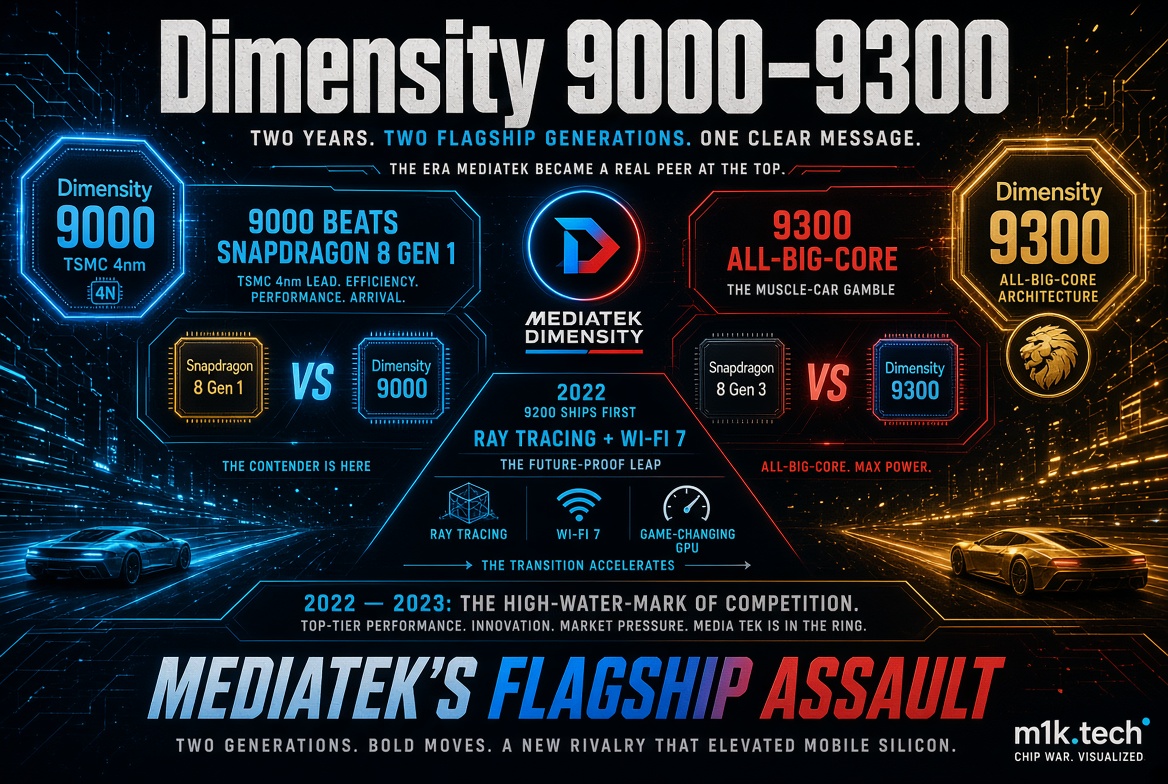
For years, the honest answer to whether you should care about a MediaTek flagship was no, because none were worth the word. The Dimensity 9000 changed that in a way I did not expect. It reached early 2022 phones as the first mobile chip built on TSMC’s 4nm node, and the timing was almost unfair: Qualcomm had put the Snapdragon 8 Gen 1 on Samsung’s 4nm, which ran hot enough to become a meme, so for one whole generation, MediaTek’s flagship was simply the cooler, more efficient one. It carried an Armv9 Cortex-X2; it broke a million points in AnTuTu before any other Android phone, and no, it did not win everything; single-core still trailed Qualcomm. But for the first time in the company’s history, the honest answer flipped to yes.
What MediaTek did next is the part I respect more than the raw scores. Instead of playing catch-up on Qualcomm’s terms, it started shipping features first. The Dimensity 9200 brought hardware ray tracing and Wi-Fi 7 to its flagships in late 2022, both ahead of the Snapdragon equivalent, and it rode an Immortalis-G715 GPU and a Cortex-X3. Ray tracing on a phone is mostly a demo-reel flex, and I will not pretend I play many ray-traced mobile games, but being first to ship it mattered for a company that had spent a decade copying late and cheap. The narrative was inverted.
The all-big-core gamble
In November 2023 MediaTek did the boldest thing it had tried in years. The Dimensity 9300 threw out the little cores entirely, running four Cortex-X4 big cores next to four A720s with nothing underneath, an all-big-core layout nobody else would touch. President Joe Chen called it the company’s most powerful flagship yet, and on multi-core and on-device AI he was basically right: the APU 790 could run billion-parameter language models locally, exactly when generative AI became the thing every chip vendor had to have a slide about. It was a muscle car, raw power over finesse, and it edged the Snapdragon 8 Gen 3 in the workloads that reward brute force. The catch, and there is always a catch with MediaTek, is that a phone with no efficiency cores runs on borrowed thermal headroom, so under sustained load the 9300 heated up and throttled while Qualcomm’s more balanced design held steadier. Adreno still won the actual gaming too, whatever the ray-tracing checkbox claimed. I’m leaving the camera-ISP fight out of this, Qualcomm’s Spectra kept a quiet lead there that deserves its own breakdown.
The real tell is what Qualcomm was doing at the same time. The Snapdragon 8 Gen 3 held the line rather than pushing it, a safe, well-optimized 1+5+2 chip that leaned on software maturity and the Adreno GPU while the company saved its real move for the following year. Qualcomm could afford to coast a cycle because it knew something no MediaTek spec sheet could answer: a custom CPU core was already in the pipeline. MediaTek was sprinting flat out. Qualcomm was pacing itself before a reset.
- Dimensity 9200: ray tracing and Wi-Fi 7
- Dimensity 9300: the all-big-core gamble
- Snapdragon 8 Gen 3 holds the line
This two-year stretch is the high-water mark for MediaTek as a real peer at the top, and I don’t think that gets said clearly enough. It shipped ray tracing and Wi-Fi 7 before Qualcomm did, edged the 8 Gen 3 on multi-core, and beat the whole industry to running real language models on a phone, which still surprises me. That would have been science fiction in the Helio years. But muscle-car engineering has a ceiling, and you hit it with your thermal budget, and MediaTek was flooring it right as Qualcomm walked off to build a custom core that would change the terms of the fight. The assault worked. Whether MediaTek can hold the ground it has taken is the next chapter, and it is not a comfortable one.
Two decades of MediaTek, oldest to newest: Turnkey Empire (2006-2015) · Helio Years (2015-2019) · Dimensity 5G (2019-2021) · Flagship Assault (2022-2023) · The AI Turn (2024-2026)