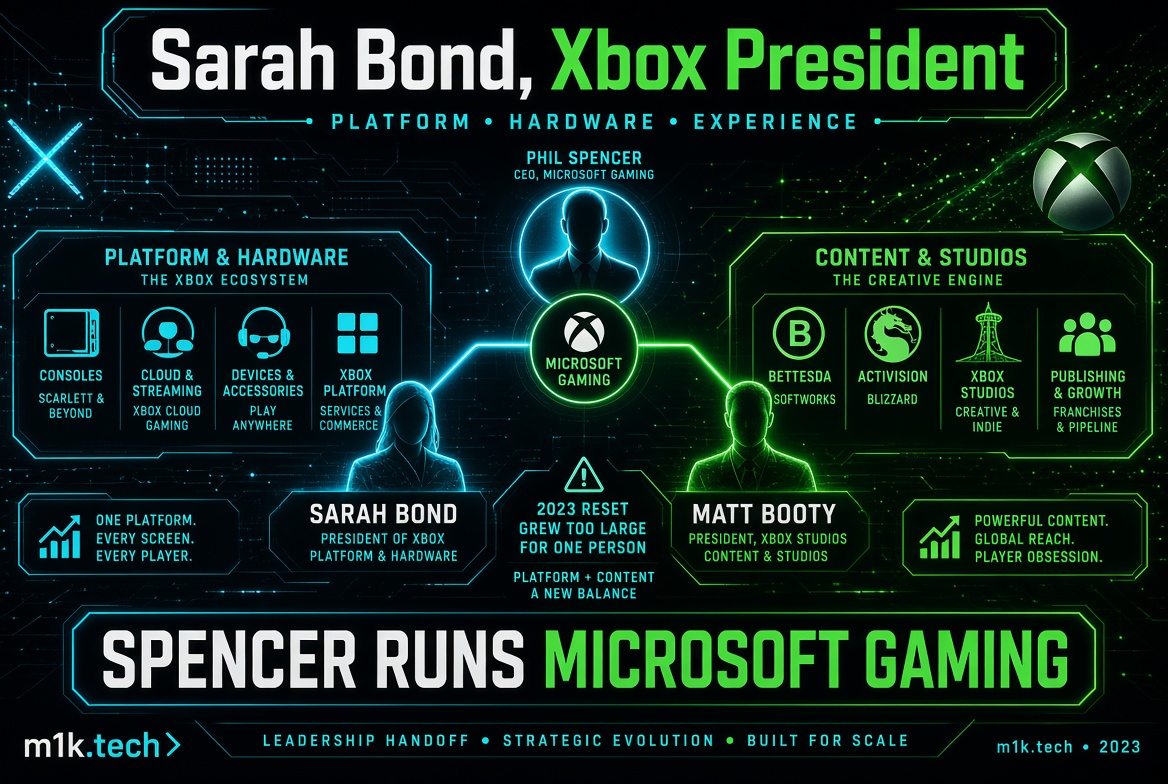
Sarah Bond’s appointment as Xbox President in 2023 was the clearest sign of how much the org chart had grown. Once Microsoft started spending tens of billions on Activision Blizzard and Bethesda, running “Xbox” stopped being a one-person job, and the leadership structure expanded to match.
A bigger org needs a bigger chart
As the acquisitions piled up, Microsoft formalized a gaming division, Microsoft Gaming, with Phil Spencer elevated to CEO of the whole thing. Beneath him, the responsibilities split: Sarah Bond stepped up as President of Xbox, overseeing the platform and hardware side, while Matt Booty ran the studios. Bond was a longtime Microsoft executive who had built her reputation on developer relations and the ID@Xbox indie program, not on flashy stage announcements.
Why the structure mattered
This was not a cosmetic reshuffle. A company about to absorb Activision Blizzard needed clear lines of ownership across platform, content, and the overall business, and this is the structure it landed on. Bond in particular became the public face of Xbox hardware and platform strategy, the executive who would later front the next-generation and handheld announcements.
Why it matters
This leadership layer set the stage for the most turbulent stretch in Xbox history: the multiplatform pivot, the studio closures, and the layoffs all happened under this structure. It also set up the 2026 shock, when Spencer retired, Bond was passed over for the top job, and an outsider was brought in to run the whole thing. To understand that 25th-anniversary reshuffle, you have to know who was in the chairs first.
My take
Org-chart stories are usually boring, but this one matters because of how it ended. Bond was the steady, respected operator many people assumed would eventually run Xbox. That she did not is a big part of why the 2026 leadership change landed as such a surprise.