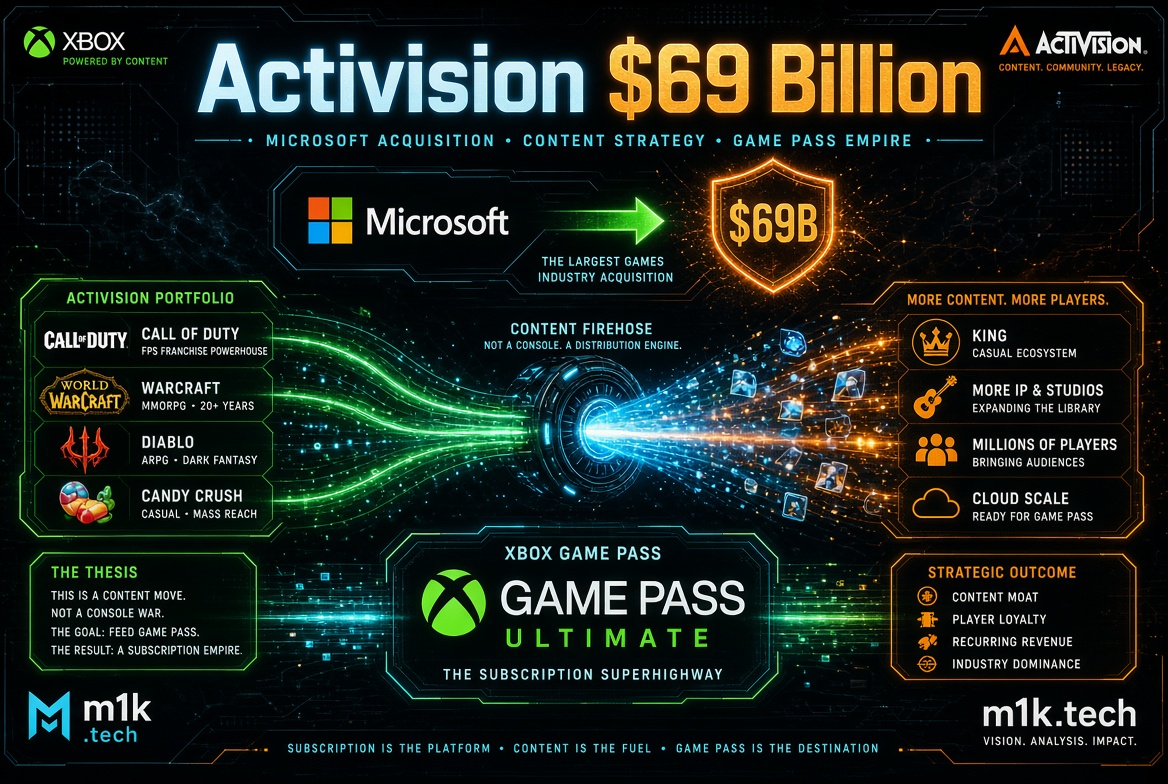
After nearly two years of regulators trying to kill it, Microsoft today closed its $69 billion purchase of Activision Blizzard, the largest acquisition in the industry’s history by a wide margin. Call of Duty, Warcraft, Diablo, and Candy Crush now belong to the company that makes the Xbox. This is not a console move. It is a content move, and the console is almost incidental.
Getting here took 21 months and a genuine brawl. The FTC sued to block it and lost. The UK’s competition regulator blocked it outright over cloud gaming, then signed off on a restructured version after Microsoft handed cloud-streaming rights for these games to Ubisoft. Along the way Microsoft inked ten-year deals to keep Call of Duty on PlayStation, which tells you the point was never to rip CoD off Sony’s console and hoard it.
So why spend $69 billion? Game Pass. Microsoft stopped trying to win this fight on hardware years ago and started trying to win it on subscription, and a subscription service lives or dies on the size of its content firehose. Owning Call of Duty and Candy Crush means owning two of the largest recurring-revenue franchises on the planet and dropping them into Game Pass on day one. This is Netflix logic applied to games: buy the studios, own the catalog, and rent it back to everyone monthly.
It is also the capstone of a spending spree. Bethesda in 2021 for $7.5 billion brought Doom, Elder Scrolls, Fallout, and Starfield in the door. Now Activision Blizzard on top of it. Microsoft has spent something like $76 billion turning itself from a console maker that fumbled its last launch into the largest games publisher in the West, and it did it in roughly two and a half years.
Sony’s answer has been to dig deeper into what it is genuinely great at: big-budget single-player exclusives you buy one at a time, at full price, and finish. The two companies have now fully diverged. Microsoft is assembling a content empire to feed a subscription, and Sony is making fewer, bigger, premium games to sell outright. Nintendo, off doing its own hybrid thing, is not in this conversation at all, which by now is just the normal state of affairs.
I am not going to pretend I know whether this is good for players, because the honest answer depends entirely on whether Game Pass stays cheap once the catalog is captive, and acquisition math has a way of finding your wallet eventually. What I am sure of is that the old console-war framing is rotting. Microsoft did not buy Activision to sell more Xboxes. It bought Activision so that it stops mattering which box you own.
The thing I keep circling is that $69 billion buys a different war than the one I have been covering since 2006. The console used to be the prize. Now it is a distribution channel, and Microsoft just spent the GDP of a small country to make sure games flow through its channel, no matter whose hardware sits under your TV. Sony is still selling consoles. Microsoft is increasingly selling the thing; the console was always just a way to reach it. I do not know who wins that fight, but it is not a hardware fight anymore.
The Console War, in Order
- Six Years, Three Survivors: How the PS2 Era Ended and the Real Console War Began
- Microsoft Just Set Aside a Billion Dollars Because the Xbox 360 Keeps Dying
- Everyone Spent 2010 Copying the Wii, and Microsoft Did It Without a Controller
- Nintendo’s Wii U Has a Great Controller and a Branding Problem That Might Kill It
- Microsoft Just Reversed the Xbox One in Public, and Sony Barely Lifted a Finger
- Nintendo’s Switch Is the Wii U Idea That Finally Makes Sense
- Xbox One X: The Most Powerful Console of 2017
- The PS5 and Xbox Series X Are the Same AMD Box, and the Real Upgrade Is the SSD
- Microsoft Just Bought Activision Blizzard for $69 Billion to Feed Game Pass
- The Switch 2 Is Exactly the Sequel Nintendo Needed
- The Console War in 2026: Sony Won the Box, and Microsoft Stopped Fighting for It
- Sony Spent 2013 Mocking Xbox’s Anti-Consumer Playbook. In 2026 It Runs the Whole Thing.