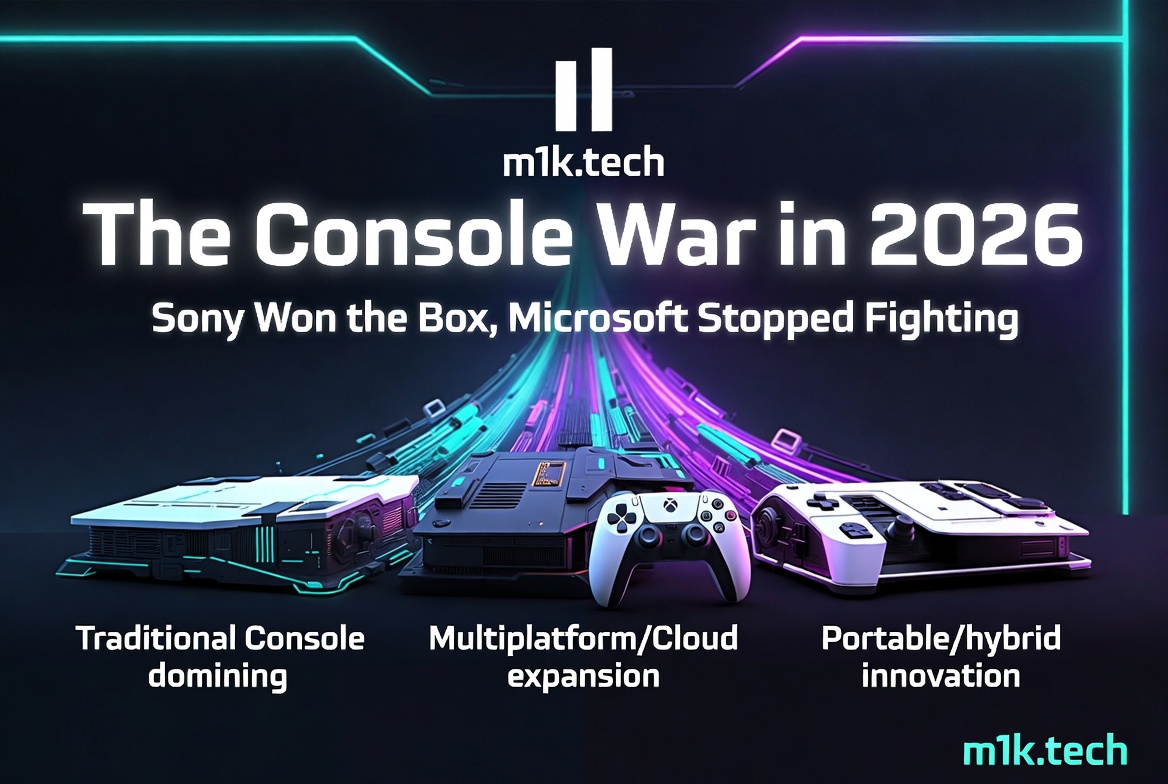
In mid-2026, the ninth-generation console war has a clear winner, and it’s barely a console war anymore. The PS5 has sold north of 93 million units, roughly two-thirds of the traditional console market, while the Xbox Series X and S together are stuck in the mid-thirties. Sony won the box decisively. The genuinely strange part is that Microsoft stopped trying to win the box quite a while ago.
Sony’s win is almost boring in how it happened. The PS5 did exactly what the PS4 did: it showed up without unforced errors, leaned on its exclusives, and let the competition trip over itself. It has outsold the Series consoles by something close to 3-to-1. The playbook has not meaningfully changed since 2013: premium hardware and premium single-player games are sold one at a time at full price, and it keeps working mostly because the alternative keeps failing.
The most interesting move of the entire generation is that Microsoft effectively conceded the hardware fight and went multiplatform. Games that used to be Xbox-exclusive now ship on the PS5 and the Switch. After spending $69 billion on Activision to stock Game Pass, Microsoft looked at its own strategy and decided the box was the least valuable piece of it, then started selling its games on its rivals’ machines. That is not losing the console war. That is deciding the console war is not worth winning.
Nintendo, meanwhile, won a different prize entirely by doing the thing nobody else would. The original Switch finished as one of the best-selling consoles ever made, past 150 million, and the Switch 2 hit nearly 20 million units inside ten months, the fastest launch in Nintendo’s history. Nintendo does not compete with the PS5 on raw power and never intends to. It just owns the hybrid and portable category outright, because Sony abandoned handhelds years ago and Microsoft never built one.
So who actually won? It depends entirely on what you think the war was about. If it were traditional console sales, Sony would be comfortable. If it was the format that defines how people actually play, Nintendo’s hybrid is arguably the most copied idea in the business right now, and you can see it in the PC handheld boom and in a run of Snapdragon Android handhelds coming at the same itch from a different angle, from the Logitech G Cloud through the Razer Edge and the AYN Odin 2 to the Ayaneo Pocket S. If it was the future business model, Microsoft’s bet on services and being everywhere might look the smartest of the three in a decade, even though today it looks a lot like surrender.
I am leaving the PC handheld and cloud-streaming surge out of this, even though the Steam Deck and its growing pile of clones are quietly the most disruptive force in gaming at the moment, because that is a different war and it has earned its own post. What I will say about these three specifically is that the 2006 framing, three boxes scrapping over the same living room, is simply dead. They have stopped fighting over the same thing.
Twenty years ago, I watched three companies line up three incompatible theories of what a console even is, and I wrote that the best part was that nobody knew which theory would win. Here is the punchline I did not see coming: they all did. Sony’s box theory, Nintendo’s toy-you-carry-with-you theory, and Microsoft’s it-should-not-matter-what-box-you-own theory are all alive and all making money, just no longer aimed at one another. The console war did not end with a winner. It ended with everyone wandering off in a different direction, and that is a stranger and frankly better ending than a clean winner would ever have been.
The Console War, in Order
- Six Years, Three Survivors: How the PS2 Era Ended and the Real Console War Began
- Microsoft Just Set Aside a Billion Dollars Because the Xbox 360 Keeps Dying
- Everyone Spent 2010 Copying the Wii, and Microsoft Did It Without a Controller
- Nintendo’s Wii U Has a Great Controller and a Branding Problem That Might Kill It
- Microsoft Just Reversed the Xbox One in Public, and Sony Barely Lifted a Finger
- Nintendo’s Switch Is the Wii U Idea That Finally Makes Sense
- Xbox One X: The Most Powerful Console of 2017
- The PS5 and Xbox Series X Are the Same AMD Box, and the Real Upgrade Is the SSD
- Microsoft Just Bought Activision Blizzard for $69 Billion to Feed Game Pass
- The Switch 2 Is Exactly the Sequel Nintendo Needed
- The Console War in 2026: Sony Won the Box, and Microsoft Stopped Fighting for It
- Sony Spent 2013 Mocking Xbox’s Anti-Consumer Playbook. In 2026 It Runs the Whole Thing.
- Xbox’s Most Significant Restructure: 3,200 Jobs, Four Studios Divested