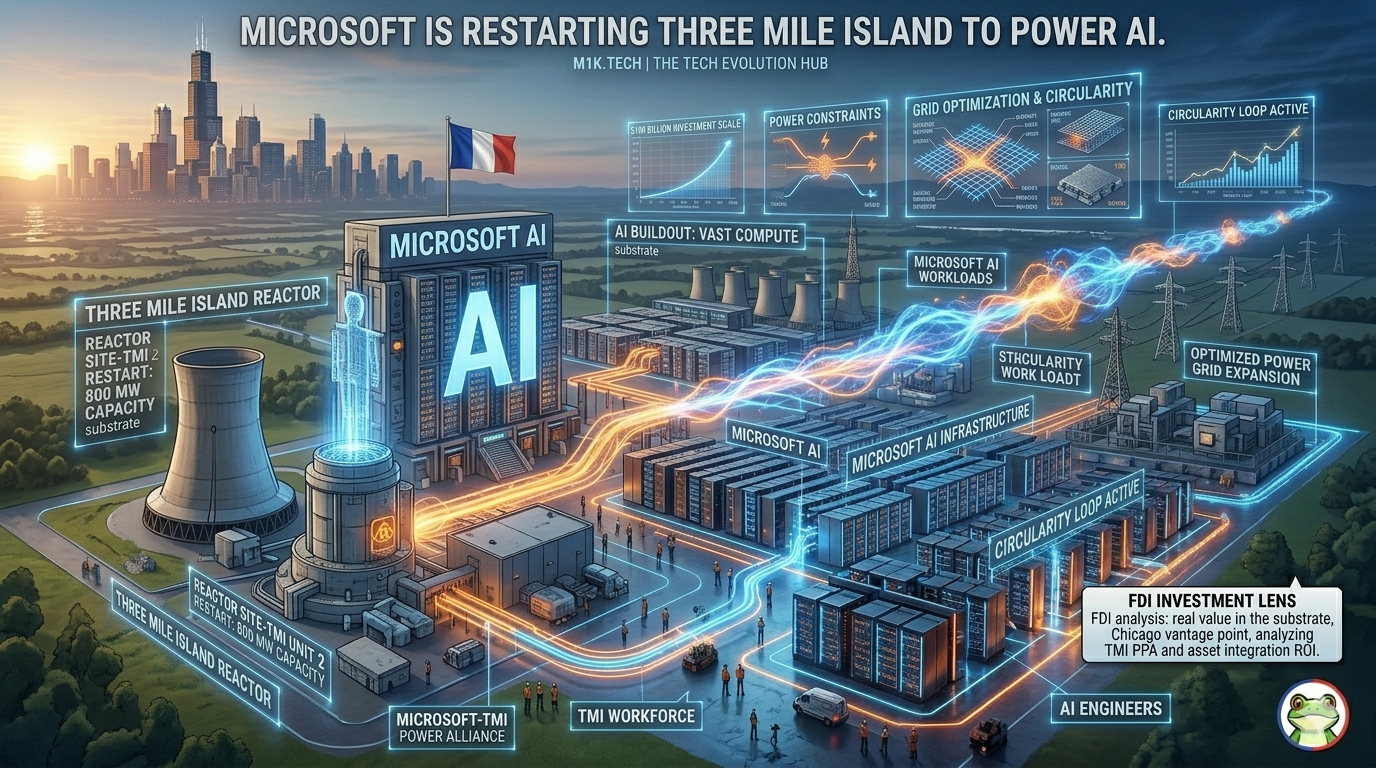
When I wrote about the $100 billion Stargate supercomputer report back in March, the detail that stuck with me was that the planners were already thinking about nuclear power. Six months later, here is the proof that was not idle talk. On September 20, Constellation Energy announced it will restart the Three Mile Island nuclear plant and sell the power to Microsoft under a 20-year agreement, specifically to feed Microsoft’s AI data centers. Yes, Three Mile Island. The site of the worst nuclear accident in US history is being brought back to life to power artificial intelligence. If you wanted one image to capture how serious the AI infrastructure crunch has become, this is it.
The deal
The specifics matter. Constellation will restart Three Mile Island Unit 1, the reactor that was retired in 2019 for economic reasons, not Unit 2, which partially melted down in 1979. Unit 1 can generate about 835 megawatts of power, enough to power more than 800,000 homes, and Microsoft has agreed to buy that output for 20 years. Constellation called it the largest power purchase agreement it has ever signed. The plant is expected to be back online in 2028, pending regulatory approval, and will be renamed the Crane Clean Energy Center. Constellation says the restart will create around 3,400 jobs and add roughly 16 billion dollars to Pennsylvania’s economy.
One detail tells you everything about the demand: Microsoft would have rights to essentially the entire output of the reactor. Not a slice. The whole thing. A single tech company is restarting a nuclear reactor and taking it all.
Why nuclear, and why now
This is the part that connects to the whole AI infrastructure story. Data centers have become so power-hungry that the electricity supply, not the chips and not the money, is turning into the real constraint. And the hyperscalers have a second problem layered on top: they have all made aggressive carbon-neutral commitments, and AI is blowing holes in them. Microsoft’s own emissions have been climbing as it pours resources into AI, which puts its climate goals at risk. Nuclear solves both problems at once: it is carbon-free, and unlike wind and solar, it runs around the clock, the baseload reliability a data center needs every hour of every day.
I find this genuinely fascinating, and a little unsettling. Fascinating because it is a real answer to a real engineering problem, and because it might give nuclear power the second life it has needed for decades, on the back of AI demand. Unsettling because the symbolism is heavy. We are restarting Three Mile Island, of all places, because chatbots and copilots need that much electricity. It’s a sentence I would not have believed a few years ago.
The bigger pattern
This is not a one-off. Earlier this year, Amazon Web Services bought a data center attached to a nuclear plant in Pennsylvania. The hyperscalers are all circling nuclear at once because they have all run the same math and reached the same conclusion: the grid as it exists cannot deliver what AI will demand. Expect more of these deals, not fewer. The AI buildout I have been tracking is increasingly an energy story as much as a computing one, and that energy story is starting to run through reactors.
Whether the Three Mile Island restart actually happens on schedule is a separate question; 2028 is a long way off, and regulators have to sign off. But the direction is unmistakable. The bottleneck for AI is power, and the most ambitious answer anyone has yet put on paper is to switch a decommissioned nuclear reactor back on. And it did not take long for the rest to follow: within weeks, Google and Amazon went all-in on nuclear too, betting on small modular reactors to solve the same problem.