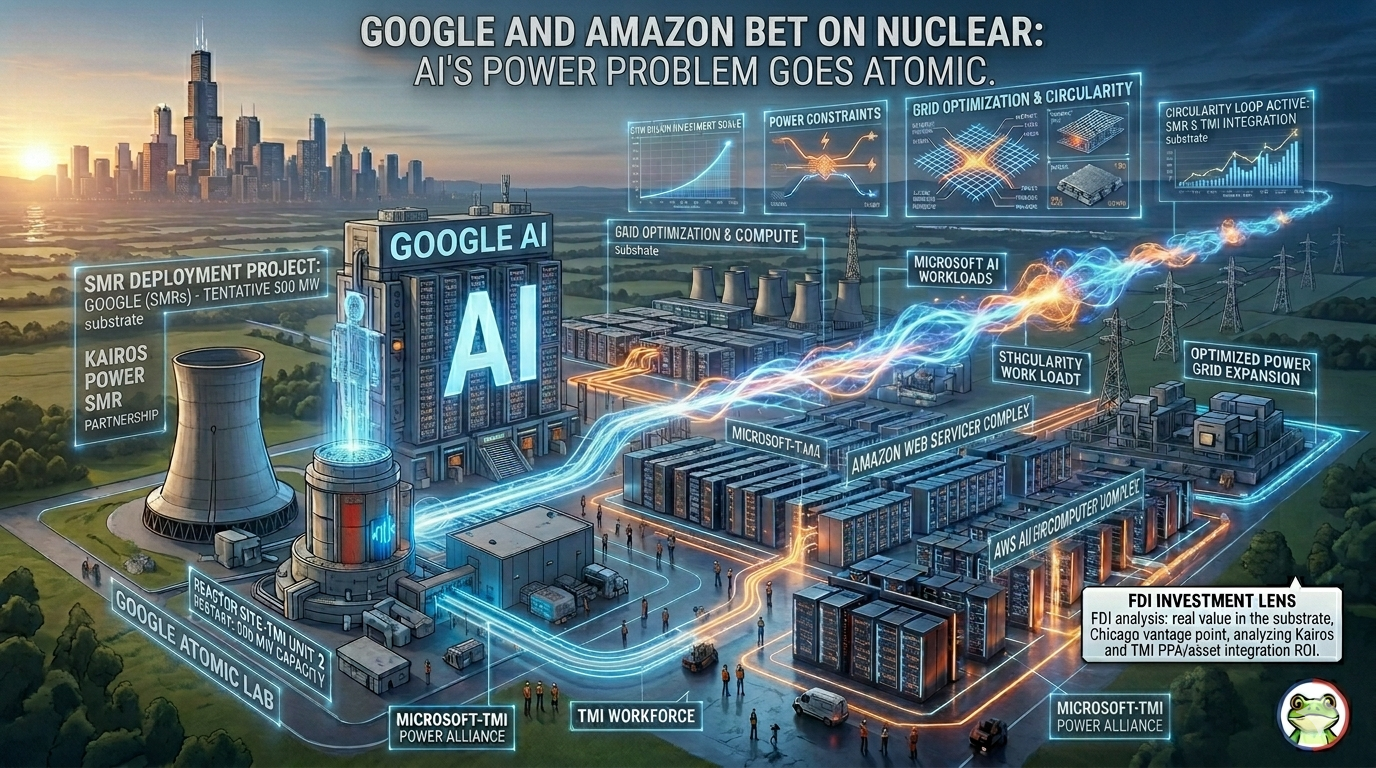
A month ago, I wrote that Microsoft restarting Three Mile Island would not be a one-off, that the other hyperscalers had run the same math and would follow. That took about four weeks to come true. This week, Google and Amazon both announced nuclear deals centered on small modular reactors (SMRs) that have been promised for years and are now suddenly the hottest thing in tech energy. Two of the biggest companies on earth, days apart, are betting on next-generation nuclear to power AI. The pattern is now undeniable: the AI buildout has become a nuclear buildout.
Google goes first
On October 14, Google signed what it called the world’s first corporate agreement to buy power from multiple small modular reactors, partnering with Kairos Power. The deal targets up to 500 megawatts across six or seven reactors, with the first unit expected online by 2030 and the full fleet by 2035. That is roughly enough to power a midsize city or a single large AI data center campus. Google is the first tech company to actually commission the building of new nuclear plants, rather than just buying existing output. Kairos is a seven-year-old startup with an unusual design: a reactor cooled by molten fluoride salt rather than water.
Google’s energy lead framed it honestly: this is a longer-term bet, but a necessary one. Their own modeling showed that achieving fully carbon-free grids will require more than wind, solar, and batteries; you also need this next set of advanced technologies. That is a striking admission from a company that has leaned hard on renewables.
Amazon follows two days later
On October 16, Amazon announced its own set of nuclear moves, anchored by a roughly 500 million investment in Maryland-based SMR developer X-energy. Amazon is anchoring a fundraising round to help X-energy develop and license its reactors, and the investment includes manufacturing capacity to support more than 5 gigawatts of new nuclear projects using X-energy’s technology. Amazon also signed on with the utility Energy Northwest in Washington state and is exploring the possibility of siting an SMR near Dominion Energy’s existing North Anna nuclear station in Virginia. Three nuclear-flavored deals in one announcement.
Stack it all up. In about a month, Microsoft committed to restarting a full-size reactor, Google ordered up to 500 megawatts of SMRs, and Amazon backed more than 5 gigawatts of SMR capacity. Big tech has effectively decided that nuclear is the answer to AI’s power problem, and they are putting real money behind reactor companies that, in some cases, have never built a commercial plant.
My take: promising, and a long way off
I am genuinely excited about this and skeptical about the timelines in equal measure. Excited because AI demand might finally give advanced nuclear the push it has needed for decades. SMRs have been five years away for a long time; having Google and Amazon write checks and send a demand signal to the market is exactly the kind of catalyst the technology never had. If it works, the benefits go way beyond data centers to grids everywhere.
But look at the dates: first reactors around 2030, fleets by 2035. That is five to ten years out, for AI demand that is exploding right now. These deals do nothing for the power crunch over the next few years; they are bets on the next decade. And SMRs still have to clear regulatory approval, prove they can be built on budget, and actually scale, none of which is guaranteed for designs that are mostly still on paper. C’est a real strategy and a real gamble at the same time. What I will be watching is the gap between signing and switching on, because in nuclear, that gap is where optimism usually goes to die. If these companies can actually compress it, that is the real story, bigger than any single data center. And the buildout it is meant to power was about to get dramatically bigger: a few months later, AI infrastructure went from corporate strategy to national policy with the half-trillion-dollar Stargate announcement at the White House.