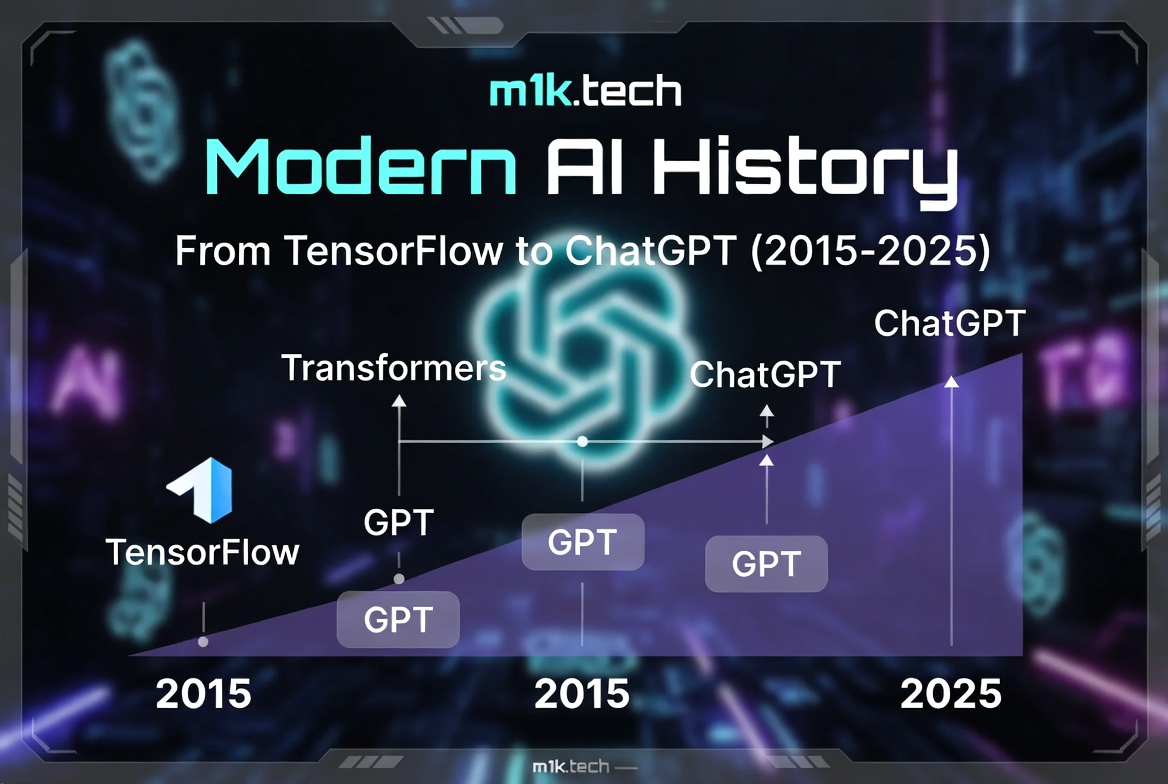
Most people date the AI boom to the morning ChatGPT showed up. That is the wrong start line by about seven years. This is my modern AI history, the version that begins with a Google open-source release in 2015 and a research paper almost nobody read in 2017, then runs through the model that scared its own creators, the one that changed everything by simply being bigger, and the chatbot that finally dragged the whole thing into your group chat. The hype is loud and the timeline is short, so it helps to see it in order.
The plumbing years (2015 to 2021)
None of this was an accident. It started with Google open-sourcing TensorFlow to kick off a framework arms race, and the conceptual bomb dropped two years later with the Attention Is All You Need paper that quietly invented the transformer, the architecture every model you have heard of is built on. OpenAI then spent three years proving a thesis: GPT-2, the model it called too dangerous to release hinted at it, and GPT-3 and the moment raw scale changed everything confirmed it. Underneath the headline models, the boring half of the field was being built too, the MLOps and feature-store plumbing nobody talks about that decides whether any of this ships.
ChatGPT and the year everything woke up (2022)
Then came the last day of November 2022. ChatGPT launched as a research preview almost casually, and the whole world paid attention at once in a way the field had never seen. It capped a 2022 that I called the year AI woke up, the moment the technology stopped being a conference topic and became a thing your relatives asked you about over dinner.
The gold rush (2023)
2023 was pure acceleration. ChatGPT hit 100 million users in two months, the fastest adoption of anything, ever, and Microsoft bolted it into Bing and started an actual search war. The capability jump came in March with GPT-4 arriving and passing the bar exam, the model that finally made the skeptics believe. Quietly, the more durable story was infrastructure: RAG became the technique that made enterprise AI trustworthy enough to deploy, and the data platforms scrambled to reposition, with Databricks buying MosaicML to become an AI company overnight.
From models to companies to agents (2024 to 2025)
By 2024 the question was no longer whether AI worked, but who captured the value. Snowflake swapped its CEO and bet the entire company on AI, a tell for how the enterprise software world was repricing itself. Then the frontier moved again toward action, with the shift from AI that answers to AI that acts, the agent turn that is still playing out. And the clearest winner sat one layer down: Nvidia became the kingmaker of the entire AI economy, which is where 2025, the year AI went deep left things. The models get the headlines. The company selling the shovels gets the margin.
The full timeline
- Google open-sources TensorFlow
- Attention Is All You Need
- GPT-2, too dangerous to release
- GPT-3 and the scale moment
- the MLOps plumbing
- ChatGPT launches
- the world notices at once
- 2022, the year AI woke up
- 100 million users in two months
- Bing gets ChatGPT and a search war begins
- GPT-4 passes the bar
- GPT-4 makes skeptics believe
- Databricks buys MosaicML
- RAG and trustworthy enterprise AI
- Snowflake bets the company on AI
- AI that answers becomes AI that acts
- Nvidia, kingmaker of the AI economy
- 2025, AI goes deep
The thing I keep coming back to is how little of this was about the chatbot. ChatGPT was the interface that made the whole stack legible to normal people, but the real story is a seven-year buildout of architecture, scale and plumbing that happened mostly in public and almost entirely unnoticed. Everyone is arguing about whether the models are conscious. The more useful question is who owns the compute, and that one was answered in Santa Clara a long time ago.