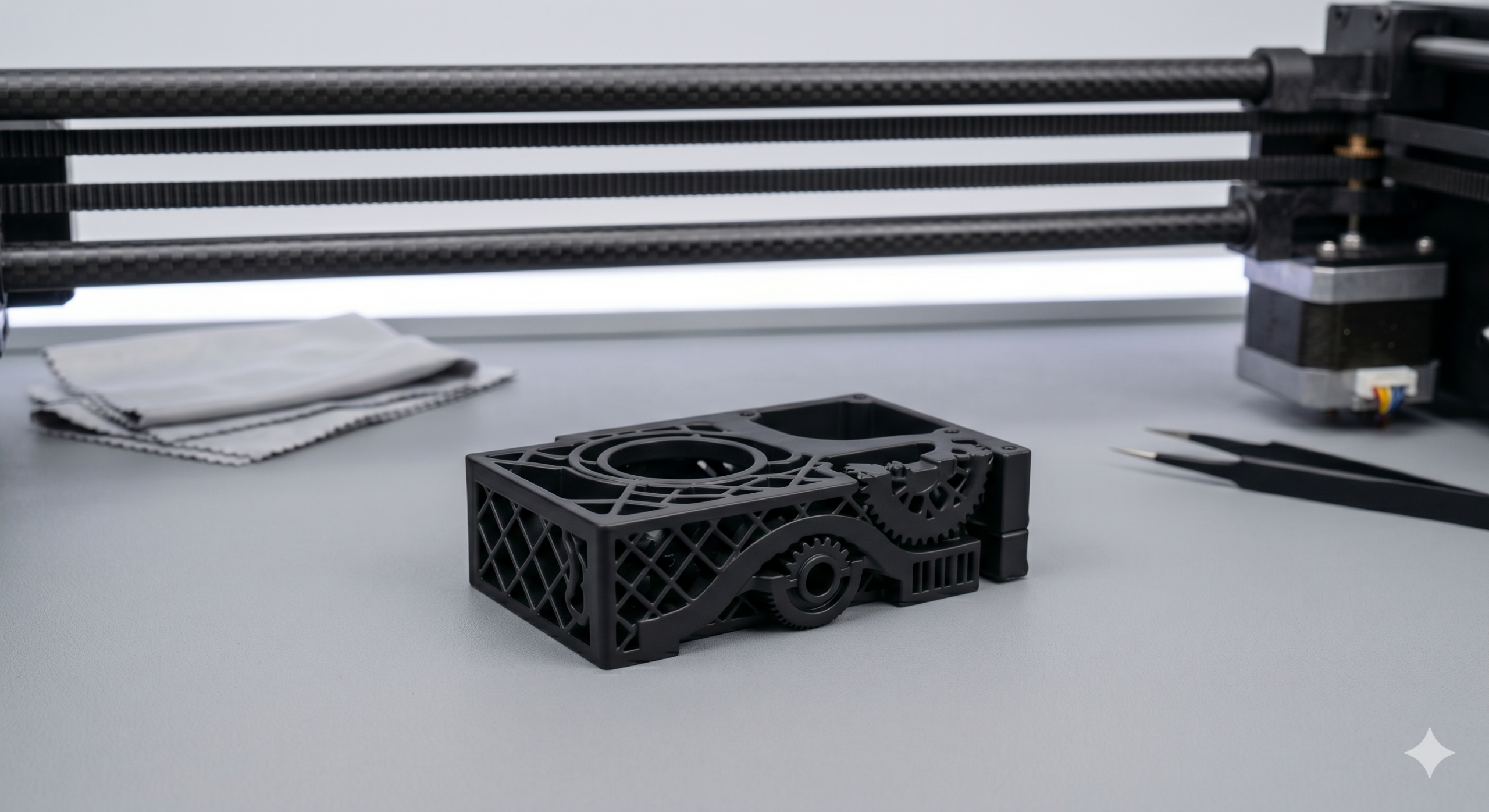
A print straight off the plate almost never looks finished, and the gap between a decent print and one that reads as a manufactured product comes down almost entirely to a post-processing sequence that most people either skip or rush.
Sanding is where that rushing does the most damage. Jumping straight to a fine grit accomplishes almost nothing against visible layer lines, because a high grit is designed to polish a surface that is already close to flat, not to remove the actual ridges a printer leaves behind. Start coarse, genuinely coarse, 120 or 180 grit, working in a gentle circular motion rather than aggressive strokes, because heavy pressure at a coarse grit carves new unevenness into the part faster than it removes the old kind. Work up through the grits in sequence rather than skipping steps, and once you pass roughly 400 grit, switch to wet sanding, because dry sanding at fine grits generates enough friction heat to soften and smear the plastic rather than actually removing material.
Sanding alone will not fully erase layer lines regardless of how far up the grit sequence you go, which is where a high-build primer earns its place. A proper sandable primer is thick specifically so it settles into the tiny valleys between layers rather than just coating the surface uniformly. Two thin coats beats one thick one every time, because a heavy single coat runs and pools in ways that create new irregularities you then have to fix. Once it has dried fully, a pass with 400 grit again knocks down what the primer built up, and the surface underneath the paint should now read as genuinely flat rather than merely closer to flat.
Paint itself rewards the same patience the earlier steps did. Several thin coats hold detail and resist running in a way a single thick coat never does, and rushing the drying time between coats is the single most common way people ruin work they got right up to that point. A matte or satin clear coat at the end does more than protect the finish, it kills the slightly plasticky sheen that gives an otherwise well-finished print away as a print rather than a manufactured object.
What I would tell anyone starting this process is that none of the individual steps are hard. What is hard is resisting the urge to skip ahead once the part is starting to look decent, because every shortcut taken at grit 180 or coat one shows up clearly once the paint goes on, and paint has an unfortunate habit of making earlier mistakes more visible rather than less.