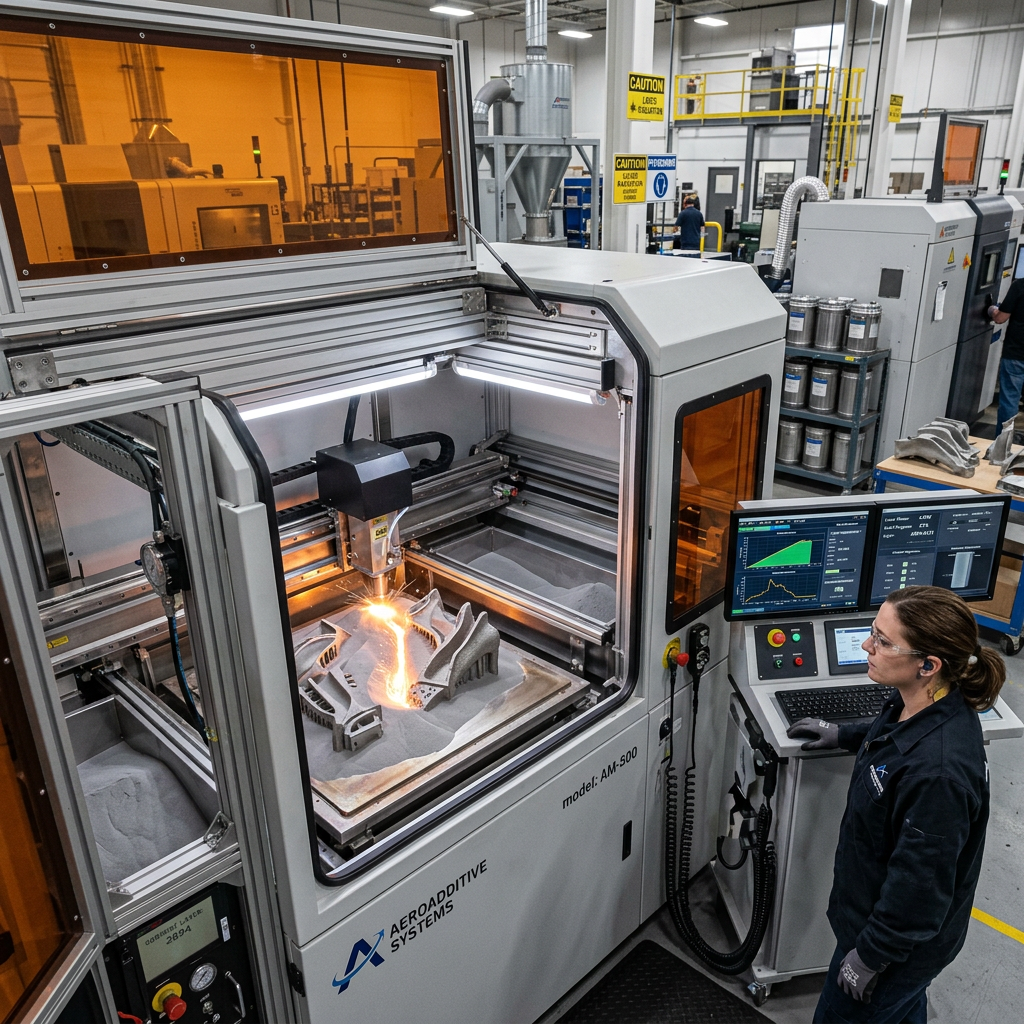
A team of metallurgists published research this month on using looping lasers to mix molten metals in real time during additive manufacturing, creating alloys that cannot be made through traditional casting. The 3D printing conversation has been stuck on plastic prototypes for years. This is the version that matters: parts with gradient material properties, hard on the outside and flexible inside, or corrosion-resistant at one end and thermally conductive at the other, because the laser controls how the metals blend layer by layer. That’s not an incremental improvement on casting. You can’t specify a part like that if you don’t have a process that can make it.
The ability to print functional metal parts on demand without tooling changes the economics for low-volume, high-complexity production. A turbine blade with internal cooling channels that can’t be machined. A satellite bracket that weighs half what the cast version does. The point isn’t speed or cost, though both improve. The point is that some parts that were physically impossible to manufacture now aren’t, and the first industries to operationalize that are going to have components nobody else can replicate yet.
From my FDI seat this connects to the Chicago hardware corridor directly. mHUB has metal additive prototyping capability. Argonne runs materials science research on everything from battery chemistry to nuclear components. The proximity between those two means breakthroughs in metal printing can move from lab paper to prototype to pilot faster here than almost anywhere else. Metal 3D printing is also one of the processes that benefits most from AI integration, because the laser parameters, powder distribution, and thermal management are complex enough that machine learning can optimize them better than manual programming. Industrial AI in Chicago is not about chatbots.
For European manufacturers evaluating US operations, the supply chain implication is the interesting one. Instead of shipping cast parts from a foundry in Asia to a US assembly plant, you print near the point of assembly, on demand, with no tooling lead time. The factory doesn’t need a casting line if it has a metal printer. Capital investment drops, inventory drops, the supply chain shortens from months to days. Factories evaluating nearshoring right now are asking about unit economics and lead times. The better question is what parts they couldn’t design at all before this month.