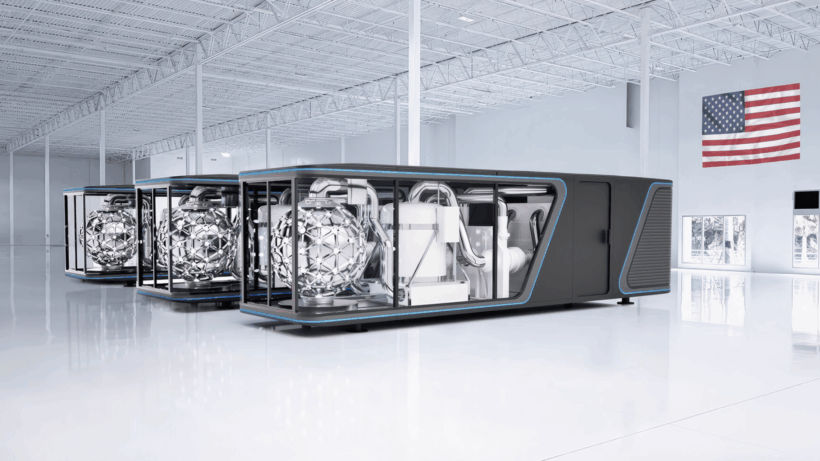
Over a hundred people packed AMPERA’s Innovation Center in Palm Beach Gardens on July 1, 2026, Mayor Dana Middleton among them, to watch the company roll out what it calls the world’s first full-scale, 3D-printed nuclear reactor module. Core and pressure vessel both, printed from silicon carbide, built around a subcritical solid-state thorium fuel cycle and wrapped in a new tagline: “Power Now. Nuclear Next.” Whether that unveiling marks an inflection point for advanced nuclear manufacturing or a striking prototype years from any regulator’s desk comes down to which of its claims you press hardest.
Start with the physics, because the three choices AMPERA stacked together are odd and each drags consequences behind it. A subcritical reactor can’t sustain a fission chain on its own. Its neutron multiplication factor k-eff stays pinned below 1.0 at all times, so to make power it needs a continuous external neutron source. In the serious engineering literature, that means an accelerator-driven system: a particle accelerator throws a proton beam at a spallation target, the target spits out neutrons, and those neutrons drive fission in the subcritical assembly. CERN’s n_TOF facility and Belgium’s MYRRHA project have both shown spallation-driven subcritical neutronics at research scale. The safety pitch writes itself. Kill the driver and the reaction stops on the spot, no control rods, no emergency cooling actuation, no operator standing by. Prompt criticality is off the table by definition.
The hole is that AMPERA’s press release never says what neutron source drives the thing. An accelerator-driven subcritical system needs a high-current proton accelerator, typically hundreds of milliamperes at 600 MeV or higher to get useful spallation yields, and that’s a huge, costly, mechanically fussy machine that has to sit right next to the reactor. MYRRHA, the most advanced ADS on the planet, has been in development since the late 1990s and is aiming at first operation in the early 2030s at a research scale of 100 MWth. Swap in a different driver, a californium-252 source or a D-T fusion neutron generator, and the achievable neutron flux moves, which moves the power output with it. The 30 MWe number is unevaluable until someone names the driver.
Thorium piles more on. Th-232 isn’t fissile; it has to swallow a neutron and decay through protactinium-233 into uranium-233, which is. That Pa-233 decay runs about 27 days, so a thorium reactor needs a startup slug of fissile material (U-233, U-235, or plutonium) just to light the cycle. In a subcritical system, the breeding ratio and steady-state U-233 inventory both track the neutron spectrum and flux, and both depend on the driver nobody has specified. The upside is real: thorium runs three to four times more abundant than uranium, throws off far less long-lived transuranic waste, and Th-232’s thermal neutron capture cross-section beats U-238’s, which makes it an efficient breeder in a thermal spectrum. India has built a three-stage nuclear program around exactly these properties for decades. The fuel cycle is still a genuine headache, not a footnote.
For the fuel form, AMPERA picked TRISO, tri-structural isotropic particles: a fissile kernel wrapped in porous carbon buffer, inner pyrolytic carbon, silicon carbide, and outer pyrolytic carbon. For uranium, that’s mature technology. Idaho National Laboratory has qualified uranium TRISO past 1600°C, and Kairos Power holds an NRC construction permit for a fluoride salt-cooled reactor running on it. Nobody has fabricated thorium TRISO kernels at commercial scale. The kernel chemistry, how the coatings adhere, how ThO₂-based particles behave under irradiation, all of it diverges from UO₂ kernels enough to demand its own qualification campaigns. AMPERA’s 30-year core-for-life claim leans entirely on fuel performance data that does not exist at commercial scale yet. Setting up an Australian subsidiary to lock down thorium supply solves where the thorium comes from, not how you turn it into qualified fuel.
The 3D-printing claim is both the most technically specific thing AMPERA said and the piece screaming loudest for independent verification. Silicon carbide is well established in nuclear work, with a melting point near 2730°C, a low neutron activation cross-section, strong radiation resistance, and chemical inertness, and it already serves as that third TRISO coating layer. What AMPERA says it did is additively manufacture a full-scale core and pressure vessel out of SiC as a single monolithic sphere with a gyroid interior.
That gyroid is a triply periodic minimal surface, mathematically defined so mean curvature hits zero at every point, which in practice buys a very high surface-area-to-volume ratio through continuous interconnected channels, handy for both heat transfer and moderation geometry. Printing one in SiC at reactor scale would be a legitimate frontier achievement if it holds up. Binder jetting, direct ink writing, and laser powder bed fusion have all been demonstrated on SiC ceramics in the lab, and outfits like Ceramic Additive Manufacturing alongside academic groups are turning out intricate geometries. Jumping from a lab specimen to a full pressure vessel that has to hold internal pressure, ride out thermal cycling, and survive neutron flux for decades is another problem entirely.
None of the numbers that would let you check the work are in the release: no dimensions, no mass, no wall thickness, no mechanical or neutronics test data. In nuclear engineering, the gap between “fabricated” and “qualified for operation” runs years and tens of millions of dollars in testing. Pressure vessel qualification under ASME Boiler and Pressure Vessel Code Section III wants extensive material characterization, nondestructive examination, and stacks of documentation, and whether a monolithic SiC structure can be certified at all under frameworks written for metallic pressure boundaries is genuinely unsettled. The NRC’s licensing pathway for non-light-water reactors under 10 CFR Part 53 is still being built out, and a SiC pressure vessel wrapped around a subcritical thorium ADS would hand regulators several first-of-their-kind questions at once.
“Solid-state” means no liquid coolant, which walks away from most of the advanced field: Kairos with its liquid fluoride salt, Oklo with liquid sodium, every conventional light-water plant. Cooling through conduction and radiation inside the core material itself caps power density. At 30 MWe, that’s microreactor territory, and the thermal approach is plausible at that scale, but the release never describes how heat actually leaves the SiC core to reach the power conversion system.
Commercially, “Power Now. Nuclear Next.” is a shrewd bit of sequencing. AMPERA is selling modular gas-powered generation on supercritical CO₂ cycles as the near-term revenue product, and it claims those systems share two-thirds of their hardware with the eventual nuclear version. sCO₂ Brayton cycles are a live research area for good reason, hitting roughly 45 to 50% thermal efficiency above 700°C turbine inlet temperatures where steam Rankine sits around 33%, and doing it with more compact turbomachinery. The commonality argument has real architectural teeth: if the power conversion module, balance-of-plant, and structural frame carry over between gas and nuclear variants, a customer’s spend on the gas box quietly pre-funds the nuclear upgrade.
Everyone is chasing the same buyers, AI data centers whose power appetite has hyperscalers restarting mothballed nuclear plants, defense, maritime, industrial, and every microreactor and SMR developer alive is circling them too. Oklo’s Aurora fast reactor is publicly traded and has letters of intent with data center operators. Radiant’s Kaleidos microreactor aims at forward operating bases and remote sites; Last Energy has announced PWR microreactor deployments across Europe for industrial customers, and BWXT delivered a mobile microreactor prototype to the U.S. Army in 2024 under Project Pele. Kairos holds an NRC construction permit for its Hermes demonstration reactor in Tennessee. What separates AMPERA from all of them is also what could sink it: subcritical operation, thorium fuel, and SiC additive manufacturing are real distinctions, and every one is a regulatory novelty a competitor running uranium through conventional materials simply doesn’t carry. Oklo is grinding through NRC licensing for a fast reactor, already a hard road. AMPERA is trying to walk an unspecified neutron driver, a never-certified pressure vessel material, and a fuel form nobody has commercially qualified all at once. The company has disclosed no NRC pre-application engagement, no licensing timeline, and no fuel fabrication partner.
For reference, here is how the field lines up on the basics:
| Company | Reactor Type | Fuel | Coolant | Output | NRC Status |
|---|---|---|---|---|---|
| AMPERA | Subcritical, solid-state | Thorium TRISO | None (solid-state) | Up to 30 MWe | Not disclosed |
| Oklo | Fast (Aurora) | HALEU metal | Sodium | ~15 MWe | Combined license application filed |
| Kairos Power | Fluoride salt-cooled | Uranium TRISO | FLiBe salt | ~140 MWth (Hermes demo) | Construction permit received |
| Radiant Nuclear | Thermal (Kaleidos) | HALEU TRISO | Helium | 1 MWe | Pre-application engagement |
| Last Energy | PWR microreactor | LEU | Water | 20 MWe | Pursuing European regulators |
| BWXT (Pele) | Heat pipe | HALEU TRISO | Heat pipes | 1–5 MWe | DoD prototype delivered |
Getting this reactor to commercial operation means running a chain of things that have never been done commercially. Thorium TRISO would have to be fabricated, irradiated, and qualified to a 30-year core-life standard, and for uranium TRISO that qualification ate roughly two decades of INL research before Kairos could even reach for a construction permit. The neutron driver would have to be named, engineered, and packed into something compact enough for these markets. The SiC pressure vessel would have to clear mechanical, thermal, and radiation testing and win NRC acceptance under a framework that isn’t written for this class of reactor. Then the sCO₂ conversion system would have to be proven at scale and married to the nuclear heat source.
None of that is physically impossible, and some of it is genuinely appealing. The subcritical architecture gives you a safety guarantee that lives in the physics rather than in a procedure. Thorium’s fuel cycle really does buy long-term supply security and less waste. SiC really is, on paper, a better bet than zirconium cladding or steel vessels in a radiation field.
The straight read is that AMPERA has shown off a manufacturing capability, a full-scale SiC structure with a complex internal geometry, and that’s a real materials science achievement regardless of what the reactor version of it eventually needs. Calling it a nuclear milestone in any regulatory or operational sense rests on work that hasn’t visibly started. Doubt the timeline above everything else: the distance between this printed module and a licensed, operating reactor is wider than for any uranium-fueled rival on that table, and AMPERA has said nothing about how it plans to cover the ground.