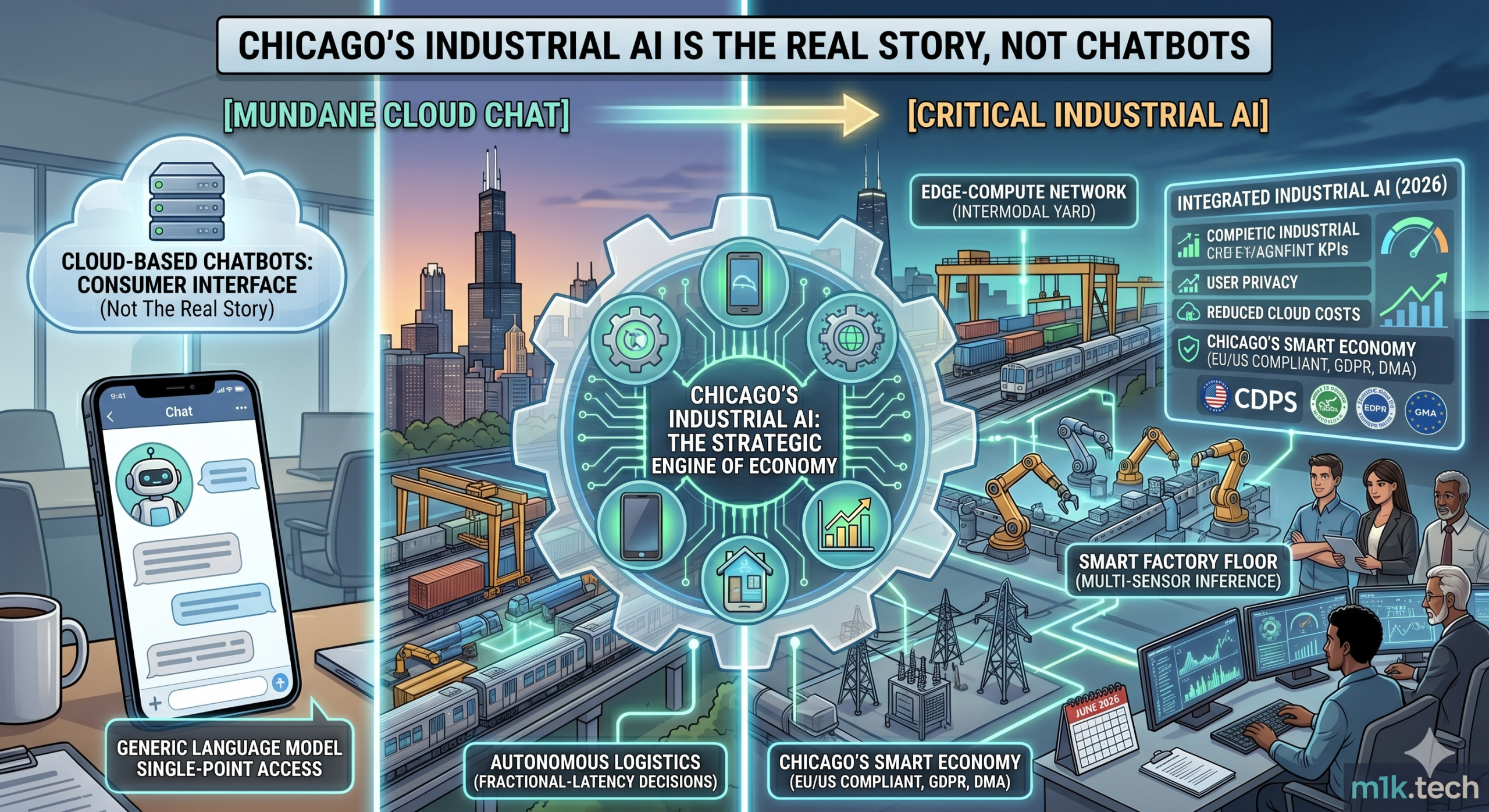
While the coasts argue about chatbots and how close we are to AGI, Chicago is quietly building something less glamorous and probably more durable: industrial AI. Software pointed at trucks, factories, warehouses, and insurance claims. You can see it most clearly in where the money is going.
Follow the funding
According to reporting on the city’s startup scene in early 2026, the standout rounds are not consumer chatbots. Formic Technologies, which rents out factory robots as a service so manufacturers can automate without a huge upfront cost, raised a $59.3 million Series A. Arturo.ai, which runs computer vision over aerial and satellite imagery to assess properties for insurers, has pulled in around $58 million to date. And a cluster of logistics-AI startups like Datatruck and Loop are built directly on top of Chicago’s status as a freight hub, with O’Hare and one of the country’s densest rail networks sitting right there as a testing ground. According to the same reporting, a lot of this traces back to research coming out of Argonne National Laboratory.
The scale is bigger than people think
Zoom out and the numbers stop being cute. According to a roundup of the city’s startups, Chicago founders across AI, fintech, and healthcare have raised more than $16 billion combined, with names like the market-research firm Circana at $1.2 billion and Kin Insurance at over $708 million. This is not a scrappy little scene hoping to be noticed. It is a large, well-capitalized ecosystem that just happens to point its AI at unsexy problems.
Why boring is the strategy
Here is the thing people on the coasts miss. Chicago’s advantage was never going to be out-hyping San Francisco. Its advantage is that it sits on top of enormous, boring, essential industries: logistics, insurance, trading, manufacturing, healthcare. Those industries generate the two things applied AI actually needs, real data and paying customers. A computer-vision model that prices insurance risk, or a robot that runs a production line, has a business model on day one. A lot of coastal AI is still looking for one.
How it fits the rest of Chicago’s bet
This applied layer is the third leg of a stool I have been writing about all week. There is the frontier swing, the quantum park on the South Side. There is the commercialization engine, the university pipeline turning research into companies. And then there is this, the applied industrial layer that turns all of it into revenue, riding on Chicago’s enterprise and logistics backbone. It also fits where the technology itself is heading: toward AI that runs where the work actually happens, on the factory floor and in the vehicle, not in a distant data center.
I would take a hundred unglamorous companies with paying customers over one buzzy demo with no revenue, every single time. The risk for Chicago is the mirror image of its strength: applied AI is harder to hype, so it draws less attention and sometimes less capital than the flashy coastal stuff, and that can cap how big these companies grow before someone acquires them. But if you are betting on which AI businesses are still standing in five years, I would put my money on the ones already getting paid to move freight and price risk. That is a very Chicago way to win, and it suits the city just fine.